
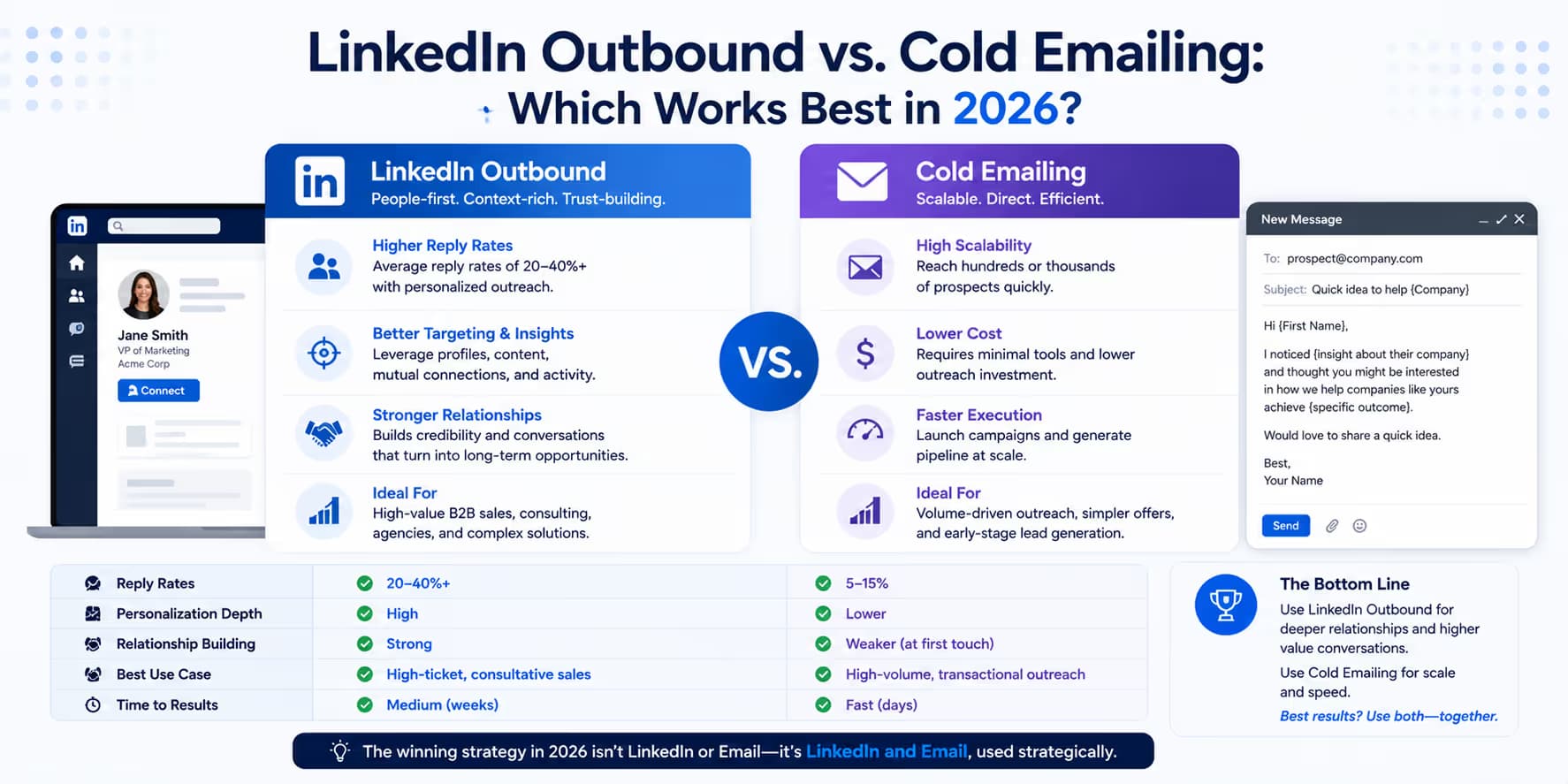
Choosing an outbound channel is one of the first decisions a B2B sales leader or startup founder has to make. For years the question was: pour energy into high-volume cold email, or into relationship-driven LinkedIn prospecting? In 2026 it is rarely a one-channel choice. Buyers are tired of generic messaging on both, and major email providers block a lot of unsolicited mail.
To build a predictable outbound pipeline, you need the tactical differences, the safety constraints, and the cost of each channel. Compare LinkedIn outbound and cold email on deliverability, response rates, and cost, then run a hybrid playbook that uses each channel for the job it actually does well.
LinkedIn outbound vs cold email: the core differences
LinkedIn and cold email are different outbound philosophies. Cold email is high-volume and scalable. Sales teams can reach thousands of prospects every month with small incremental costs. Because email is detached from a public profile, it has less built-in credibility and is heavily restricted by server-level filters.
LinkedIn is a high-trust, relationship-first channel. When you send a message, the prospect does not only read the copy. They review your professional background, mutual connections, and content. That public context is why connection and response rates are higher. LinkedIn also enforces strict account-level safety boundaries, so it stays a low-volume, high-value channel that needs careful execution.
The deliverability split
In cold emailing, you are fighting automated machine-learning spam filters (Google Workspace and Microsoft 365) before a human ever sees your copy. On LinkedIn, you are fighting human filters. If your profile and message are tailored, your deliverability is practically 100 percent.
LinkedIn outbound: tactical pros and cons
LinkedIn prospecting is the usual choice for high-value B2B lead generation. Why it works, and where it gets in the way:
The pros:
- Built-in credibility (the landing page effect): Your profile behaves as a landing page. Prospects can instantly verify your company, read testimonials, see mutual connections, and establish trust before replying.
- Rich intent signals and trigger events: LinkedIn provides real-time contextual signals. You can target prospects based on recent promotions, company hiring trends, public comments, or shared article interactions.
- Low friction communication: Posing a question in a direct message feels like a conversational dialogue rather than a formal B2B sales email, driving up positive engagement rates.
The cons:
- Strict volume limitations: LinkedIn restricts connection requests to roughly 80-100 per week to protect users from spam, making high-volume outreach impossible.
- Account suspension risks: Using poorly optimized automation scripts or sending low-quality copy will lead to quick account flags, resulting in temporary or permanent profile restrictions.
Cold emailing: tactical pros and cons
Cold email remains a staple of B2B outbound because of scale. The channel also needs real technical overhead to survive.
The pros:
- Infinite mass scalability: By utilizing multiple secondary domains and inbox rotators, you can safely scale your outbound volume to thousands of prospects daily.
- Flexible message design: Email allows you to embed formatted text, rich signatures, and complex image files, which can be useful for showing quick product screenshots.
- Easy multivariate testing: With large send volumes, you can split-test different subject lines, copywriting frameworks, and CTAs to find winning combinations quickly.
The cons:
- Complex technical overhead: Launching a cold email campaign requires setting up multiple secondary domains, warming up inboxes for 14-30 days, and configuring complex DNS records (SPF, DKIM, DMARC) to preserve deliverability.
- Severe provider restrictions: Google and Microsoft enforce strict daily bounce rates (below 3 percent) and spam complaint thresholds (below 0.1 percent). Exceeding these metrics will land your entire domain workspace in the spam folder.
ROI and cost-per-meeting analysis
To decide which channel fits your B2B sales team, compare financial performance and resource cost, modeled around booking 10 sales meetings per month.
| Performance Metric | Cold Email Campaign (Target: 10 Meetings) | LinkedIn Outreach (Target: 10 Meetings) |
|---|---|---|
| Monthly Reach | 3,000 Prospects | 350 Prospects |
| Open/Delivery Rate | 40% to 50% (Deliverability Lag) | 98% (In-Inbox Placement) |
| Average Reply Rate | 1% to 2% | 15% to 25% |
| Booked Meeting Rate | 0.3% of total sent (10 meetings) | 3.0% of total sent (10 meetings) |
| Tooling Cost & Setup | $250/mo (Domains, Warmups, Rotators, Verifiers) | $90/mo (LinkedIn Sales Nav + Omentir Workspace) |
Cold email hits bigger numbers, but conversion is low because of spam filtering and cognitive friction. LinkedIn needs only a fraction of that volume to generate the same number of meetings, which usually means higher ROI and a cleaner brand reputation.
A modern B2B hybrid outbound playbook
The highest-performing outbound sales teams do not choose between LinkedIn and cold email. They run a hybrid multi-channel playbook that uses the strengths of both. Use cold email to scale top-of-funnel list verification. Use LinkedIn for high-value personalization sequences aimed at warm, high-intent prospects.
A step-by-step hybrid cadence:
- Day 1: Passive LinkedIn warmup. Visit the prospect's profile. Follow their updates and leave a thoughtful comment on their recent post to build name recognition.
- Day 3: Low-volume cold email. Send a brief, personalized cold email introducing a specific operational challenge. Mention that you noticed their team expanding in [Department].
- Day 5: LinkedIn connection request. Send a personalized connection invite on LinkedIn. Keep it pitch-free: "Hi [FirstName], emailed you a couple of days ago regarding [Department Issue]. Thought it would be easier to connect and share outlines directly here."
- Day 8: LinkedIn follow-up (if accepted). Drop a conversational QAB message offering a free checklist or a quick 90-second loom video addressing the challenge.
- Day 12: Cold email follow-up (if not accepted on LinkedIn). If they haven't connected on LinkedIn, send a quick email follow-up sharing a peer case study to build credibility.
Multi-channel compliance safe bounds
To coordinate hybrid sequences without risking account suspensions or domain blacklisting, enforce strict limits:
- Cold email daily maximum: Send no more than 30-40 emails per inbox per day, spread across multiple secondary domains.
- LinkedIn daily limit: Send no more than 15-20 connection requests and 25 direct messages per day per active profile.
- Verification rule: Always run all cold email lists through a verification tool to keep bounce rates strictly below 2 percent.
Final channel decision matrix
The title asks which works best, so the decision should be explicit. LinkedIn works best when trust, profile context, and conversational selling matter. Cold email works best when you need broader reach, repeatable testing, and access to buyers who are not active on LinkedIn. The best 2026 outbound teams use both, but they do not use both for the same job.
- Choose LinkedIn first for founder-led sales, high-ticket services, niche SaaS, and audiences that inspect the sender's profile before replying.
- Choose cold email first for larger account lists, multi-person buying committees, outbound tests across many segments, and prospects who rarely accept new LinkedIn connections.
- Use LinkedIn after email when a prospect opens or clicks but does not reply. The social touch makes the follow-up feel warmer.
- Use email after LinkedIn when a connection request stays pending but the account remains high priority.
If you must pick one channel, pick the channel where you can be most relevant with the least friction. If you can run both safely, let LinkedIn create familiarity and let email provide consistent reach.
Common channel mistakes
The biggest mistake is treating LinkedIn and cold email like identical delivery pipes. LinkedIn is relationship-sensitive, profile-driven, and visible. Cold email is inbox-sensitive, deliverability-driven, and easier to test at scale. Copying the same pitch across both channels usually weakens both.
On LinkedIn, avoid long first messages, early calendar links, and aggressive bump messages. In cold email, avoid unverified lists, oversized sending volume, and subject lines that create opens but not replies. The winning channel is the one where your targeting, copy, and follow-up match the medium.
Frequently asked questions
Technical founders should prioritize LinkedIn. Because their profiles show real engineering work rather than generic sales backgrounds, their connection and reply rates are extremely high, which lets them book early meetings without high-volume email infrastructure.
You must configure three DNS TXT records: SPF (Sender Policy Framework) to define authorized sending servers, DKIM (DomainKeys Identified Mail) to cryptographically sign your emails, and DMARC (Domain-based Message Authentication) to declare your email handling rules.
Use free domain reputation monitors like MXToolbox or Google Postmaster Tools. If your open rates suddenly drop below 25 percent across multiple campaigns, your domain is likely experiencing inbox placement issues.
Use safety-first lead generation platforms like Omentir. Omentir lets sales teams coordinate tailored variables, manage daily outbound safety limits, and run conversational campaigns while keeping account health in view.