
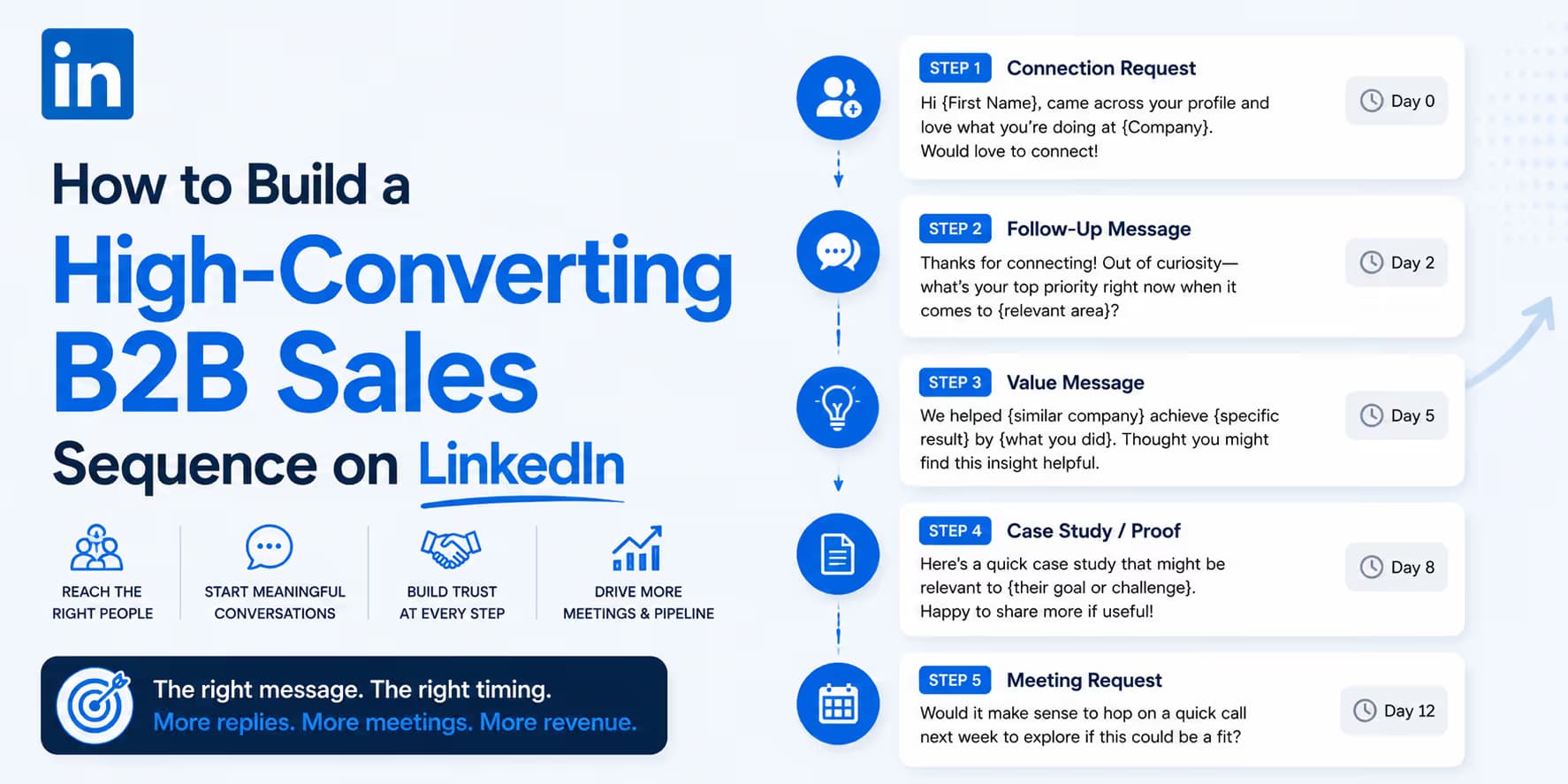
A single cold message is rarely enough to secure a B2B demo. Decision-makers get hit with notifications, emails, and platform updates. They might see your first message, find it relevant, even plan to reply, then get pulled into an internal meeting and forget your profile.
Relying on a single touchpoint is leaving money on the table. To build a predictable, scalable sales pipeline, you must establish a multi-step outbound sequence on LinkedIn. A modern sequence guides prospects systematically through connection, initial observation, conversation starters, value-add touches, and thoughtful follow-ups, without ever crossing the line into spam.
The 2026 outbound reality: multi-touch or bust
The traditional method of "spray and pray"-sending a massive block of pitch text along with a booking link in the first message-is completely dead. In 2026, LinkedIn users have developed acute "pitch slap" blindness. The moment they detect a standardized sales template in their inbox, they archive the thread, delete the request, or worse, mark it as spam.
Buyer psychology has fundamentally shifted. Prospects want conversations with peers, not one-sided sales pitches from strangers. B2B decision-makers require an average of 6 to 8 touchpoints before they actively engage in a sales conversation. A successful sequence maps out these touchpoints across a healthy calendar window, allowing your brand, expertise, and mutual value to slowly sink in. By distributing the interaction over time, you build familiarity and trust, significantly lowering the friction required to book a demo.
The golden rule of sequencing
Always structure your automated sequences to stop immediately the moment a prospect replies. Continuing to send pre-programmed follow-ups to a lead who has already replied is the quickest way to destroy your credibility and trigger a spam report. Every touchpoint from the reply onwards must be strictly manual and peer-to-peer.
The multi-touch LinkedIn sequencing framework
A high-converting sequence is built like a conversation, not a megaphone broadcast. Instead of badgering a prospect to "jump on a quick call," each touchpoint must deliver a discrete slice of value or focus on a highly specific operational trigger. This establishes you as an industry expert who understands their world.
Optimal pacing, timing, and structure of a 4-part LinkedIn sequence:
| Sequence Step | Timing Gap | Primary Objective | Message Angle |
|---|---|---|---|
| Step 1: Connection Request | Day 1 | Maximize acceptance rate | Low-friction, disarming connection note with 0% pitch. |
| Step 2: Conversational Hook | Day 4 (+3 days) | Gauge interest & start dialog | Observe a highly specific operational friction and ask a soft question. |
| Step 3: Value Reinforcement | Day 8 (+4 days) | Educate & build authority | Provide a frictionless asset (PDF checklist, short video, or template). |
| Step 4: The Clean Breakup | Day 14 (+6 days) | Prompt urgency or preserve relationship | Politely bow out of their inbox while leaving the door open for future growth. |
The 4-step high-converting sequence scripting and templates
Templates you can copy, customize, and deploy. Each message is conversational, brief (under 100 words), and written from the prospect's side of the desk.
Step 1: The low-friction connection
Your connection request note has one job: get accepted. Adding a sales pitch, a calendar link, or a laundry list of company features will immediately tank your acceptance rate. Instead, mention a shared interest, mutual group, or clean industry topic.
"Hi [First_Name], noticed you're scaling the engineering group at [Company_Name] and have a focus on high-reliability systems. Loved your recent post about tech debt. Would love to connect peer-to-peer to follow your journey!"
Step 2: The conversational hook (3 days post-acceptance)
Do not pitch your software directly yet. Instead, highlight a common friction point that peers in their exact position experience daily, and ask if they are navigating it.
"Thanks for connecting, [First_Name]. Quick question for you: most technical founders I chat with say that keeping their sales pipelines filled takes up 4+ hours of manual scrubbing weekly, pulling them away from actual engineering.
Are you seeing manual lead discovery eat up your team's development time too, or do you have this fully automated?"
Step 3: The value reinforcement (4 days later)
If they didn't reply to Step 2, don't say "just checking in on this." "Checking in" adds zero value and signals that you're just following an automated task list. Instead, drop a high-value asset, such as a short loom video, a PDF checklist, or a case study framework.
"Hey [First_Name], figured this might be relevant to your engineering roadmaps. We recently mapped out a clean, 3-step automation blueprint that pulls real-time buyer intent signals directly into Slack, saving our team about 12 hours a week.
I put the exact workflows in a short 2-page PDF. Happy to drop the link here if you'd find it useful to skim?"
Step 4: The clean breakup (6 days later)
If they still haven't engaged, it is time to step away. The "breakup" message is highly effective because it triggers a psychological response known as fear of missing out (FOMO). By taking away the opportunity, you often prompt them to reply to preserve the relationship.
"Hey [First_Name], completely understand that automating outbound isn't your main focus right now as you scale. I'll stop cluttering your inbox.
If you ever want a cleaner way to source leads in the future, I'll be sharing updates on my profile. Wish you all the best with [Company_Name]!"
Technical safety, guardrails, and automation deliverability
While building a high-converting sequence is a copywriting challenge, executing it safely is a technical challenge. LinkedIn has aggressively stepped up its tracking of automated browsers, browser extensions, and scraping bots. If you run your campaigns using low-grade tools, your profile will end up in "jail"-restricted or permanently banned.
To protect your personal brand and LinkedIn profile, adhere to these strict deliverability rules:
- Keep connection requests low: Limit your daily connection requests to 15-20. Weekly totals should never exceed 100 to stay well under the platform's flags.
- Simulate human behavior: Ensure your automation system uses random, staggered delay intervals between clicks (e.g., 45 to 180 seconds) rather than running actions on precise cron-job intervals.
- Avoid heavy link density: Do not include links to external websites, booking widgets, or YouTube videos in your initial connection requests or first messages. High link density signals commercial spam to the algorithm.
- Monitor your Social Selling Index (SSI): Keep your LinkedIn SSI score above 60 by sharing organic content, engaging in your network feed, and maintaining a high conversion-to-reply ratio in your inbox.
Case study: booking 14 demos in 30 days
A B2B SaaS startup used this 4-step sequencing framework to target Series A Product Managers.
The company, a technical product intelligence dashboard, identified a highly focused ICP of 400 prospects. They loaded these prospects into their sequence queue and set strict daily constraints of 15 requests per day.
| Sequence Metric | Count / Percentage | Strategic Takeaway |
|---|---|---|
| Total Prospects Targeted | 300 | Highly curated list built using deep intent crawlers. |
| Connections Accepted | 138 (46% Acceptance) | High rate driven by organic profile optimization and zero connection pitch notes. |
| Total Conversational Replies | 39 (28.2% Reply Rate) | Active replies distributed across Step 2 (12 replies), Step 3 (18 replies), and Step 4 (9 replies). |
| Demos Booked | 14 Demos Booked | 35.8% conversion from active conversation to calendar booking using soft friction-free frameworks. |
By delaying the pitch, presenting friction-free resources, and utilizing the breakup sequence, the company converted almost 10% of their cold targeted accounts into active, high-context product demonstrations in under a month.
Review the sequence before scaling
Use the sequence structure above to define timing, channel choice, and exit rules. Once the manual flow is clear, software can help keep the process consistent.
Sequence pitfalls to avoid
When setting up your first multi-step sequence, it is extremely easy to fall into bad sales habits that tank your conversion rates. Keep your campaigns clean by steering clear of these common mistakes:
- Using generic dynamic variables: If your system replaces `[Company_Name]` with messy strings like `Acme Corp LLC - EMEA Division`, the prospect will instantly spot the automation. Clean your CSV data carefully before launching.
- Short message gaps: Spacing follow-ups by only 24 hours comes across as desperate and annoying. Give prospects breathing room: space messages by at least 3-4 business days.
- Pitching features instead of outcomes: Decision-makers do not care about your database speeds or dashboard integrations. They care about their own bottom line: saving time, growing MRR, and eliminating operational friction.
- Neglecting your profile presence: If your sequence is high-value, but your profile looks like a generic résumé or has a blurry headshot, prospects will drop off immediately. Your profile must act as a clean landing page for your expertise.
Frequently asked questions
No. Dropping a booking link in the first message assumes they are already interested in booking a call. It forces the lead to make a massive micro-commitment immediately, which leads to high drop-offs. Always wait for them to express interest before sending your link.
Stop the sequence immediately. Thank them politely for their time: "Completely understand, [First_Name]. If anything changes down the line, I'm always happy to help. Have a great week!" This leaves a stellar impression and keeps the door open.
Yes, as long as you maintain low daily volume constraints (under 20 connection requests daily) and utilize random, humanlike delay timing intervals. High-volume scraping and bulk extension scripts must be avoided completely.
Short, highly focused 1-2 page PDF checklists or blueprints. Busy executives will not watch a 45-minute webinar or read a 50-page ebook, but they will happily skim a beautiful 2-minute actionable cheatsheet that solves their immediate friction.