
B2B outbound used to be simple: a database subscription plus an email sequencer. Reps exported general contact lists, mapped fields, and launched template-driven drip campaigns.
Inbox filters got stricter and buyers got tired of generic sequences. Prospecting now depends on precise data and real context. Sales operations teams responded by stacking more tools.
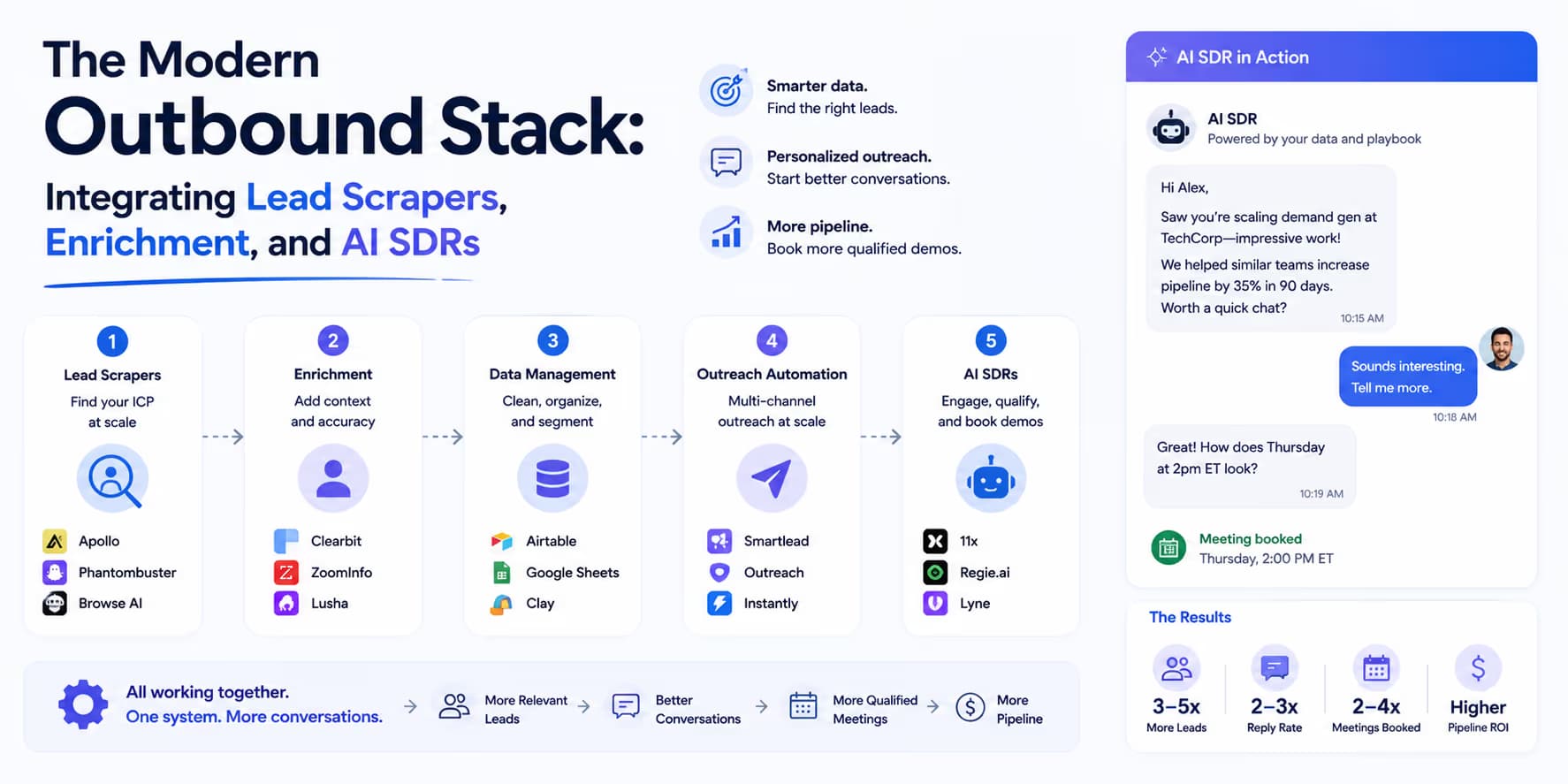
This article maps that stack: lead scrapers, waterfall enrichment, and AI sales development representatives (SDRs). It also explains why some growth teams are leaving fragmented multi-tool setups for a single workspace like Omentir.
How the B2B outbound stack changed
To understand sales development today, it helps to see how we got here. In earlier eras, the database sat at the center. Teams used centralized directories to search, filter, and export contacts by hand.
As databases decayed and professional records changed rapidly, static directories became unreliable. Senders experienced high bounce rates, which damaged their domain reputations. To solve this, sales operations teams began layering specialized tools: lead scrapers to extract real-time data, waterfall enrichment APIs to verify records across multiple sources, and sequencers to schedule campaigns.
While this multi-tool approach solved specific data issues, it introduced high software costs and significant operational complexity as teams managed fragile integrations.
Cross-linking
If you want to turn this enriched data into qualified meetings, read our playbook on Building High-Converting B2B Sales Sequences on LinkedIn and keep the channels coordinated.
The three-layer outbound architecture
A working B2B sales stack usually has three layers:
- Layer 1: Sourcing and Scraping: Tools that identify target companies and contacts matching specific profiles. These engines scrape social platforms, crawl public directories, and analyze firmographic databases to build a base lead list.
- Layer 2: Programmatic Enrichment: Waterfall data APIs that verify email deliverability, find direct dials, and gather company-specific signals (such as hiring trends or software packages used) so the data stays accurate.
- Layer 3: Autonomous outreach (AI SDRs): Autonomous systems that crawl company websites using AI, draft personalized pitches, and execute campaigns across LinkedIn and cold email, managing replies and follow-ups automatically.
| Stack Layer | Primary Function | Legacy Tool Examples |
|---|---|---|
| Layer 1: Sourcing | Find target companies and contact profiles | Apollo.io, Sales Navigator, BuiltWith |
| Layer 2: Enrichment | Waterfall API email verification and mobile discovery | Clay, Lusha, Hunter, Dropcontact |
| Layer 3: Execution | Multi-channel delivery, personalization, and follow-ups | Smartlead, Instantly, Expandi, CRMs |
Why siloed stacks fail
The three-layer model works, but keeping separate tools for sourcing, enrichment, and delivery creates operational friction.
Because these layers are disconnected, sales teams spend time exporting CSV files, managing webhooks, and troubleshooting API integrations. Fragmentation leads to data decay, broken tracking, and extra monthly software fees.
The Omentir approach: one outbound workspace
Omentir was built to cut this complexity. Instead of making you maintain a fragile data pipeline, Omentir is an autonomous, all-in-one B2B salesman.
Omentir combines lead discovery, verified contact enrichment, company website crawling, and multi-channel delivery across LinkedIn and cold email in one closed-loop workspace. That keeps data in one place, helps protect domain health, and shortens the path to booked demos.
A playbook for migrating the stack
If you want to grow B2B sales development without juggling disconnected tools, use this three-step blueprint:
- Identify active buying triggers: Settle on active signals rather than cold directories. Look for targets that are hiring, raising capital, implementing specific integrations, or launching new products.
- Design coordinated campaigns: Coordinate your outreach across platforms. Warm up cold prospects by visiting and connecting on LinkedIn before sending emails.
- Personalize every message: Avoid generic templates. Every outreach message should reference target-specific company goals or products.
The modern outbound stack checklist
A modern outbound stack should not be a random collection of lead scrapers, enrichment credits, and inboxes. Each layer needs a clear job. If a tool does not improve targeting, context, delivery, or reply handling, it is probably adding complexity without increasing pipeline.
- Lead source layer: Finds companies and people that match the ICP. This can include databases, LinkedIn searches, website crawlers, job boards, funding data, and intent signals.
- Enrichment layer: fills missing fields, verifies email addresses, adds role data, and rejects risky contacts before they enter a campaign.
- Context layer: explains why the prospect is relevant right now. This is where company pages, recent posts, hiring signals, and product changes become message angles.
- Sequencing layer: delivers outreach across LinkedIn, email, and follow-up steps without overloading any one channel.
- Reply intelligence layer: classifies responses, separates interested replies from objections, and routes warm leads to the founder or sales team quickly.
The reason AI SDRs are becoming central to the stack is that they connect these layers. A scraper may find a company. An enrichment tool may find the email. A sequencer may send the message. But the AI SDR decides whether the account is worth contacting, what context matters, and how the next reply should be handled. That is the difference between a tool stack and a pipeline system.
Example stack configurations
The right outbound stack changes by team size. A solo founder, a sales agency, and a funded revenue team should not buy the same set of tools just because each tool appears in a growth stack diagram.
- Solo founder stack: Use one sourcing and outreach workspace, one calendar link, and one simple CRM. The priority is speed and learning, not tool depth.
- Agency stack: Use stronger inbox management, client separation, reporting, and approval workflows. The priority is safe execution across several brands.
- Technical growth stack: Use Clay-style enrichment, custom scoring, verified data providers, and a sequencer. The priority is control and experimentation.
- AI SDR stack: Use an autonomous sales agent that combines sourcing, enrichment, LinkedIn, email, and reply classification. The priority is reducing handoffs between tools.
The best stack is the smallest stack that reliably creates qualified conversations. If adding a tool makes the workflow harder to operate, it needs to produce a measurable gain in list quality, reply quality, or booked demos. Otherwise, the stack is becoming a maintenance burden rather than a revenue engine.
Signs your outbound stack is too complex
A stack is too complex when the team spends more time maintaining workflows than talking to buyers. Common warning signs include duplicate leads across tools, unclear ownership of reply handling, manual CSV transfers, inconsistent personalization fields, and reports that show activity without explaining pipeline quality.
Another warning sign is tool overlap. If one tool scrapes leads, another enriches the same fields, a third verifies emails, a fourth sends messages, and a fifth stores replies, every handoff becomes a point of failure. The more handoffs you have, the harder it becomes to know why a campaign worked or failed.
Simplify by assigning one job to each layer. Keep only the tools that improve list quality, message relevance, delivery safety, or reply handling. If an AI SDR can combine several layers without reducing control, it may be worth replacing a fragmented stack with a more unified workflow.
How to decide what to remove from the stack
When the outbound stack feels heavy, remove tools by asking one question: would pipeline quality drop if this tool disappeared? If the answer is no, the tool is probably operational clutter. A scraper that produces weak-fit accounts, an enrichment tool that fills fields no one uses, or a reporting dashboard that does not change decisions should be cut.
Keep tools that directly improve one of four outcomes: better-fit accounts, more accurate contact data, more relevant messaging, or faster handling of interested replies. Everything else should justify its place with measurable lift.
This is why unified AI SDR systems are attractive to lean teams. They reduce the number of tools needed to move from account discovery to conversation, while still preserving the checks that prevent bad targeting and careless automation.
Outbound stack FAQs
Multi-tool stacks are expensive to maintain and operationally fragile. Managing data transfers via CSV exports or custom webhooks increases the risk of data mismatch, which can lead to personalization errors and high email bounce rates.
A unified workspace like Omentir runs real-time email verification checks directly before sending and enforces safety limits on social actions, protecting your accounts from being flagged or restricted by major platforms.
Yes. Omentir unifies lead discovery, verified contact enrichment, deep company website crawling, and multi-channel delivery across LinkedIn and email in a single workspace. This eliminates the need to subscribe to and manage separate scrapers, verification databases, and sequencers.