
Social selling and LinkedIn campaigns can work as B2B sales channels. Senders build lists in databases, configure copywriting prompts, and launch campaigns targeting hundreds of prospects. To run these loops, your software must access the target sending profiles.
Most outbound tools access profiles using risky methods. They ask for raw login passwords, or instruct you to install browser extensions that manipulate the page DOM at mechanical speeds.
These methods trigger security blocks. Social platforms actively scan for DOM injections and unrecognized logins, restricting profiles that display bot activity.
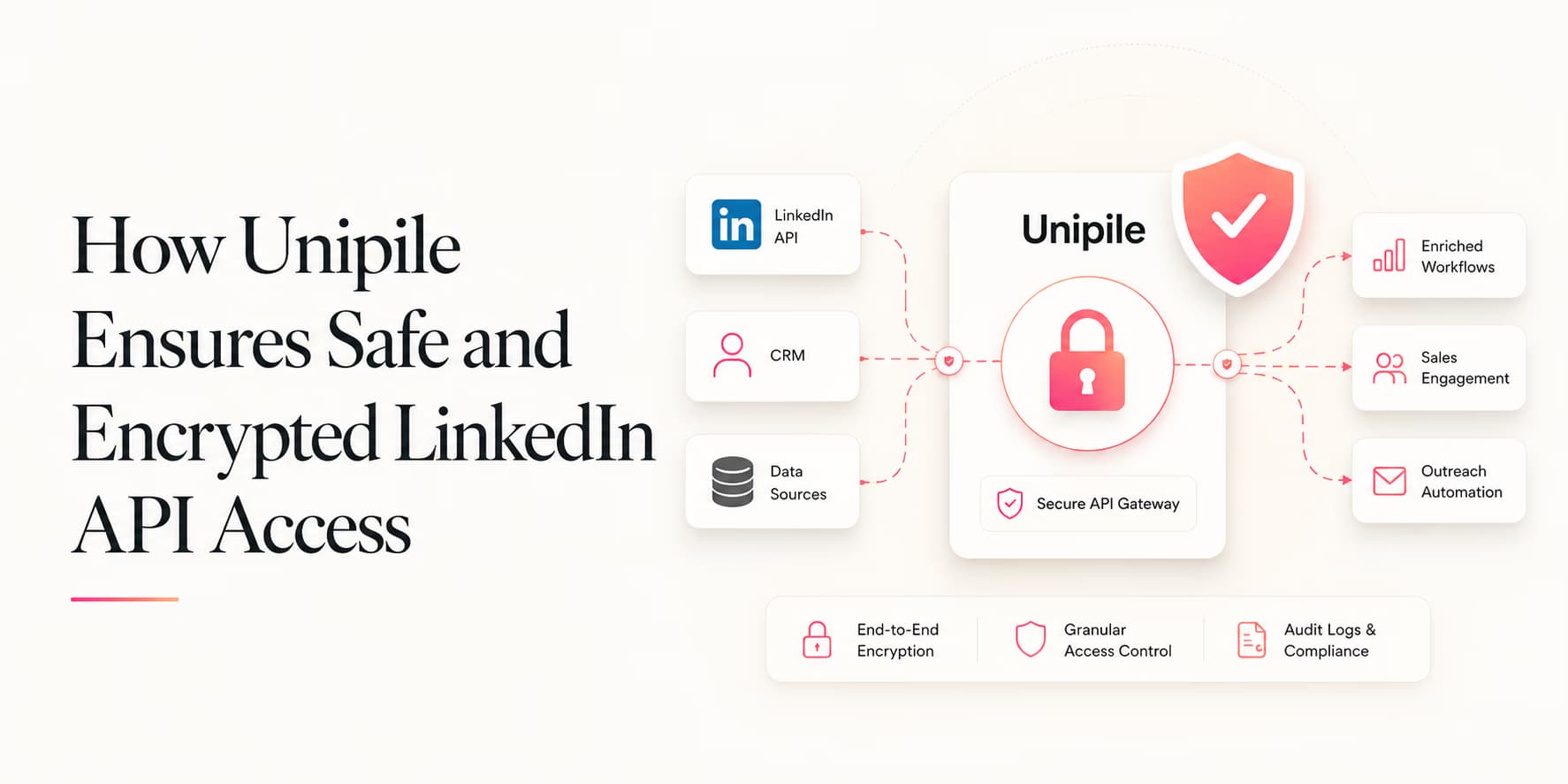
The solution is to use secure API routing. By integrating sending profiles through an API layer like Unipile, you can centralize connection, messaging, invitation, and inbox workflows without asking your team to run fragile browser scripts.
The point of a LinkedIn API layer is to keep credentials off laptops and scripts. The rest of this piece is about what that layer actually does, and what it does not excuse.
What safe access actually means
Safe access does not mean "nothing can ever go wrong." LinkedIn still controls its own platform rules, rate limits, session checks, and account restrictions. Safe access means the software architecture avoids the most reckless patterns: raw password storage, uncontrolled browser extensions, hidden scraping loops, and bulk actions the user cannot review.
A good integration should make three things obvious. The user should know which account is connected, what actions the product can perform from that account, and how to disconnect or pause activity. If any of those details are unclear, the sales motion becomes risky even if the underlying API provider is solid.
This is the standard Omentir follows: connected accounts are used for lead discovery, outreach execution, and reply sync inside workflows the user configures. The automation helps with repetitive work, but the sender still owns the targeting, message quality, and compliance decisions.
How Unipile acts as a secure API buffer
Unipile is a messaging gateway that provides server-side connections to communication channels, including LinkedIn, WhatsApp, Instagram, Telegram, email, and calendars. In the LinkedIn context, it lets software products connect authenticated user accounts and support workflows such as message sync, sending, invitations, and conversation management.
An API buffer manages three security workflows:
- Token Encryption: Isolating and encrypting login cookies.
- Proxy Mapping: Routing API calls through matching regional IP addresses.
- Server-Side Execution: Performing actions via backend routes instead of browser scripts.
For profile safety guidelines, see our guide on maintaining LinkedIn account health.
The hosted auth connection flow
Unipile's documentation describes hosted authentication as a connection method where the application generates a temporary link and sends the user through an auth wizard. That matters because the user is intentionally connecting the account rather than handing credentials to an operator in a spreadsheet or support chat.
In practice, the safe product experience should look like this: the user clicks "connect account," reviews the provider being connected, completes the authentication flow, and returns to the app with the account visible in settings. From there, the app should show whether the account is active, disconnected, or needs attention.
That visibility is not cosmetic. When a campaign depends on a real LinkedIn profile, the operator needs to know whether sends are paused because the account disconnected, because a provider rejected an action, or because an internal safety rule blocked the next step.
Session security: token isolation and cookie encryption
Storing raw passwords in databases is a major security risk. If a database is breached, sender credentials will be compromised.
Unipile bypasses password storage by using session token isolation. When you connect a profile, Unipile authenticates the session and converts the login cookies into an encrypted token.
This token is stored in a secure environment. Omentir references this token to trigger campaigns, so your passwords are never exposed.
The important operating rule is separation. Your application should store only the account identifier and the minimum metadata needed to run the workflow. It should not copy sensitive session material into random tables, logs, analytics events, or support tools.
Logs deserve special care. A useful log says "message send rejected by provider" or "account missing," not "here is the request payload with every sensitive token attached." Debuggability is valuable, but it should not create a second credential leak surface.
IP geolocation: mapping connections to regional proxies
Platform security algorithms track login geolocations. Triggering campaigns from a cloud server IP in a different region than your manual login will trigger security blocks.
Unipile prevents these alerts by routing API calls through regional proxy servers.
If your sales operator is based in San Francisco, Unipile routes campaign messages through a West Coast proxy, maintaining matching geolocation parameters.
Treat geography as a consistency problem. If a sender normally logs in from one region, avoid creating sudden access patterns from unrelated regions. Even when an integration abstracts the transport layer, your team should still keep account ownership clean: one real owner, one normal operating region, and no casual sharing across contractors.
Safety rule: enforce daily limits
Never bypass daily volume quotas. Even with secure API routing, sending excessive messages will trigger spam flags. Keep invitations under 20 requests per profile daily.
Avoiding detectable DOM and browser automation
Browser extensions automate actions by clicking elements directly on your web pages. Platforms scan for this DOM manipulation, identifying bot behavior instantly.
Unipile routes campaigns server-side, communicating with endpoints directly. That keeps actions off the page DOM, which platforms scan for bot-like clicks.
Server-side execution also makes controls easier to enforce. A backend queue can check plan limits, campaign state, opt-outs, daily quotas, and retry rules before an action is attempted. A browser extension often acts too close to the page, where it is harder to maintain a clean audit trail.
Omentir's local Unipile client reflects that pattern. Profile reads are budgeted because each lookup can count as activity on the user's LinkedIn account. Requests are throttled, connection notes are clipped to LinkedIn's note limit, and messages are limited before being sent. Those small controls are not glamorous, but they prevent a high-candidate run from accidentally turning into unsafe account activity.
Design least-privilege workflows
A safe integration should not use every endpoint just because the API exposes it. Start from the workflow the user actually needs. For a LinkedIn outbound system, the core actions are usually account connection, lead/profile lookup within budget, invitation sending, message sending, and inbox sync.
Anything outside that path should earn its place. Do you really need aggressive profile enrichment on every candidate, or only on leads that pass ICP scoring? Do you need attachments in the first sequence, or can those be reserved for human replies? Least privilege is a product decision as much as a security decision.
Enforcing human pacing and daily volume limits
Outbound safety depends on pacing. Omentir enforces safe connection quotas (restricting invites under 20 requests daily) and spaces out requests using random delays.
API access does not remove the need for judgment. If you send irrelevant messages too quickly, prospects can still ignore, block, or report them. If a connected account is new, dormant, or already unhealthy, a technically clean integration can still create a bad outcome.
The right setup combines API access with campaign limits. Use daily caps, random spacing, opt-out suppression, and review queues. Most importantly, stop automation when a prospect replies. The whole point of a unified inbox is to move real conversations out of a sequence and into human handling.
For pacing details, see our guide on pacing B2B campaigns safely.
Handle API failures safely
Safe infrastructure is not only about successful sends. It is about what happens when something fails. A provider can reject an action, an account can disconnect, a network request can time out, or a profile lookup can return incomplete data.
Your retry logic should treat those cases differently. If the provider clearly rejects a request, it may be safe to retry later after correcting the cause. If the network drops after the action was sent, the result is ambiguous; blindly retrying can create duplicate messages. When the system is unsure, it should park the action for review instead of guessing.
This is especially important for real outreach. Duplicate invites and repeated messages are not harmless technical glitches. They are visible to prospects and can damage the sender's reputation.
SOP: connecting profiles safely via API routes
Connect your sales profiles safely using these steps:
- Step 1: Access Omentir's dashboard and select "Add Profile."
- Step 2: Connect the profile via the secure Unipile API authorization screen.
- Step 3: Configure campaign proxies to match your local region.
- Step 4: Verify safe daily connection limits and pacing delays.
- Step 5: Confirm opt-out suppression is active before the first sequence starts.
- Step 6: Review the first batch of replies manually before increasing campaign volume.
Omentir handles variable mapping and safety limits, allowing you to validate your campaigns. The operator still owns the final go/no-go decision: whether the account should send, whether the list is appropriate, and whether the message is good enough to represent the brand.
Treat the API as infrastructure
B2B campaigns need secure infrastructure. Unipile's token encryption, proxy geolocations, and server-side routes help protect profile assets from restrictions.
Use the API layer as infrastructure, not as permission to send more than the account or the market can safely absorb. Unipile moving a message is not the same as a buyer wanting that message.
Frequently Asked Questions
Unipile is a messaging API that provides access to social platforms. Omentir uses Unipile to send messages and monitor reply threads without storing raw login passwords.
Unipile encrypts login session cookies and stores tokens in isolated environments that prevent unauthorized access.
If an automated action is triggered from an IP address in a different region than your manual login, platform security flags the session mismatch and locks the profile.
No. Unipile runs entirely on server-side API endpoints, eliminating the need for risky browser extensions that manipulate web pages.