
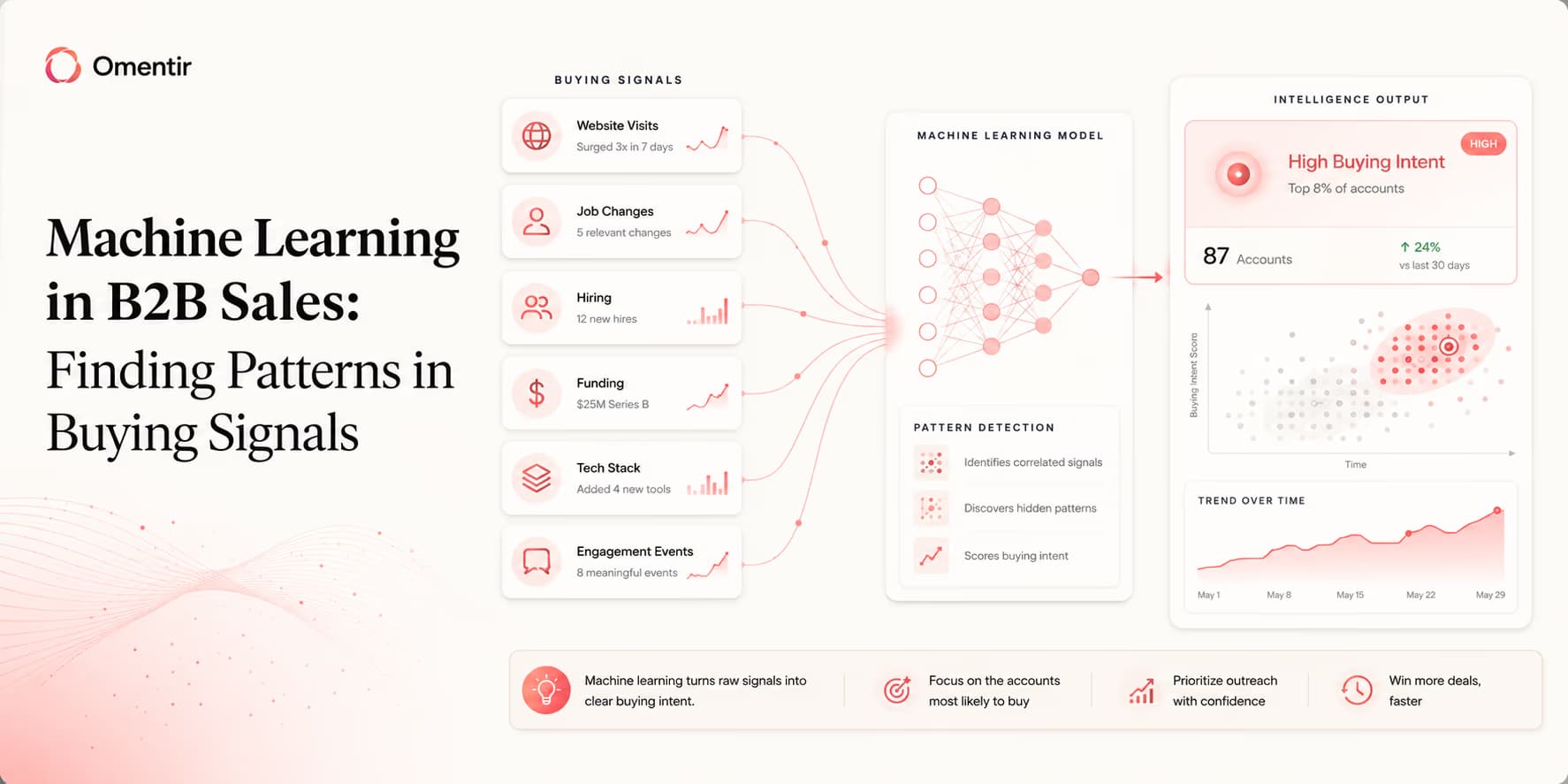
Outbound B2B prospecting has long used static rules. Senders configure queries like "industry equals software AND head count is between 50 and 200" to export target lists. Those queries isolate general accounts, but they miss active intent.
To raise campaign relevance, you have to read buying signals. That means finding patterns across hiring board listings, corporate announcements, and profile updates.
Rules-based filters cannot process unstructured text well. Machine learning can. Classification models, semantic search, and regression scoring let you evaluate prospect relevance programmatically.
Omentir uses this intelligence layer, checking live signals so campaigns stay on the right accounts. The models that power outbound sales work like this.
The practical value of machine learning is not that it makes sales automatic. It helps teams sort messy evidence faster. A human can read a homepage, job post, LinkedIn profile, and recent company update to decide whether an account is worth contacting. Machine learning helps perform that same kind of pattern recognition across far more accounts, then routes the uncertain cases back to people.
That distinction matters. If you treat a model score as truth, you will send bad campaigns with confidence. If you treat the score as a decision aid with visible evidence, it becomes useful.
When machine learning is worth it
Not every sales workflow needs machine learning. If your target market is tiny and the qualification rules are obvious, a simple checklist may be better. For example, "founders at B2B SaaS companies hiring their first SDR" can often be found with search filters, manual review, and a few clear disqualifiers.
Machine learning becomes useful when the signal is messy, hidden in text, or spread across multiple sources. It helps when you need to classify company positioning, infer likely workflows from a website, group replies by intent, compare public job descriptions, or prioritize hundreds of leads with different evidence.
Use this rule: if a human reviewer can explain the decision in one or two rules, start with rules. If the decision requires reading context and weighing several weak signals, machine learning may help. The simpler approach should win until the problem actually needs a model.
Machine learning architectures in outbound sales
Machine learning in sales development refers to the mathematical models used to process unstructured B2B data and predict conversion likelihood.
A modern outbound machine learning pipeline uses three primary model types:
- Classification Models: Group prospects and replies into categories (e.g. identifying target industries).
- Semantic Neural Networks: Map website copy to conceptual variables, identifying value integrations.
- Regression & Scoring Engines: Calculate numerical fit parameters to prioritize outreach queues.
In a practical outbound system, those models should produce structured outputs, not mysterious scores. A good output says: what category the account belongs to, what evidence supports that category, how confident the system is, and what action should happen next. The action might be approve, reject, human review, draft message, or enrich with more data.
For example, a lead-scoring pipeline might read a company website, identify that the company sells to B2B sales teams, notice two open SDR roles, find that the prospect is a head of growth, and score the account as high fit because the role, company, and trigger line up. The same pipeline should reject a consumer ecommerce store even if the contact has a sales title.
To learn how to setup these data pipelines, see our guide on modern outbound data stacks.
Classification models for hiring and career milestones
Career milestones (such as promotions or new job changes) are strong buying signals. When a prospect updates their LinkedIn profile, classification models verify the update.
The model parses the unstructured job title changes, classifying them into specific role shifts. For example, a transition from "Account Executive" to "VP of Sales" is classified as a leadership promotion.
This classification alerts your sales operator to trigger a congratulatory campaign note.
Classification is most useful when the categories are tied to campaign decisions. "Promotion" is interesting, but it is too broad. A promotion into a revenue leadership role may justify an executive message about pipeline process. A lateral move into a technical role may not. The category should tell the campaign what to do next.
Strong classification labels might include:
- New budget owner: A role change that suggests the person may evaluate tools or processes.
- Team expansion: Hiring that suggests the company is adding capacity and may need workflow support.
- Market shift: Messaging or product changes that suggest a new customer segment.
- Low relevance: A profile update that is real but not useful for your offer.
The last category is important. Models should not force every event into an outreach opportunity. Sometimes the correct action is no action.
Neural networks for semantic context and copywriting
Outbound copywriting requires high copy relevance. Neural networks run semantic evaluations, mapping competitor usage and integrations by scanning corporate websites.
Instead of matching exact keywords, the model processes the context of the page copy. If a company's website mentions "syncing client details to our CRM," the model identifies that they use CRM systems, even if they do not explicitly name the vendor in the copy.
This semantic mapping lets your prompts write customized copy that references their operational setup. For details on copywriting triggers, see our guide on writing high-converting LinkedIn message hooks.
Semantic analysis is powerful because buyers do not always use your vocabulary. A company may not say "outbound sales automation" anywhere on its site, but its careers page may mention manual account research, SDR ramping, territory building, or CRM hygiene. A semantic model can connect those phrases to the broader workflow you care about.
The mistake is letting semantic inference become overconfidence. If the model infers that a company likely uses a CRM, do not write "I saw your team uses Salesforce" unless that fact is public and verified. Use inferred context to shape the question, not to pretend you know private details.
A safe message based on semantic context might say: "Saw you are hiring SDRs and emphasizing account research in the role. Are reps building prospect lists manually today?" That is different from claiming you know their internal process.
Model Rule: Clean Inputs First 💡
Ensure your data is cleaned before running machine learning classification. Passing raw HTML containing navigation links and javascript code will result in incorrect fit scores.
Regression models for lead fit scoring
To run campaigns well, the system needs Fit Scores. Regression engines evaluate incoming leads against multiple data points and estimate conversion probability.
The model weights parameters (such as company size, role seniority, and tech integrations) based on your historical conversions.
This scoring helps your sales team prioritize prospects, but it should not be treated as a guarantee.
Lead fit scoring works best when the score is decomposed. Instead of one number, show the component reasons:
- Account fit: Company size, industry, geography, business model, and maturity.
- Contact fit: Role, seniority, department, and likely ownership of the problem.
- Timing signal: Hiring, funding, product launch, expansion, public pain, or tech change.
- Evidence quality: Whether the signal came from a strong source or a weak inference.
- Exclusion risk: Existing customer, competitor, student, consumer company, or poor-fit segment.
This makes the score auditable. A human can see whether the model is approving a lead because the account is genuinely strong or because one weak signal was overweighted.
Where lead scoring goes wrong
Machine learning can make bad decisions look scientific. The most common failure is training or tuning on noisy outcomes. If your campaign booked demos with poor-fit prospects, and the model treats those demos as success, it will learn to find more poor-fit prospects.
Avoid these mistakes:
- Optimizing for replies only: Reply volume can reward curiosity, controversy, or vague copy rather than buying intent.
- Ignoring negative examples: The model needs to know which leads were rejected, unqualified, or bad customers.
- Overweighting easy-to-find data: Company size and title are visible, but urgency often matters more.
- Hiding evidence: A score without source details cannot be trusted or improved.
The fix is to define success carefully. A strong positive label might be "qualified demo with a buyer who owns the workflow." A stronger label is "customer activated and retained after the first month." The closer the label is to real business value, the more useful the model becomes.
The feedback loop: tune models with real outreach results
A machine learning model requires validation. By tracking conversion metrics such as connection acceptances, replies, qualified demos, and retained customers, the system can improve its scoring over time.
If leads from a specific sector show low response rates, that may suggest the sector deserves a lower score. But do not update weights blindly. Low response can come from the wrong message, the wrong timing, weak proof, or poor deliverability. The feedback loop should compare outcomes across segments and then send the pattern to human review.
A useful feedback record includes:
- The original score and the evidence behind it.
- The message angle used.
- The prospect's reply category, if any.
- Whether a qualified next step happened.
- Whether the account became a good customer or a poor-fit customer.
This lets the model improve from outcomes that matter, while the human team keeps judgment over ambiguous patterns.
SOP: structure outbound data for machine learning
Structure your sales data using these steps to enable machine learning optimization:
- Step 1: Record complete engagement profiles for all campaign prospects.
- Step 2: Classify replies into intent categories (interested, referral, objection).
- Step 3: Match conversion outcomes directly to target profile variables.
- Step 4: Update fit scoring algorithms in Omentir based on conversion rates.
Add these guardrails before trusting the scores:
- Keep source fields: Store where each signal came from so reviewers can inspect the evidence.
- Separate account and contact scoring: Do not let a great company hide a wrong buyer title.
- Review borderline scores: Route medium-confidence leads to humans instead of sending automatically.
- Track false positives: Record leads that scored well but turned out to be irrelevant.
- Refresh assumptions: Revisit weights when the product, pricing, or target market changes.
Omentir helps manage this feedback loop, updating lead scores programmatically.
Build a conversion pipeline you can inspect
Outbound campaigns work better when they use evidence. Apply machine learning models to buying signals and you can score more accounts without pretending the score is a close.
The strongest systems combine models with human review: models find patterns, people judge context, and real outcomes improve the next campaign. A model that never sees "this reply was a no because timing" will keep scoring the same dead segment as hot.
Frequently Asked Questions
Machine learning models analyze unstructured data (such as career changes, website text updates, and company news) to classify buyer intent and score lead relevancy automatically.
Classification models group contacts into categories (e.g. B2B vs B2C, or reply intent buckets). Regression models estimate numerical fit scores to prioritize lead lists.
Omentir uses natural language processing to analyze prospect profiles, verify software installation signals, and draft personalized copywriting variables.
No. Senders can use pre-configured scoring parameters in Omentir's dashboard, while developers can build custom integrations via REST APIs or hosted MCP servers.