
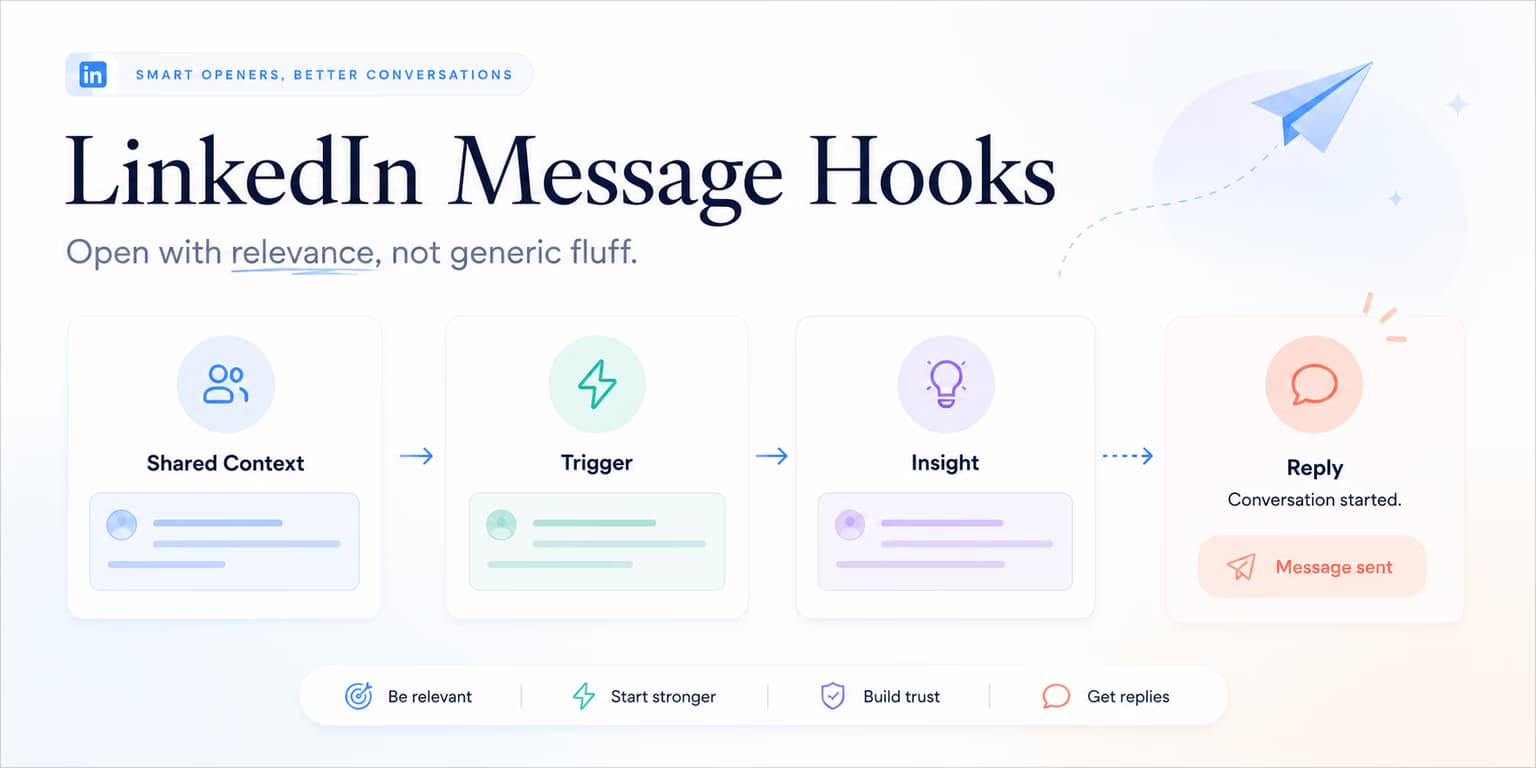
A LinkedIn hook has one job: earn the next five seconds. It does not need to explain your whole product, prove your credibility, or book the meeting. It needs to make the buyer feel that the message might be relevant enough to keep reading.
Buyers protect their attention aggressively. When a connection request or first message appears, they see your name, headline, and a short preview. If the preview sounds like every other sales message, they often decide before reading the rest. That is why the first line matters so much.
Bad hooks announce themselves immediately: "I was impressed by your profile," "quick question," "hope you're well," "we help companies like yours," or "wanted to introduce myself." These lines are not offensive; they are invisible. They give the buyer no reason to believe the message was meant for them.
Good hooks use a real reason for contact. They reference a public signal, role-specific problem, shared context, or useful asset without pretending to know private pain. Omentir helps draft these openings from prospect and product context, but the same rule applies whether a human or an agent writes the line: the hook must be specific, truthful, and easy to answer.
What a good message hook contains
A good LinkedIn hook does not sell. It creates relevance and a small opening for conversation. The prospect should understand why you reached out before they understand every feature you offer.
- Brevity: Keep the opening short enough to understand in a notification preview.
- Grounding: Reference a specific signal, role, or business context rather than generic praise.
- Restraint: Do not overclaim what the signal means. Ask a question instead of diagnosing their business.
- Natural tone: Write like a person starting a conversation, not a campaign announcing itself.
- Clear next line: The hook should lead naturally into one useful sentence, not a long pitch.
The easiest test is to remove the prospect's name and company. If the hook could still go to 500 people unchanged, it is not a hook; it is a template. If the hook depends on a real source and would sound strange to send to a different prospect, you are closer.
Be careful with fake intimacy. "Loved your post" is weak if you did not actually read it. "Saw your team is hiring for RevOps" is stronger because it references something concrete. "Looks like your pipeline reporting is broken" is too far because it turns a public clue into a private diagnosis.
For detailed sequence templates, check out our guide on LinkedIn B2B pitch templates.
Copywriting strategy: skip the hype
Avoid opening with greeting lines like 'I hope this message finds you well' or 'Congrats on your success'. These are empty fillers that waste lock screen preview characters.
Hook formula 1: the active sourcing department trigger
Hiring is one of the cleanest public signals because companies describe work they need done. A role description can reveal tools, responsibilities, goals, and gaps in the current team. It does not prove they want your product, but it can give you a relevant question.
The key is to reference the work, not the hiring event alone. "Saw you're hiring" is common. "Saw the role includes owning LinkedIn prospecting and pipeline reporting" is more useful because it points to an actual workflow.
Hiring hook template
"Saw the new growth role includes LinkedIn prospecting and weekly pipeline reporting..."
A bad version would be: "Congrats on growing the team." It sounds polite, but it does not connect to a business problem. A better follow-up line would be: "Curious if you are trying to make that workflow repeatable before the new hire ramps?" The hook and question now fit together.
Do not use old job posts as urgent hooks. If the posting date is unclear, soften the wording: "Noticed your team has been hiring around outbound operations" is safer than "saw you're currently hiring." For tips on list segmentation, check our guide on sales pitch personalization workflows.
Hook formula 2: the content reflection and feed update hook
Content hooks work when the prospect has shared something that genuinely relates to your offer. They fail when the reference is shallow. "Loved your post" is one of the most overused lines in outbound because it asks for credit without proving any thought.
A good content hook reflects the idea, not just the existence of the post. If the prospect wrote about sales efficiency, your hook might point to the tension they named. If they commented on hiring challenges, your hook can ask about the workflow behind that challenge.
Content hook template
"Your point about outbound quality dropping when volume rises felt very real..."
This works because it proves you understood the idea. It also creates a natural bridge: "How are you keeping quality high as the team scales prospecting?" That is a real question. It is not a disguised pitch.
Skip content hooks when the post is personal, unrelated, or too old. Reaching into a personal update to sell software can feel invasive. When in doubt, use a role-based hook instead. For modular copywriting strategies, check our article on personalized sales pitches.
Hook formula 3: the peer-to-peer mutual connection hook
Mutual connections can create trust, but they are easy to misuse. A shared LinkedIn connection is not the same as a referral. Do not imply endorsement unless the person actually introduced you or gave permission.
The safest mutual hook is light and factual. It can mention shared context, an alumni network, a community, a previous company, or an actual introduction. It should not lean on someone else's credibility too heavily.
Mutual referral hook template
"Saw we both know [Name] from the early-stage SaaS world..."
A stronger version adds why the shared context matters: "Saw we both know [Name] from the early-stage SaaS world. I had a quick question about how your team is handling founder-led outbound." The mutual connection lowers friction, but the business question still carries the message.
Avoid name-dropping. If the prospect asks, "Oh, how do you know them?" you should have a truthful answer. If you do not, use another hook.
Hook formula 4: the frictionless asset offer hook
Asset hooks are useful when you do not have a strong personal or company signal, but you still have something genuinely helpful for the buyer. The asset should solve a narrow problem, not act as a disguised brochure.
The best asset hooks are specific to the role. A founder may care about a checklist for validating outbound before hiring an SDR. A RevOps leader may care about a QA rubric for message personalization. A sales leader may care about a pipeline review worksheet. The asset should make the buyer's job easier even if they never buy from you.
Asset offer hook template
"Put together a short QA checklist for LinkedIn outreach before teams scale volume..."
The follow-up question matters: "Want me to send it over?" is lower friction than "Can we book 30 minutes?" The asset earns permission for a conversation. It does not replace relevance.
Do not offer an asset unless it exists and is worth sending. Buyers remember when a "custom teardown" turns out to be a generic PDF. If you promise something specific, deliver something specific.
Automating hook sourcing with workspace discovery agents
Sourcing hooks manually for every prospect takes time, but automation only helps if the evidence is clean. A hook generation workflow should gather a small number of useful signals, score them, choose the safest angle, and draft a line that a human can review quickly.
Define your target buyer signals in settings, then let discovery agents search for profiles and context that match those rules. Omentir can help draft campaign messages from that context and either stage drafts or launch campaigns depending on how you configure the workflow.
The QA layer should ask four questions before a hook goes live: is the signal public, is it current, is it relevant to the offer, and does the wording avoid private-sounding assumptions? If the answer to any question is no, rewrite or reject the hook.
Maintaining outreach safety cadences and account security
Great hooks do not make unsafe sending safe. LinkedIn outreach still depends on pacing, sender reputation, campaign overlap, and reply behavior. If you send too much activity too quickly, strong copy will not protect the account.
Configure campaigns with conservative daily quotas and human-paced delivery. Review the first batch of hooks before increasing volume. If replies are mostly negative or confused, do not scale. Fix the sourcing or message angle first.
Omentir coordinates outreach through paced queues and daily quotas. Treat those controls as part of copy quality, not only account safety. The best hook in the world is still a poor business decision if it goes to the wrong person at the wrong volume.
SOP: the LinkedIn message hook copywriting checklist
Follow this SOP to audit opening hooks before launch:
- Brevity check: Can the hook be understood in a notification preview?
- Evidence check: Is the hook grounded in a real profile, company, content, hiring, or mutual-context signal?
- Relevance check: Does the signal connect to the problem your product solves?
- Assumption check: Does the hook avoid diagnosing private pain from public evidence?
- Tone check: Does it sound like a person starting a conversation, not a marketer launching a campaign?
- Reply check: Is the next sentence a low-pressure question someone could answer quickly?
- Safety check: Are drafts reviewed and delivery paced before scaling volume?
Keep a swipe file of hooks that earned good replies, but do not blindly reuse them. The pattern may be reusable; the sentence should still fit the next prospect's context.
Make the first line earn the rest
Outreach success on LinkedIn is not determined by cleverness. It is determined by whether the buyer sees a real reason to continue reading. A good hook is short, grounded, restrained, and connected to a question that makes sense for the person's role.
Use the formulas as judgment tools, not as fill-in-the-blank scripts. Hiring hooks, content hooks, mutual hooks, and asset hooks all work only when the underlying context is true. Omentir can help gather context and draft the first version; your review process keeps it human.
Start by rewriting the first line of your current campaign. Remove the greeting filler, name the real signal, and ask one small question. That single change often teaches more about your buyer than another page of template variations.
Frequently asked questions
LinkedIn displays message previews in notifications and inbox listings. If your opening hook looks like a generic sales pitch, the recipient will delete it without reading further.
A content reflection hook is an opening that references a post or comment the prospect shared on their feed. This proves you have researched their profile and establishes immediate relevance.
Omentir can use discovery context and product context to draft hooks around public signals such as role, company context, and relevant buying triggers. The best hooks should still be reviewed for accuracy before scaling.
No. Introducing your product name in the opening hook triggers sales defense mechanisms. Focus instead on their challenges and ask a low-pressure question.