
The average B2B executive receives dozens of cold connection requests and sales pitches on LinkedIn every week. Most of these messages are deleted within seconds. The reason is simple: they are generic templates that show no understanding of the buyer's actual business needs.
Many sales teams have responded with shallow personalization. They use automation to pull a prospect's university or city and insert it into a standard pitch: "I saw you went to [University], congrats! We help companies scale outreach..." This approach is transparent and often backfires. Buyers recognize it as automated spam and archive the thread immediately.
You need deep business relevance instead. Your sales pitch should focus on the prospect's professional goals, team expansion, or public company updates. Connecting your value proposition to their active initiatives shows that you have done your research and deserve their time.
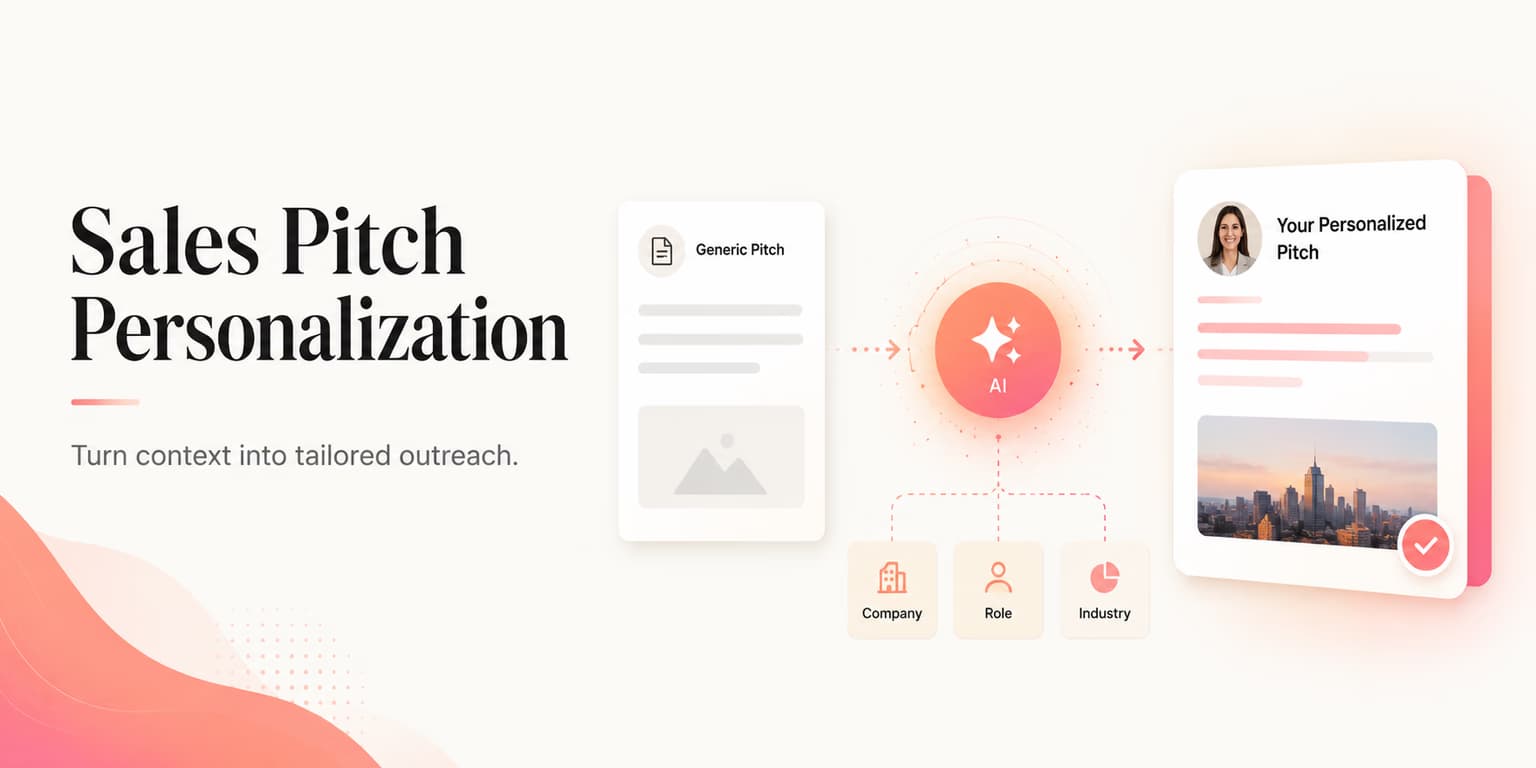
Omentir is built to do this kind of customization at scale. By pulling details from your product profile and matching them with a prospect's role and company context, the system drafts relevant outreach automatically. Here is how to structure a modular sales pitch that books meetings.
The important word is relevance, not personalization. Personalization says "I noticed something about you." Relevance says "that thing may connect to a business problem you care about." The second version earns attention because it respects the buyer's work instead of using trivia as a hook.
The three-part anatomy of a modular sales pitch
A useful cold message on LinkedIn should be short, low-pressure, and relevant. Structure your pitch into three core components:
- The Context Hook: The opening sentence that explains why you are reaching out right now. This should reference a real-world event, such as department hiring, a promotion, or a recent post.
- The Contextual Value: A single sentence explaining how you help companies like theirs solve a specific challenge related to the hook, backed by a brief proof point.
- The Friction-Free Offer: A low-commitment call to action (CTA) that asks for permission to share a short video, checklist, or guide, rather than demanding a 30-minute meeting.
This modular structure makes your copy flexible and easier to reuse.
A modular pitch should still read like one human sentence chain. The context hook should naturally set up the value sentence, and the value sentence should naturally set up the question. If the blocks feel like three unrelated snippets stitched together, the buyer will feel the automation even if every variable is technically correct.
Here is a simple before-and-after. Bad: "Saw you are hiring. We help companies scale outbound. Want to chat?" Better: "Saw you are hiring two SDRs and a RevOps lead. Usually that creates pressure around lead quality before the new reps ramp. Are you already tightening that workflow?" The second message is not longer because it is fancy. It is better because the premise is specific.
The pitch framework
Avoid pitching a meeting in your first sentence. Focus the opening on their business, introduce your proof point, and end with a simple question: "Open to taking a look at a short 2-minute video?"
Sourcing company and role context programmatically
Writing personalized messages by hand for every prospect is slow. To scale your outbound pipeline, automate the sourcing of company and role context.
This context can be pulled from several places. Look at company page updates on LinkedIn, hiring filters in LinkedIn Sales Navigator, and firmographic data from platforms like Apollo.io or enrichment systems like Clay.
Do not treat all context as equal. A current job posting is usually more useful than a generic industry tag. A founder's recent post about pipeline issues is more useful than a company description. A technology mentioned in an active role is more useful than a stale database field. Your system should prefer context that is recent, role-relevant, and easy for a human reviewer to verify.
The safest sourcing rule is this: if you cannot point to the source in one click, do not put the claim in the message. Use unverified data for internal scoring, not outward-facing copy.
Designing modular templates with dynamic variables
Instead of simple placeholders like [First Name] and [Company], design complex variables that change entire sentences based on target data.
For instance, create a variable called hiring_trigger. If a company is hiring, the variable swaps in: "saw your department is currently expanding and listing openings for [Role]." If they are not hiring, it defaults to: "saw you are managing the development workflow at [Company]."
This modular structure ensures your copy reads naturally, regardless of which data is available. For more template ideas, check out our guide on writing personalized sales pitches.
Build fallback variables deliberately. If hiring_trigger is missing, do not fall back to a fake-sounding line like "noticed your impressive growth." Use a neutral role-based opener instead: "Given you own outbound at [Company]..." A boring truthful fallback is better than a polished guess.
You can also create variables for tone. A founder-to-founder note can be direct and informal. A message to a VP at a larger company should sound more measured. A referral follow-up should be warmer and shorter. Personalization is not only what you mention; it is also how much pressure you apply.
Validating sourced context to prevent hallucinations
Automated data enrichment is rarely perfect. Web scrapers pull stale job listings, and LLMs make mistakes when summarizing profile details. If you send a message with incorrect facts, you lose credibility instantly.
This is why a human-in-the-loop review queue matters. Omentir handles this by staging all AI-drafted messages inside your workspace drafts. The system does not send messages automatically; it generates the copy, links the target profile, and highlights the variables, leaving you to click approval. For detailed templates, read our review of personalization at scale frameworks.
Validation should catch three failure modes. First, the data may be wrong. Second, the data may be true but irrelevant. Third, the data may be relevant but too sensitive or awkward to mention. A good review queue helps you reject all three before the prospect ever sees the message.
The review question is not "does this sound personalized?" It is "would this person understand why I sent this message today?" If the answer is no, rewrite the hook or remove the lead.
Handling common B2B objections in your first touch
The most common objections you will face in cold outreach are: "we already have a solution," "no budget," and "we are too busy." You can lower those hurdles by addressing them directly in your copy.
For example, if you target companies using a major competitor, do not write a generic pitch. Acknowledge their setup and frame your value as an add-on or a simpler alternative:
"Hi [Name], saw you guys are using [Competitor] for email sequencing. Most groups find that adding a human-paced social layer increases booked calls without replacing their core email stack."
This shows that you respect their current setup while offering a specific improvement. You can find more copywriting rules in our guide to the AI sales pitch workflow.
Objection-aware copy should stay subtle. Do not write a defensive paragraph before the prospect has even replied. Instead, use one phrase that lowers friction. For budget concerns, offer a small audit instead of a purchase conversation. For timing concerns, ask whether it is worth revisiting later. For competitor concerns, position your product as a layer or workflow improvement rather than a rip-and-replace project.
Pacing and delivering personal pitches safely
Even the most personalized message will fail to perform if it is sent via unsafe automated browsers. LinkedIn's algorithms flag profiles that send messages too quickly or trigger volume limits, leading to restrictions or bans.
To protect your account, configure your campaigns to respect daily direct message quotas. Space out your outreach, schedule actions within natural working hours, and review your response queues regularly. Omentir coordinates these parameters automatically, sending messages through secure, human-paced queues that mimic real user behavior.
Personalization does not excuse aggressive delivery. If anything, stronger personalization should make you more selective. A small batch of relevant notes gives you cleaner feedback than a huge batch of mixed-quality messages. When replies come in, you can see which hooks worked and which segments should be paused.
SOP: the personalization audit checklist
Use this simple audit routine to review your message drafts before clicking send:
- Confirm Relevance: Is the hook based on a real company or profile event rather than university or location data?
- Check length: Is the message under 100 words? Can a prospect read it on a mobile screen in 10 seconds?
- Validate Tone: Does the copy sound like a personal note from a founder or colleague, rather than corporate marketing speak?
- Audit CTA: Does the closing sentence ask for permission to share a value resource instead of asking for a calendar meeting?
- Ensure Safety: Is the campaign set to send within your daily safety quotas?
Add one qualitative check: remove the prospect's name and company from the message. If the note could still be sent to fifty other people, it is not personalized enough. If the note depends on one truthful signal that belongs to that buyer, it is probably ready.
Keep a small library of approved hooks by signal type. Hiring hooks, funding hooks, tool-stack hooks, founder-post hooks, and referral hooks all need different language. This library gives the AI strong patterns without forcing every message into the same template.
Earning the prospect's attention
Outbound in 2026 is won on relevance. Replace generic templates with modular, signal-led message patterns, and you can write copy that buyers actually answer.
Use Omentir to manage the logistics of your campaign. Ground your drafts in your product profile, configure modular templates with dynamic variables, and let the system queue up personalized outreach notes safely.
The best sales pitch does not feel like a pitch at first. It feels like someone noticed a real business context and asked a reasonable question. Build your modular system around that standard, and personalization becomes a quality control process rather than a gimmick.
Frequently asked questions
Reference points like shared schools or sports teams feel manipulative because they are unrelated to the buyer's professional goals. True personalization focuses on the buyer's department growth, public announcements, or job changes.
Modular messaging uses dynamic placeholders (like recent team hiring, specific competitors, or industry signals) that swap in custom sentences based on company data. This allows each message to read as if it was written individually.
Yes, provided the AI is grounded in verified company and profile facts. Omentir writes custom notes based on the prospect's role and product profile details, saving drafts for manual review to ensure quality.
Keep your first message short enough to read on a phone without effort. In practice, that usually means one clear hook, one value sentence, and one low-pressure question.