
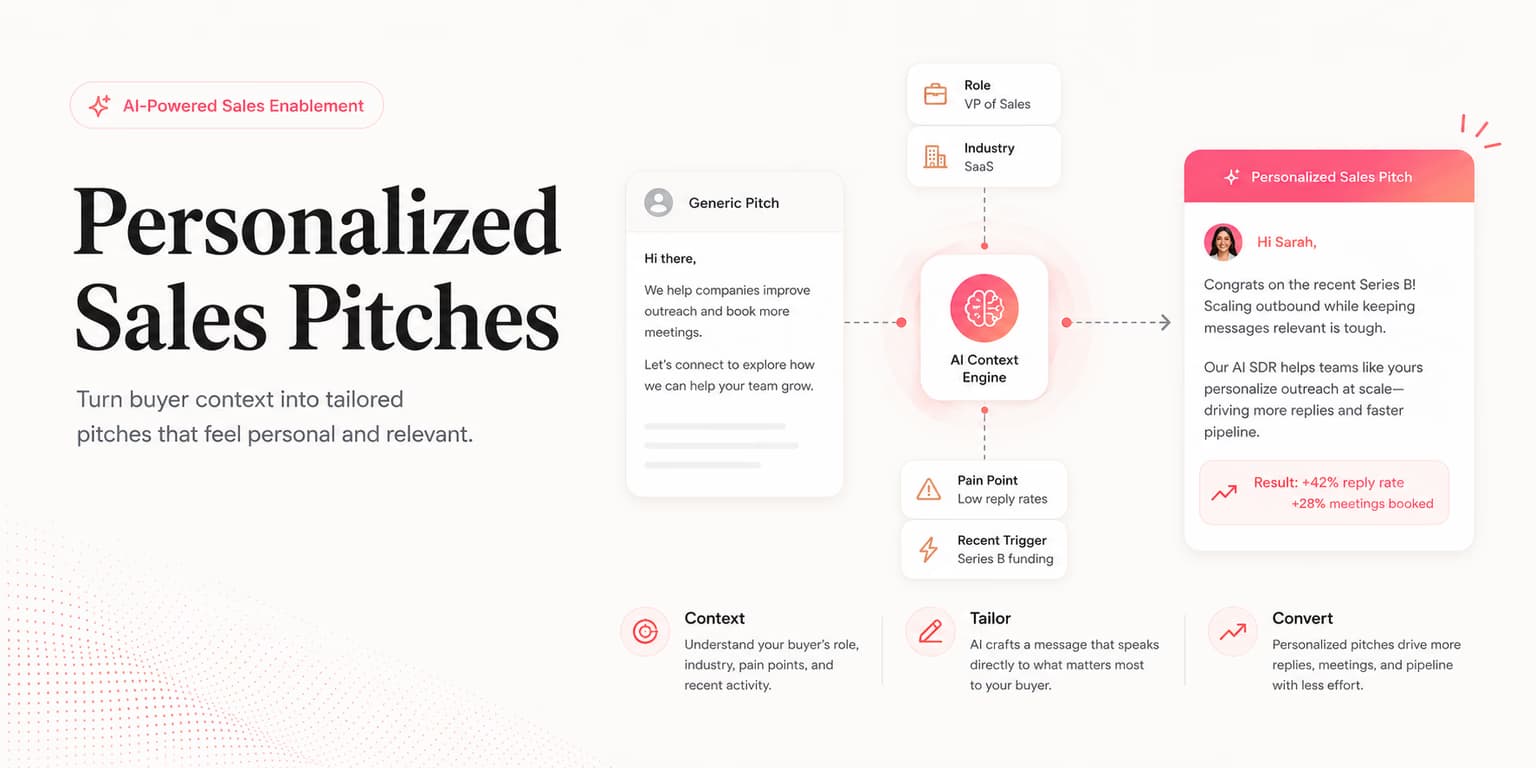
A personalized sales pitch is not a normal pitch with a name inserted. It is a message that explains why this buyer, at this company, at this moment, should care enough to answer.
That distinction matters on LinkedIn because buyers can feel the difference quickly. A surface-personalized note says, "Saw your company is growing." A genuinely personalized pitch says, "Hiring your first RevOps lead usually means outbound handoffs are getting harder to manage. Is that already a formal process for you?"
This article is about building the finished pitch. If you want the broader strategy for turning product facts into buyer language, read the AI sales pitch guide. If you want reusable structures, use the LinkedIn pitch templates.
Personalization is a reason
The point of personalization is not to prove you researched the buyer. The point is to give the pitch a fair reason to exist.
A weak personalized pitch mentions a detail and then jumps to a generic offer. "Congrats on the launch. We help teams save time." The launch is decoration. It does not explain why the pitch belongs in the buyer's inbox.
A stronger version ties the detail to a plausible operating problem. "Congrats on the launch. When a new product motion starts pulling in more founder-led demos, teams often need a cleaner way to prioritize which replies deserve attention first." Now the launch matters.
Personalization rule
If the personalized detail does not change the problem, proof, or question, remove it. Flattery without relevance makes the pitch feel assembled.
Six-layer pitch stack
Build personalized sales pitches from six layers. You do not need all six in the final message, but you should understand all six before you write.
- Account context: what is true about the company, stage, market, team, or business model.
- Person context: why this person likely owns or influences the problem.
- Timing signal: what makes the message reasonable now, not six months from now.
- Problem hypothesis: the friction that often appears around that context.
- Credible proof: what you can safely show, claim, compare, or offer.
- Low-friction ask: a question or next step the buyer can answer without committing to a meeting too early.
This stack prevents the pitch from turning into a product summary. The buyer should recognize their world before they hear about your offer.
The stack also helps teams avoid accidental over-personalization. You do not need to mention every personal detail you found. You need enough context to make the business reason feel fair, specific, and easy to answer.
Start with the first three layers, then decide whether the evidence is strong enough to write. If account context, person context, and timing are all weak, the pitch will lean on guesswork.
The LinkedIn lead scoring rubric is useful here because it helps you decide whether a prospect has enough evidence for a personalized pitch at all.
Choose one angle
Personalization gets messy when a message tries to use every fact you found. A buyer does not need your whole research file. They need one relevant angle.
Pick the angle that best connects the buyer's current situation to your strongest proof. If the company is hiring, the angle might be scaling handoffs. If the buyer posted about pipeline quality, the angle might be lead review. If they replied with a timing objection, the angle might be a lightweight nurture path.
| Signal | Personalized angle | Avoid |
|---|---|---|
| Hiring sales roles | Keeping outreach quality consistent as volume grows. | Assuming the team is failing. |
| Founder posts about growth | Turning interested replies into focused demo conversations. | Using the post as a fake compliment. |
| Accepted connection | Continuing the original reason for connecting. | Sending a pitch with no bridge. |
| Warm reply | Answering the buyer's stated problem directly. | Restarting the cold sequence. |
One angle makes the message easier to answer. Multiple angles make the buyer choose which part to respond to, which usually means they respond to none.
If two angles both seem strong, write two separate versions and choose the one with the clearest evidence. The winner is not the cleverer pitch. The winner is the one a busy buyer can understand without rereading.
Write the first version
Use a four-sentence first draft. Sentence one names the signal. Sentence two names the problem hypothesis. Sentence three gives proof or a useful offer. Sentence four asks one low-friction question.
"Saw you are hiring your first two SDRs. Teams at that point often start feeling the gap between lead volume and lead review quality. We help founders keep LinkedIn outreach focused on ICP-fit buyers and warm replies. Is lead review already handled cleanly for you, or still founder-owned?"
This pitch is not perfect for every buyer. That is the point. It is grounded in one signal and one operating question. A sales leader at a mature company would need a different version.
After the first draft, cut anything that explains your company before the buyer's situation. The buyer should not have to read three product nouns before understanding why you reached out.
If you are using an AI assistant to draft, give it the six layers and ask for three versions with different levels of directness. Then choose the version that sounds most like something you would actually send.
Do not let the first version become precious. A first draft is only a way to expose the sales logic. If the signal feels weak, go back to research. If the problem feels too broad, narrow the buyer. If the proof feels thin, change the ask from "book time" to "useful if I send the checklist?"
Make it answerable
Many personalized pitches fail because the ask is too large. The buyer might agree with the problem but still avoid replying because the next step feels like a meeting request in disguise.
Make the pitch easy to answer. Ask whether the problem exists, whether you are early, whether the process is already owned, or whether a short example would be useful.
- Good ask: "Is that already handled cleanly, or still a bit manual?"
- Good ask: "Is this on your radar this quarter, or am I early?"
- Good ask: "Useful if I send the short checklist?"
- Hard ask: "Do you have 30 minutes tomorrow for a demo?"
The demo ask has a place, but usually after the buyer confirms relevance. For the handoff from interest to meeting, use the LinkedIn demo booking playbook.
A good answerable pitch gives the buyer three graceful exits: "yes, that is relevant," "not right now," or "not my area." All three are useful. A message that only allows "book a meeting" or silence teaches you much less.
Before and after examples
The easiest way to improve a pitch is to compare the surface-personalized version with the reason-personalized version.
Before
"Congrats on the growth at Acme. Omentir helps companies automate LinkedIn outreach with AI. Would you like to see a demo?"
After
"Congrats on the new sales hires. When founders move from founder-led outreach to a small sales team, the first messy part is usually deciding which LinkedIn replies deserve attention. Is that already owned by the team, or still landing with you?"
The after version does not pitch everything. It uses the growth signal to ask about one specific transition. That makes the buyer's reply easier.
Another after version
"Your post about pipeline quality hit a nerve. A lot of teams can source more leads now, but the hard part is knowing which conversations are worth a founder's time. Is lead quality the bottleneck for you, or more the follow-up motion?"
That version uses a public point of view instead of a company trigger. Both are personalized, but they personalize around different evidence.
Notice what both after versions avoid. They do not claim the buyer has a hidden problem. They do not overstate urgency. They do not use the researched detail as a compliment. They use the detail to open a specific business question.
Quality check
Before sending a personalized pitch, run a short review. The review should be stricter than your ego. A clever sentence that does not help the buyer answer should go.
- Signal test: can the buyer see why this message arrived now?
- Specificity test: could this be sent unchanged to 100 people?
- Truth test: does every claim come from something you can verify?
- Pressure test: does the ask match the warmth of the relationship?
- Mobile test: does the message feel readable on a small screen?
Omentir is built around this same order: find ICP-fit buyers, score the lead, draft personalized outreach from real context, follow up at human-paced limits, and collect replies in one inbox sorted by intent. The pitch works because it starts from the buyer evidence, not because it sounds impressive in isolation.
Review the pitch again after the first ten replies. If people say "not my area," your person context is weak. If they say "not a priority," your timing signal is weak. If they ask "what do you do?" your pitch is too vague. Replies are feedback on the personalization system. They tell you which layer failed.
Personalized sales pitches are not about writing longer messages. They are about making a shorter message carry a better reason. When the reason is clear, the buyer knows exactly what to answer.
FAQs
A personalized sales pitch uses a real buyer signal, a role-specific problem, relevant proof, and a next step that fits the buyer's current context. A first name or company variable is not enough.
For LinkedIn, keep most pitches under 80 to 120 words. Shorter is usually better when the signal is clear and the question is easy to answer.
Yes. A template can provide structure, but the signal, problem hypothesis, proof, and question must be rewritten for the specific buyer.
Mentioning a surface detail without connecting it to a business reason. The buyer should understand why the detail matters to the conversation.