
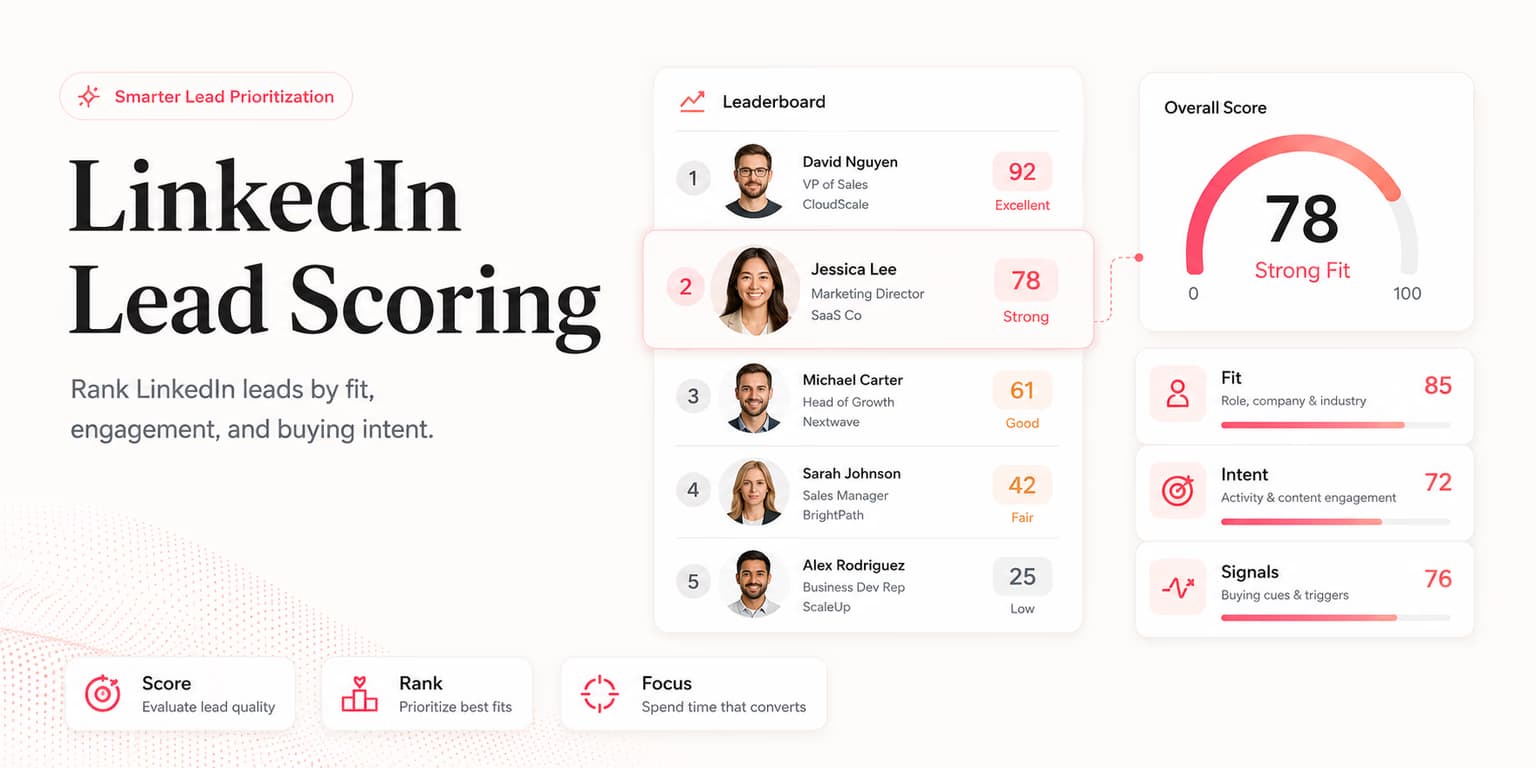
LinkedIn lead scoring should answer one question: what should we do with this person next? If the score only ranks names from high to low, it is not enough. A useful score tells you whether to research, connect, message, follow up, pause, or hand the conversation to a human.
The channel matters. A lead on LinkedIn is not just a company record. You can see profile context, activity, mutual connections, posts, comments, accepted requests, and replies. Those signals should influence both priority and message style.
This article is narrower than the broader AI lead qualification framework. That guide explains how to audit fit before outreach. This one gives you a LinkedIn-specific scoring system you can use in a campaign queue.
Score for action
The wrong way to score leads is to chase the prettiest number. A 94 out of 100 looks precise, but it does not tell the seller what to do. It also creates false confidence when the inputs are messy.
The better approach is scoring for action. Every score band should map to a concrete decision. Low fit gets rejected. Medium fit gets more research. Strong fit with weak timing goes into nurture. Strong fit with active intent gets immediate human attention.
This keeps the system honest. If a score cannot change the next step, you do not need that score. If a score can move a lead from "research" to "send a connection request," it deserves a place in the workflow.
Scoring rule
Never approve a lead because the total looks high. Approve it because the score explains why the person fits, why now is reasonable, and what the next message should reference.
The five inputs
A LinkedIn score needs inputs that are visible on the platform and useful for outreach. Do not mix every data point into one pile. Separate the evidence so the reviewer can see what is strong and what is missing.
- Account fit: company size, market, business model, location, and whether the account resembles your best customers.
- Person fit: role ownership, seniority, department, influence, and whether the person can care about the problem.
- Timing signal: hiring, launches, funding, expansion, leadership changes, tool changes, or visible workflow pressure.
- Relationship context: accepted connection, mutual contact, group, event, post interaction, profile view, or previous conversation.
- Conversation intent: replies, objections, questions, referral notes, pricing curiosity, or explicit interest.
These inputs are intentionally practical. They do not require guessing budget, private priorities, or internal politics. If the evidence cannot be observed or explained, it should not carry much weight.
For early prospecting, account fit and person fit matter most. For active outreach, relationship context and conversation intent start to matter more. The scoring model should update as the lead moves from sourced profile to live conversation.
You can also weight the inputs by campaign type. A founder-led validation campaign may accept weaker relationship context if the account fit is excellent. A high-ticket enterprise campaign may require stronger relationship context before any message is sent, because the cost of a poor first impression is higher.
The weighting should be written down before the list is reviewed. If the team changes the rules after seeing the leads, it will unconsciously rescue prospects it already wants to contact. Written weights keep the scoring system from becoming a justification machine.
Point system
Keep the scale small. A 0 to 3 score for each input is usually enough. It forces discipline and makes review faster.
| Score | Meaning | Example |
|---|---|---|
| 0 | No evidence or active mismatch. | Wrong company type, wrong role, or no visible reason to reach out. |
| 1 | Weak but possible evidence. | Title suggests relevance, but the account and timing are unclear. |
| 2 | Good evidence with one gap. | Strong account and role fit, but no recent timing signal. |
| 3 | Strong observable evidence. | Clear ICP fit, owned problem, recent trigger, or direct buyer question. |
The total possible score is 15. That is enough to prioritize without pretending the model knows more than it does. Add a short evidence note beside each component so reviewers can inspect the reasoning.
A lead with 11 points can be excellent if the score is concentrated in fit and timing. A lead with 11 points can also be weak if it earned points from shallow relationship signals but has no real business reason. Component scores matter more than the total.
Recency and decay
LinkedIn signals go stale. A profile view yesterday is different from a profile view six months ago. A hiring post from last week is more useful than a company announcement from last year.
Add a recency rule to the score. Strong timing signals should decay if no follow-up action happens. Relationship signals should decay more slowly, because a connection or prior reply can remain useful for future context.
- Fresh: within the last 7 days, use it directly in the message if relevant.
- Recent: within the last 30 days, use it as context but avoid acting like it just happened.
- Stale: older than 90 days, keep it as background unless a new signal confirms it still matters.
Decay protects your copy. "Saw your recent launch" is useful only when the launch is actually recent. If the wording overstates recency, the message feels automated even when the lead is a good fit.
Recency also prevents queue bloat. If a lead has been sitting in "priority outreach" for weeks with no action, lower the timing score or move it into nurture. A high-priority label that never expires stops meaning anything.
Worked examples
Imagine you sell software that helps B2B SaaS teams turn LinkedIn outreach replies into qualified demos. Here is how three prospects might score.
Prospect A: founder at a 20-person SaaS company, recently posted about founder-led sales, accepted your connection, no reply yet. Score: account 3, person 3, timing 3, relationship 2, intent 0. Action: send a contextual first message, not a demo ask.
Prospect B: sales manager at a large enterprise, viewed your profile twice, but the company sells into a market you do not serve. Score: account 0, person 2, timing 0, relationship 1, intent 0. Action: reject or research a better-fit business unit.
Prospect C: VP Revenue at a 90-person SaaS company, hiring SDRs, replied "curious how this works." Score: account 3, person 3, timing 3, relationship 3, intent 3. Action: answer directly, qualify, and offer a short call.
The important part is that each score produces a different next step. Prospect A needs a thoughtful first message. Prospect B should not receive a generic pitch just because there was a profile view. Prospect C should be handled like an active opportunity.
Thresholds and next steps
Once the scoring inputs are clear, set thresholds that control the queue. Do not let every lead become a send decision.
- 0 to 5: reject, archive, or keep out of the campaign.
- 6 to 8: research more before messaging.
- 9 to 11: add to outreach if the message angle is specific.
- 12 to 14: prioritize for near-term outreach or careful follow-up.
- 15: review immediately, because the buyer may already be in motion.
Use these thresholds as a starting point, not a law. If your market is narrow and high value, you may review lower-scoring accounts manually. If your market is broad, you may require stronger timing before approving a send.
Add one override rule for strategic accounts. A prospect can be below the normal threshold and still deserve research because the account is unusually important. The override should not approve outreach automatically; it should move the lead into manual review with a note explaining why.
This is where a workflow like warm LinkedIn leads connects with scoring. Once a lead replies or shows intent, the score should update and the sequence should pause for a human-quality next step.
Review loop
A scoring system should improve every week. Review a sample of approved leads, rejected leads, and replies. Ask which scores predicted good conversations and which ones created false positives.
Pay special attention to leads that replied with "not my area" or "we already solved this." Those replies are gifts. They tell you the person fit, timing fit, or problem fit was wrong.
Track false negatives too. If a low-scored lead later books a meeting through another channel, inspect what the rubric missed. Maybe the account fit was strong but the LinkedIn profile was quiet. Maybe the buyer used a nonstandard title. Those cases help you improve without lowering standards for everyone.
Omentir helps with this loop by finding ICP-fit buyers, drafting personalized LinkedIn outreach, following up at human-paced limits, and collecting replies in one inbox sorted by intent. The scoring system is the front door: it decides which leads deserve that workflow and what evidence the first message should use.
If you are still building the lead queue itself, start with AI LinkedIn prospecting. Better scoring cannot rescue a source that keeps producing the wrong accounts.
The simplest test is this: when a seller opens a scored lead, can they tell why the person matters and what to do next in under thirty seconds? If yes, the score is helping. If not, simplify the rubric until the next action is obvious.
FAQs
LinkedIn lead scoring is the process of ranking prospects using LinkedIn-specific evidence such as role fit, profile context, company timing, activity, relationship signals, and reply behavior.
Use one total for prioritization, but keep the component scores visible. A single number hides whether the lead is strong because of ICP fit, timing, relationship context, or actual intent.
Scores should change whenever a meaningful signal appears or expires: a new reply, accepted connection, company trigger, recent post, objection, or stale timing window.
AI can score and explain LinkedIn leads well when the rubric is explicit and every score cites evidence. Humans should review edge cases and high-value accounts before outreach.