
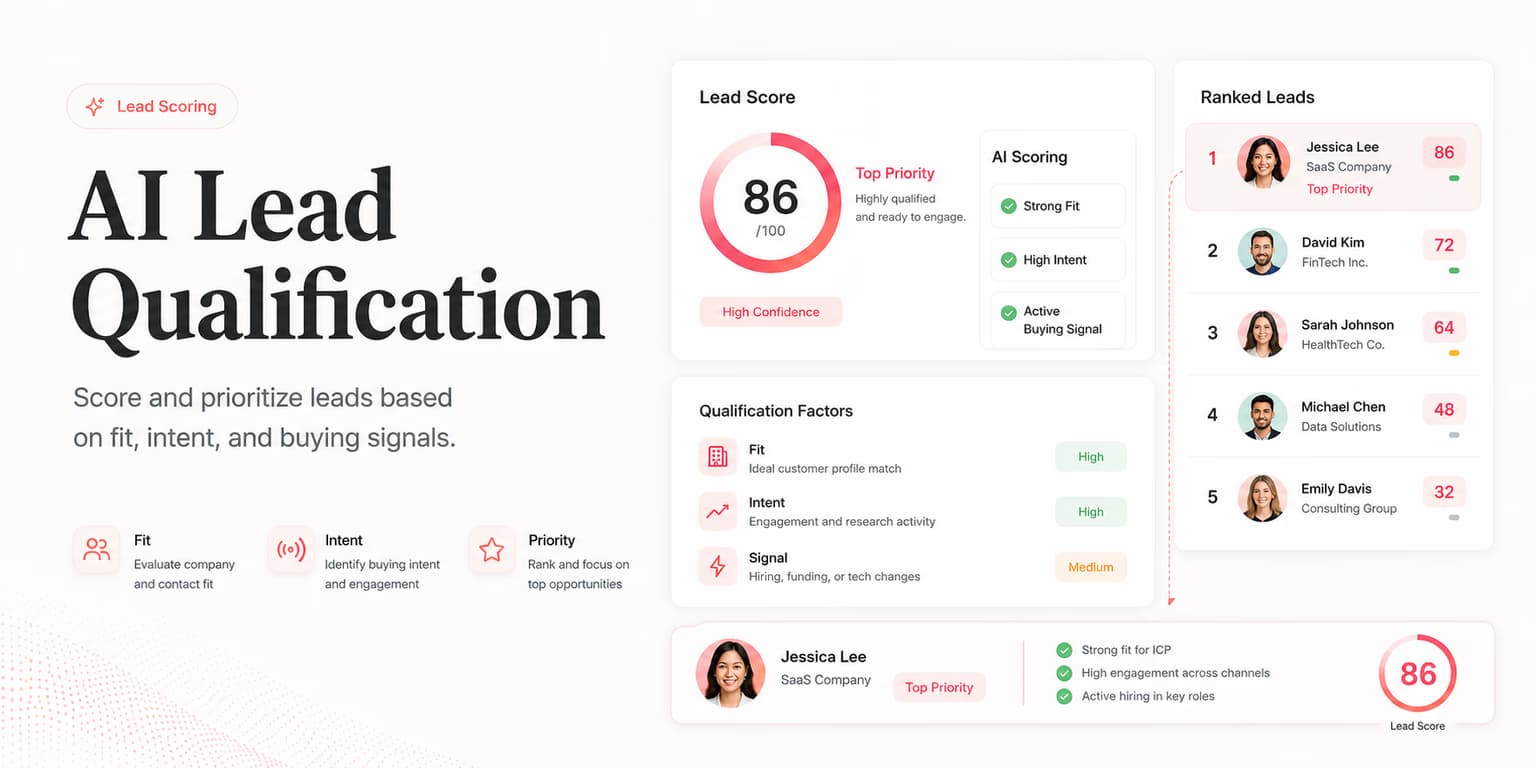
AI lead qualification is not about giving every prospect a fancy score. It is about deciding who deserves outreach, who needs more research, and who should be rejected before your brand spends a message on them.
That distinction matters because most outbound failures start before copywriting. A message can be well written and still fail if the account has no problem, no timing signal, no authority path, or no reason to trust the outreach. Better qualification protects the buyer, the sender, and the pipeline.
This guide is for founders and lean sales teams that want a practical scoring system before launching campaigns on LinkedIn or email. It is different from a broad architecture discussion of how AI sales agents qualify leads. Here, the deliverable is a rubric your team can actually inspect.
Qualification before personalization
Personalization is expensive. Even when AI drafts the first version, a good message still needs a real reason, a clean angle, and a human review path. That work should not be spent on every name that matches a job title filter.
Run qualification first. The AI should inspect the lead against your ideal customer profile, explain the fit, find evidence for urgency, and name the disqualifiers. Only after that should it draft a message.
This sequence prevents a common failure: using AI to make bad leads sound researched. A weak-fit lead with a polished opener is still a weak-fit lead. It might even be worse because the prospect can tell you spent effort on an irrelevant approach.
Operating rule
If the AI cannot write a one-sentence reason the prospect is likely to care now, the lead should not move into outreach yet.
Qualification also makes learning cleaner. When a campaign underperforms, you can inspect whether the problem was the list, the message, the channel, or the follow-up. Without a qualification record, every failed campaign becomes a vague debate.
The six-part score
A useful AI lead qualification score should be broken into parts. A single number hides too much. You want to know whether the lead failed because the company was wrong, the person was wrong, the timing was weak, or the evidence was thin.
Score each lead across six dimensions from 0 to 3. Keep the scale small so reviewers can make fast, consistent calls.
| Dimension | What AI checks | High-score signal |
|---|---|---|
| ICP fit | Company type, size, market, model, and geography. | The company matches your best customers, not just a broad industry label. |
| Pain fit | Whether the account likely has the problem you solve. | Public evidence points to a workflow constraint your product directly addresses. |
| Timing | Recent triggers such as hiring, launch, expansion, migration, or process change. | The signal suggests the problem matters this quarter, not someday. |
| Person fit | Role, ownership, seniority, and likely influence over the workflow. | The person owns or strongly influences the process you want to improve. |
| Reachability | Whether the channel and context make outreach reasonable. | The person is active enough to make a thoughtful message plausible. |
| Risk | Brand, compliance, duplication, or mismatch concerns. | No obvious reason to avoid or delay outreach. |
The output should include both the scores and the explanation. "ICP fit: 3" is not enough. The AI should write, "B2B SaaS company selling to revenue teams, 45 employees, currently hiring sales operations, matches the campaign lane."
Use thresholds, but keep them flexible. A lead with 15 total points and strong evidence can enter review. A lead with 12 points might enter nurture if the account is strategically important. A lead with high person fit but weak ICP fit should not be rescued by enthusiasm, because the message will still land in the wrong business context.
The point of the score is not to replace judgment. It is to make judgment visible. When a human overrides the score, record why, then check later whether the override produced better conversations.
Evidence quality
AI can sound confident when the evidence is weak. Your rubric needs a separate field for evidence quality so the model cannot hide a guess behind persuasive language.
Evidence quality answers a simple question: how observable is the reason for outreach? A recent job post, product launch, pricing page, founder post, or company announcement is stronger than a generic title. A guess about budget, internal pain, or urgency is not evidence.
- Strong evidence: public hiring for the role tied to your problem, a recent launch, a stated initiative, or a profile post discussing the workflow.
- Medium evidence: company category and role suggest fit, but no fresh trigger is visible.
- Weak evidence: title match only, vague industry assumption, or inferred pain with no observable source.
Require the AI to mark uncertainty plainly. A lead with strong ICP fit but weak timing should not be treated like a hot lead. It might belong in nurture, research, or a lower-priority campaign.
This is especially important for LinkedIn outreach because the message often references the qualifying signal. If the signal is weak, the personalization will feel strained. For manual research workflows, the ChatGPT LinkedIn leads guide shows how to feed structured evidence into a model without asking it to invent prospects.
Make rejections explicit
A qualification system is only useful if it rejects leads. If every prospect gets a passing score, the model has become an excuse to send more messages.
Write disqualification rules before you run the AI. These rules should be blunt enough to protect your campaign.
- Reject agencies if the campaign is built only for software companies.
- Reject companies below the size where the pain normally appears.
- Reject prospects whose role is too far from the workflow owner.
- Reject leads that require a claim you cannot prove.
- Reject duplicate accounts already active in another campaign.
Good rejection notes improve the next batch. If too many leads are rejected for company size, your search query is too broad. If too many are rejected for weak timing, your trigger definition needs work. If too many are rejected for role mismatch, your title filters are misleading.
Human review loop
Early AI lead qualification needs human review. Not forever, and not for every field, but enough to train your judgment around the model's misses. Review the first 50 to 100 leads before trusting the system with larger batches.
The reviewer should answer four questions: would I message this person, do I believe the evidence, is the reason specific enough, and what would I change in the rubric?
Review note: "Good company fit, weak person fit. The account belongs in target list, but this contact is likely too junior. Find VP Operations, Revenue Operations, or founder before outreach."
This loop turns AI from a black box into a repeatable operating system. You are not asking the model to be magically right. You are using it to apply a written rule, then improving the rule whenever reality disagrees.
Worked example
Imagine you sell software that helps customer success teams identify expansion risks before renewal. Your ICP is B2B SaaS companies with 30 to 200 employees, a growing CS team, and visible renewal or account management complexity.
A raw lead says: "Head of Customer Success at a 70-person analytics company." That is not enough. The AI should inspect company context, hiring activity, profile details, and the campaign lane before deciding what to do.
Score: ICP fit 3, pain fit 2, timing 3, person fit 3, reachability 2, risk 0. Evidence: company is hiring two CSMs, recently launched enterprise plan, prospect owns CS. Missing: no public mention of renewal workflow. Recommendation: pursue with a message about scaling CS handoffs, not a claim about churn.
That recommendation is useful because it limits the outreach angle. It does not say, "You are probably losing renewals." It says, "Your CS team appears to be scaling, and handoffs often get harder at that point." One is a risky assumption. The other is a reasonable observation.
The same lead could be disqualified if the company sells services, has no CS motion, or the prospect is an intern collecting customer quotes. AI qualification earns its place when it can explain both the yes and the no.
Handoff to outreach
Qualification should produce a usable handoff, not just a row in a table. For every approved lead, store the reason, the safest opening angle, the disqualifiers checked, and the next action.
A good handoff looks like this:
- Why this lead: scaling CS team and enterprise launch create operational complexity.
- Message angle: ask whether handoff quality is becoming harder to maintain.
- Do not say: do not claim churn, budget, or internal renewal problems.
- Next action: send a low-friction LinkedIn connection request, then follow with one contextual question after acceptance.
Omentir is built around this sequence: define the ICP, find likely-fit buyers, score the lead, draft personalized outreach, follow up at human-paced limits, and collect replies in one inbox sorted by intent. The qualification layer matters because it decides whether the rest of the workflow is worth running.
If your team is building an agent-connected version of this process, pair the rubric with the MCP LinkedIn outreach workflow. The protocol can expose lead scoring and draft creation as tools, but the scoring rules still need to be clear enough for a human to audit.
The practical test is simple: if a teammate reads the qualification record tomorrow, can they understand why this lead was approved? If yes, AI has improved the sales process. If no, it has only added a score to a guess.
FAQs
It can reject obvious weak-fit leads and rank likely-fit leads, but humans should review the first batches, inspect edge cases, and approve campaigns before live outreach.
Use public company context, role, profile notes, current triggers, and your written ICP. Avoid private assumptions and require the AI to cite observable evidence for every score.
No. A high score means the lead deserves review or outreach consideration. It does not override sending limits, brand risk, duplicate checks, or human judgment.
Scoring based on titles alone. A VP title is not a buying signal unless the account, problem, timing, and evidence all match the campaign.