
Outbound B2B campaigns need a steady sending rhythm. Sales teams set up campaigns, check their buyer lists, and send connection requests to decision makers. Connecting a new profile and immediately sending at scale will trigger restrictions.
Security algorithms on social networks watch activity velocity. If a profile that sat quiet for months starts sending connection requests at a uniform pace, security scripts will lock it.
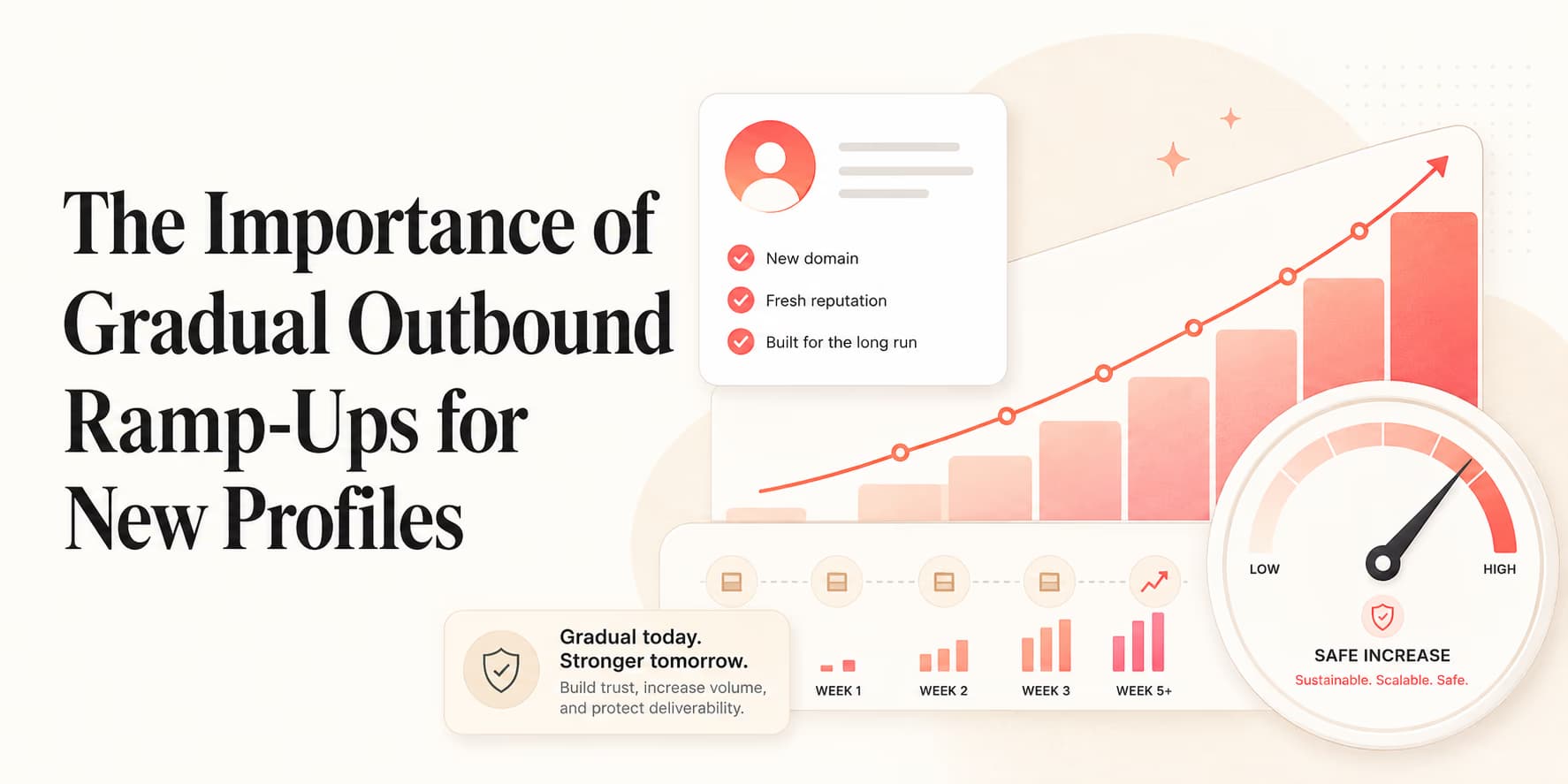
Avoiding those alerts takes patience. Scale daily activity over a 4-week curve instead of treating a new profile like an unlimited sending asset.
Omentir includes pacing settings to protect your profiles, starting at $49/month.
Choose the right starting point
There is no single safe volume for every account. A founder who has posted weekly for years, has a real network, and receives inbound replies can start higher than a brand-new sales profile with no history. The mistake is copying another team's daily limit without understanding the account underneath it.
Before setting volume, classify the sender profile. A cold profile has little activity, few recent conversations, and no predictable acceptance baseline. A warm profile has recent posts, normal browsing behavior, and existing message threads. A mature profile has a stable network, regular replies, and a history of accepted connection requests.
Cold profiles should start almost entirely manual. Warm profiles can begin with low-volume automated support. Mature profiles can ramp faster, but they still need daily caps, varied timing, and relevant targeting. The ramp-up curve should reflect trust, not ambition.
Comparing spike sending vs. gradual ramp-up outcomes
Accounts that spike volume do worse than accounts that ramp gradually:
Spike sending: Senders connect profiles and send 50 requests daily immediately. Platform security locks the account within 48 to 72 hours, resulting in low connection rates and profile restrictions.
Gradual ramp-up: Connection requests scale from 5 daily in week one to under 20 daily by week four. The profile trust score increases, acceptance rates remain high (target above 40%), and campaigns stay active.
The second path feels slower for the first week, but it compounds. A restricted account loses days to recovery, manual verification, and damaged acceptance rates. A healthy account keeps learning from every batch because the profile stays live and prospects continue seeing normal activity.
Ramp-ups also create a cleaner experiment. If you send 50 requests on day one and performance is poor, you do not know whether the problem was volume, targeting, copy, or account trust. If you send 5 to 10 carefully selected requests, you can actually read the outcomes and improve the campaign.
Staying inside safety limits keeps campaigns active, as detailed in our guide on maintaining LinkedIn account health.
Designing your gradual volume scaling curve
Scale daily invitations over a 4-week period:
- Week 1: Limit to under 5 connection requests daily (strictly manual).
- Week 2: Connect Omentir and set daily connection limits to 5 requests.
- Week 3: Scale daily connection limits to 10 requests.
- Week 4: Raise daily quotas to 15 to 20 connection requests, spacing out sends.
For warmup protocols, see our guide on warming up LinkedIn accounts.
A practical ramp-up control chart
Treat the schedule as a control chart, not a promise. The account earns the right to increase volume only if the previous week looks healthy. If the previous week produces low acceptance, angry replies, or a pile of stale pending invites, hold the line or step down.
- Green week: acceptance is healthy, replies are neutral or positive, and pending invites stay manageable. Increase by a small amount.
- Yellow week: acceptance is unclear, replies mention poor timing, or list quality looks uneven. Keep volume flat and improve targeting.
- Red week: prospects complain, verification prompts appear, or acceptance drops sharply. Pause the campaign and diagnose before sending again.
This control-chart mindset is what separates responsible automation from bulk sending. You are not trying to reach a quota at all costs. You are trying to find the highest sustainable activity level for a specific sender profile.
Data quality: excluding bad leads to prevent bounce alerts
Bad data hurts account safety. Messaging invalid accounts or out-of-market profiles drives up rejection rates and flags the account.
In a ramp-up period, list quality matters more than list size. The first 50 prospects teach the platform and your team what kind of interactions this profile creates. If those early prospects are a poor fit, the profile starts its campaign history with weak acceptance and negative feedback.
Build the first ramp-up list from your cleanest segment. Choose people who clearly own the problem, work at companies that match your ICP, and have at least one visible reason for outreach. Save the broader experiments for later, after the account has a healthy baseline.
Qualify your lead list before importing, as detailed in our guide on AI-driven lead qualification.
Safety rule: enforce daily limits
Never bypass daily volume quotas. Even with gradual ramp-ups, sending excessive messages will trigger safety checks. Keep connection invites under 20 requests per profile daily.
Copywriting: the core prompt grounding rules
Writing high-acceptance copy keeps your campaigns safe. Configure Omentir prompts to reference specific career triggers, keeping copy under 75 words, as detailed in our guide on outbound copywriting prompts.
During a ramp-up, do not test aggressive copy. This is not the moment for a hard pitch, a calendar link, or a clever pattern interrupt that might annoy people. Use simple notes that explain why you are connecting and make the recipient feel selected, not harvested.
Ramp-up opener
Hi Maya, saw your team is hiring two SDRs while expanding outbound. I work on safer lead qualification for small sales teams and thought it made sense to connect.
This message is not trying to close a meeting. It is trying to earn a connection from the right person. That distinction matters because acceptance rate is one of the earliest signals you can control.
Protecting account health with automated throttling
Outbound safety depends on pacing. Omentir enforces safe sending limits and spaces out requests using random delays.
Throttling should cover both daily volume and within-day rhythm. Sending 15 invites in the first 10 minutes of the workday is not the same as sending 15 invites across several hours. The total may be identical, but the behavior pattern is different.
A good pacing setup spreads activity across normal working windows, avoids exact repeat intervals, and stops when a human reply arrives. Once someone responds, the conversation should move out of automation and into a real sales workflow.
For pacing details, see our guide on pacing B2B campaigns safely.
Signals that mean slow down
The ramp-up schedule should never run blindly. Slow down when acceptance rate drops below your normal range, pending invites grow faster than accepts, prospects ask why they were contacted, or the sender profile starts seeing extra security prompts.
Also slow down when the team stops reviewing replies. A ramp-up is only safe if someone is reading the market's reaction. If the outbox keeps moving while replies sit unanswered, the campaign becomes automation for automation's sake.
The fix is usually simple: reduce volume for three to five sending days, tighten the ICP, rewrite the opener, and clear stale pending requests. Once the response quality improves, resume the curve gradually.
Restart after a failed ramp
If a ramp-up fails, do not immediately reconnect the same profile to a new campaign. Give the account a quiet recovery window. Stop outbound sends, answer any open conversations manually, withdraw stale pending invites, and spend a few days using the account normally.
When you restart, do not restart at the previous peak. Restart at the last volume that produced clean signals. If week three created the problem, go back to week two volume with a narrower list and a revised opener. Recovery is about proving stability again, not making up for lost sends.
SOP: the 4-week volume ramp-up checklist
Ramp up your outreach profiles using these steps:
- Week 1 (Manual): Complete profile details and manually engage on your feed daily.
- Week 2 (Automation): Connect to Omentir and set a daily connection limit of 5 requests paced safely.
- Week 3 (Automation): Scale the daily connection limit to 10 requests paced safely.
- Week 4 (Automation): Scale the daily connection limit to 15 to 20 connection requests paced safely.
- Every Friday: Review acceptance rate, reply quality, pending invites, and security prompts before increasing next week's volume.
- Any red flag: Pause, diagnose the list and copy, then restart from the previous safe volume instead of pushing forward.
Omentir handles variable mapping and safety limits. The operator still owns the weekly judgment call: increase, hold, or step down.
Keep outbound safe as you scale
Outbound B2B campaigns need safety boundaries. A gradual 4-week volume ramp-up, with paced sends, protects profiles from restrictions.
Use the four-week ramp to build a profile history that compounds. A one-week volume spike can cost you the channel. If week four still feels slow, that is the point.
Frequently Asked Questions
Social platform security algorithms monitor activity velocity. A sudden jump from zero actions to sending dozens of connection requests triggers machine learning heuristics that flag the profile as automated.
A safe volume ramp-up takes 3 to 4 weeks, scaling connection requests from 5 daily in week one to under 20 daily by week four.
Omentir dashboard lets you configure daily invite quotas, space sends with random delays using our Throttling Engine, and manage multiple accounts safely.
Yes. Senders must exclude invalid accounts and out-of-market profiles to prevent high rejection rates, which trigger safety warnings.