
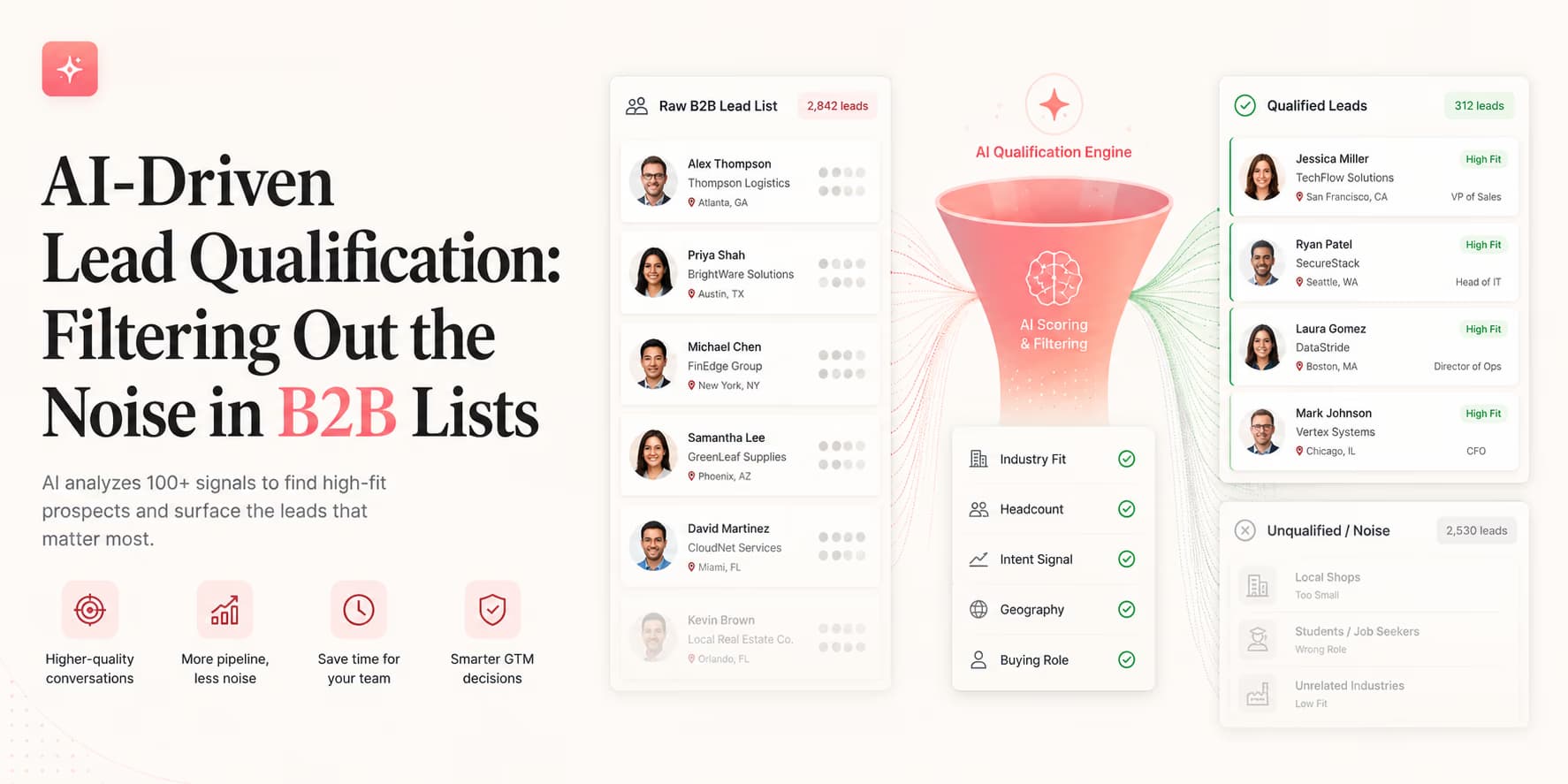
Outbound campaigns often fail because the list is wrong. Teams export directory data by industry and geography, then import it straight into a campaign. The messages go to people who were never the buyer.
Messaging unqualified leads wastes sending quotas, raises unsubscribes, and can trigger spam blocks. If reps spend hours reviewing prospects by hand, the pipeline cannot scale past that admin work.
A sustainable outbound system qualifies the list first. A multi-stage AI pipeline can drop irrelevant accounts before anyone spends a send.
Omentir runs that qualification layer against prospect profiles so campaigns hit verified buyers.
The real cost of list noise is not only lower reply rates. Bad leads also distort your learning. If half of your campaign goes to companies that cannot buy, you will blame the message, the channel, or the offer when the problem was routing. A clean qualification layer protects both your outbox and your judgment.
AI helps because it can read messy context at scale: homepages, job posts, LinkedIn descriptions, company positioning, technology pages, and public hiring signals. But AI does not magically know what a qualified buyer means for your business. You have to define the decision rules first.
Define qualified before you add AI
Before building a qualification funnel, write a plain-language definition of a good account. Do not start with a prompt. Start with your sales reality. Who can buy, who feels the problem, who is reachable, and who would be a poor use of sending capacity?
A useful qualification brief has four sections:
- Must-have fit: Company type, size, geography, role, business model, or maturity stage required for a lead to enter the campaign.
- Buying signals: Hiring, funding, product launch, technology change, new market expansion, public pain, or role changes that suggest timing.
- Disqualifiers: Consumer-only companies, agencies when you sell to SaaS, students, inactive businesses, competitors, customers, partners, or companies below your minimum size.
- Evidence required: The specific source the agent must cite before approving a lead, such as a homepage claim, job post, LinkedIn profile, or pricing page.
The evidence requirement is important. If the system cannot explain why a lead is qualified, it should not route that lead directly to outreach. "Looks relevant" is not enough. The reviewer should see the exact signal that justified the decision.
Architecture of an AI-driven lead qualification pipeline
An automated qualification pipeline processes raw lead lists through sequential filters, removing unqualified contacts at each step.
Structure the pipeline in three stages:
- Stage 1: Audience classification (separating B2B platforms from consumer services).
- Stage 2: Technical stack verification (verifying integrations and tools).
- Stage 3: ICP fit scoring (comparing site context against your buyer criteria).
In practice, add a pre-stage and a post-stage. The pre-stage cleans obvious bad data before AI spends time reading it. Remove duplicates, missing domains, personal emails when you only sell to companies, invalid profile URLs, existing customers, and previously rejected accounts. This simple cleanup prevents the model from doing expensive reasoning on records that should never have entered the list.
The post-stage routes leads based on confidence. High-confidence leads can move to message drafting. Medium-confidence leads should go to human review. Low-confidence leads should be rejected or placed in a research backlog. This keeps automation useful without letting uncertain decisions quietly become sends.
For details on list sourcing, see our guide to generating qualified leads from LinkedIn.
Stage 1: B2B vs. B2C audience classification
Broad database exports often contain B2C companies (such as local retail stores or consumer agencies) that do not buy B2B software.
To filter out these domains, set up an AI crawler to inspect the prospect's homepage copy. The crawler extracts the value proposition and checks for B2C keywords (e.g., "consumer," "storefront," or "retail").
If the crawler identifies a consumer focus, the domain is excluded from the outreach queue.
Be careful with keyword-only classification. Many B2B companies mention consumers because their customers serve consumers. A payments platform may talk about shoppers, but still sell to merchants. A healthcare SaaS product may mention patients, but sell to clinics. The classifier should read the full positioning: who pays, who uses the product, and who the homepage asks to book a demo.
Ask the model to return a structured answer:
Company audience: B2B | B2C | Mixed | Unknown
Primary buyer: {role_or_company_type}
Evidence: {homepage_line_or_public_signal}
Reasoning: {one_sentence}
Decision: approve | review | reject
This format makes errors visible. If the evidence field is weak, the lead should not advance automatically. Good qualification is not only about scoring. It is about making the scoring auditable.
Stage 2: technical integrations and competitor stack verification
Technical integrations are powerful buying signals. If your software complements HubSpot or replaces a competitor tool, you want to verify the prospect's tech stack before reaching out.
The qualification pipeline crawls public pages, reviews technical documentation, and checks header tags to identify active integrations.
This data lets you filter out accounts using incompatible setups, protecting your campaign deliverability.
Tech-stack qualification should be used carefully. Public signals are often incomplete. A website may show a CRM script, but that does not prove the sales team actively uses the platform. A careers page may mention a tool because one team uses it, not because the whole company does. Treat stack data as a signal, not as absolute truth.
Use stack checks for three decisions:
- Compatibility: Exclude accounts where the current setup makes your product impossible or painful to use.
- Personalization: Reference a relevant public integration only when it clearly relates to the buyer problem.
- Routing: Send accounts using a specific stack to the sequence, pitch, or salesperson best suited to that workflow.
Do not over-personalize from technical guesses. "I noticed you use HubSpot" can be useful if the evidence is public and relevant. "I know your sales team is struggling with HubSpot reporting" is too assumptive unless the prospect said that publicly.
Qualification rule: exclude existing clients
Ensure your qualification script checks domains against your CRM database. Pitching your product to an active customer or partner damages your brand relationship.
Stage 3: grounded fit scoring and semantic search
The final step is ICP fit scoring. Senders map prospect website text to their target buyer criteria using LLM semantic search.
The engine scores each lead on a scale from 1 to 5:
- Score 5 (perfect fit): Matches target titles, geography, tech stack, and has active buying triggers.
- Score 3-4 (moderate fit): Matches target titles and size, but has no active hiring signals.
- Score 1-2 (poor fit): Missing key targeting parameters or matches exclusion keywords. Exclude automatically.
A score is only useful if every point has a reason. Avoid black-box scores that say "4.2 out of 5" without showing the underlying evidence. The reviewer should understand whether the score came from title fit, company size, hiring activity, product category, recent trigger, or a weaker semantic match.
Use weighted scoring when some factors matter more than others. For example:
- Role fit: 30% of the score, because the wrong contact wastes the conversation even at a good account.
- Company fit: 25%, covering segment, size, geography, and business model.
- Problem signal: 25%, covering hiring, public pain, market shift, or workflow evidence.
- Reachability: 10%, covering active profile, valid domain, or recent posting.
- Exclusion risk: 10%, subtracting for competitors, customers, students, agencies, or irrelevant categories.
The weights should match your market. If your product only works with companies using a specific integration, stack compatibility may deserve more weight. If your product is horizontal but urgency matters, problem signal may matter more than company category.
Also separate account fit from contact fit. A company can be perfect while the person is wrong. A person can have the perfect title at a company that cannot buy. The best systems score both and only route leads when the account and contact are aligned.
Confidence routing: approve, review, or reject
Qualification should not produce one giant approved list. It should produce routing decisions. The most useful funnel has three lanes:
- Approve: Strong ICP fit, clear public signal, no disqualifiers, and enough evidence to draft a specific message.
- Review: Promising account, but missing one critical detail or requiring human judgment.
- Reject: Poor fit, weak evidence, duplicate record, existing customer, or clear exclusion match.
The review lane is where many teams win or lose quality. Do not treat review as failure. It is the safety valve that lets automation move quickly while preserving judgment. A human reviewer can decide whether a borderline prospect is worth research, whether the title maps to the buying committee, or whether the company signal is too weak for outreach.
Track review reasons. If many leads are marked "unclear company size," add a better enrichment source. If many are marked "wrong buyer," tighten title filters. If many are marked "signal too weak," require stronger triggers before drafting copy.
Routing qualified leads safely into paced outboxes
Once leads are qualified, they can be routed to your campaign queues. Senders must manage outreach pacing to protect account health.
Omentir manages this pacing automatically, restricting daily connection requests to safe quotas. For safety limits, see our guide on pacing LinkedIn outreach campaigns.
Qualified leads should carry their qualification context into the message draft. If the agent approves a lead because of a hiring signal, the draft should reference that signal. If the lead qualified because of a tech-stack fit, the draft should connect the stack to a real workflow problem. Otherwise the qualification work disappears before the prospect sees any relevance.
Keep send batches small enough to inspect. A clean list does not justify reckless volume. Start with a controlled batch, review reply quality, and compare outcomes by score band. If score 5 leads reply with relevant problems and score 3 leads do not, your threshold is working. If low scores outperform high scores, your model is weighting the wrong signals.
SOP: the 5-minute lead cleansing workflow
Implement this qualification checklist to clean your prospect lists:
- Step 1: Import your lead list into Omentir's dashboard.
- Step 2: Configure audience filters to classify domains as B2B.
- Step 3: Set technical stack exclusions to filter out incompatible setups.
- Step 4: Run fit scoring, excluding leads that score below 3 automatically.
Add two quality-control steps before launch:
- Step 5: Sample 20 approved leads manually and confirm the evidence matches your ICP definition.
- Step 6: Review every rejected reason category so useful edge cases are not being removed by an overly broad rule.
For the first few campaigns, keep a qualification error log. Record false positives, false negatives, weak evidence, duplicate accounts, and title mismatches. This gives you a practical way to improve the funnel instead of simply trusting the initial prompt.
Omentir automates this validation so campaigns target qualified buyers.
Focusing outbound volume on verified buyers
Outbound works when it reaches people who can buy. Unverified database exports usually mean worse deliverability and weaker replies.
By building an automated lead qualification pipeline with visible evidence, confidence routing, and human review for uncertain leads, you protect your sender reputation and learn from cleaner campaign data. The score is only useful if you can point to the field that produced it.
Frequently Asked Questions
It is the practice of running imported prospect lists through automated web crawlers and LLM classifiers to score firmographic fit and filter out unqualified contacts before campaigns launch.
Configure your AI crawler to analyze the prospect's homepage value proposition. If the text references consumers, retail, or storefront operations, classify the domain as B2C and exclude it.
Omentir runs discovery agents to verify prospect domains, check job descriptions, and score ICP fit variables, ensuring outreach campaigns target qualified accounts.
Yes. By excluding inactive domains, personal emails, and unqualified targets, you reduce bounce rates and spam reports, protecting your domain's sending reputation.