
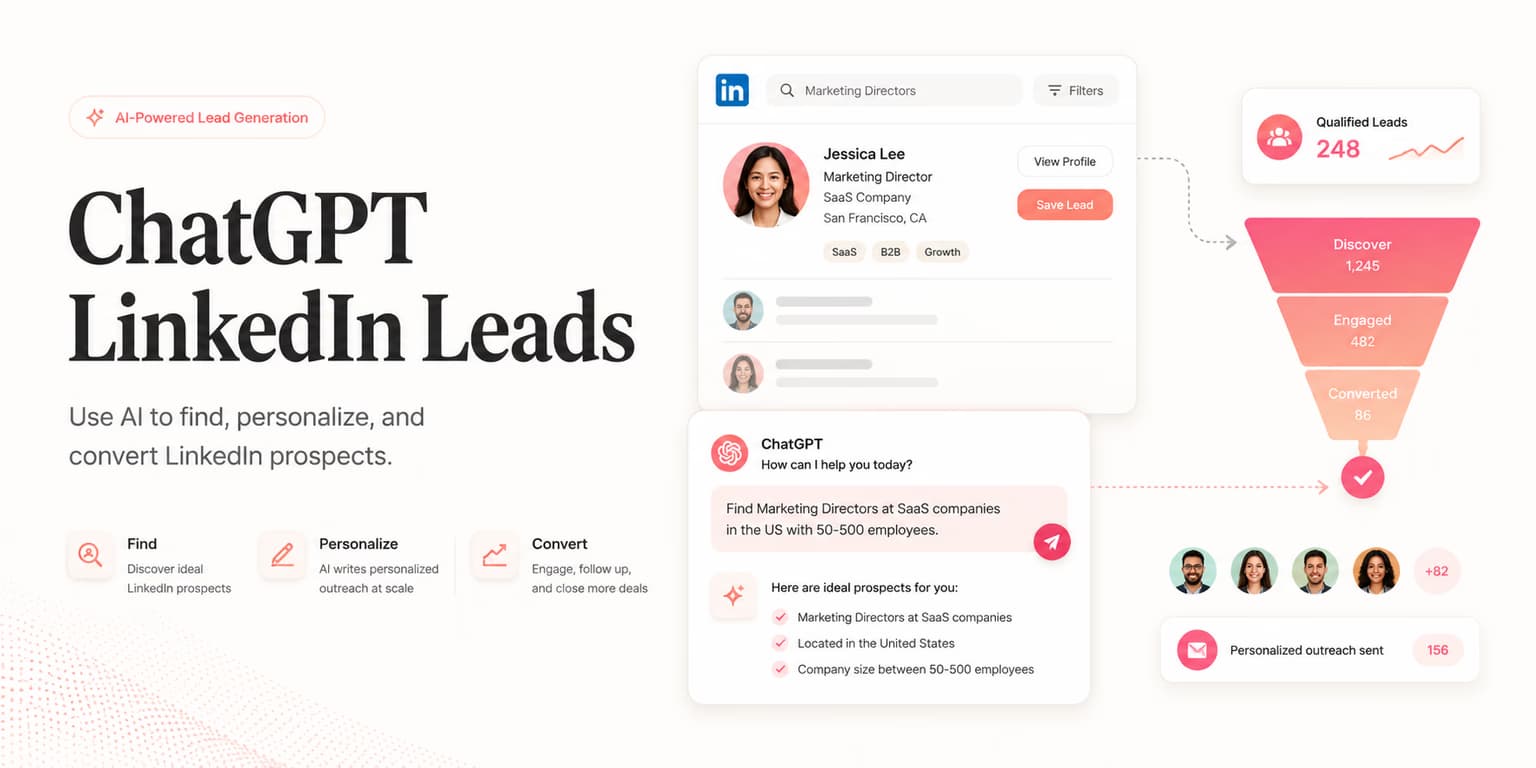
The best use of ChatGPT for LinkedIn lead generation is not asking it to magically produce a list of buyers. That gives you vague company names, stale assumptions, and profiles you cannot verify.
Use it as a judgment layer instead. Give it a tight description of your ideal customer, feed it structured snippets from LinkedIn or company pages, and ask it to decide who deserves a human-paced outreach sequence.
This workflow is built for founders and small sales teams that cannot afford to waste a week messaging the wrong people. By the end, you should have a lead list with reasons, disqualifiers, and a simple next step for every prospect.
What ChatGPT should do
ChatGPT is good at comparing messy evidence against a written rule. It can read a profile headline, company description, hiring signal, and recent post summary, then tell you whether the account matches your ICP.
It is not a dependable source of live LinkedIn data. It should not be asked to invent prospects, guess email addresses, bypass platform restrictions, or turn a broad market into a finished contact list without evidence.
The right job is qualification. You collect the observable inputs; ChatGPT turns those inputs into a decision: pursue, nurture, skip, or research more.
- Good use: classify a batch of profile snippets against your ICP and explain the strongest buying signal.
- Good use: identify which prospects need more research before you send a connection request.
- Bad use: ask for "100 SaaS founders on LinkedIn" with no source data, filters, or verification path.
- Bad use: generate fake personalization from a name and job title alone.
The operating rule
If ChatGPT cannot point to a concrete signal for why someone belongs on the list, the prospect is not qualified yet. Keep them in research, not outreach.
Build the ICP brief
Most weak AI prospecting starts with a weak ICP. "Find founders of SaaS companies" is too broad because it includes bootstrapped side projects, venture-backed infrastructure companies, agencies with software pages, and buyers with completely different budgets.
Before you collect a single LinkedIn profile, write a one-page lead brief. The brief should tell ChatGPT who buys, why they buy now, what evidence proves timing, and what evidence disqualifies the account.
Here is a practical prompt you can reuse. Replace the bracketed details with your own market, but keep the demand for evidence and disqualification.
You are helping me qualify LinkedIn leads. My product helps [specific buyer] achieve [business outcome]. My best customers are [company type, size, region, maturity]. Strong buying signals include [signal 1], [signal 2], and [signal 3]. Disqualify accounts that [bad fit 1], [bad fit 2], or [bad fit 3]. For every lead I provide, return: fit score from 1-5, best evidence, risk or missing data, and recommended next action.
The disqualification rules matter more than the positive rules. Positive filters make a list bigger; negative filters protect your calendar from bad-fit calls and protect your LinkedIn account from low-relevance outreach.
If you need help turning a broad market into specific buyer criteria, the existing Omentir guide on how AI sales agents qualify leads is a useful companion because it explains why firmographics alone are not enough.
Turn LinkedIn signals into a list
Start with a narrow source of leads, not the whole internet. LinkedIn Sales Navigator can help you build searches by role, geography, seniority, company size, and posted activity, but the same workflow also works from saved searches, event attendee lists, comments on relevant posts, or your own network.
Pull only the fields ChatGPT needs to make a decision. A useful row usually includes name, role, company, company category, profile headline, recent public signal, company trigger, and your note about why the person looked interesting.
Avoid turning this into a data-hoarding exercise. If a prospect requires ten fields before you can explain why they might buy, the account probably is not warm enough for a first pass.
- Role signal: the person owns the pain your product solves, not merely a nearby function.
- Company signal: the company has the maturity, team size, or business model that makes the pain expensive.
- Timing signal: hiring, funding, tool migration, expansion, launch activity, or public discussion suggests the pain is active now.
- Conversation signal: the profile or post gives you a respectful reason to start a dialogue without pretending you know more than you do.
Score before you message
The scoring step prevents the most common founder mistake: treating every plausible lead as outreach-ready. Plausible means "could be relevant." Qualified means "there is visible evidence that this person owns a current problem we can help with."
Ask ChatGPT to be strict. A generous model will flatter your list and mark nearly everyone as a fit; a useful model will reject prospects, flag missing evidence, and tell you what to research next.
Lead scoring rubric
- 5: clear buyer, clear pain, clear timing signal, and a natural opening line.
- 4: clear buyer and pain, but timing needs one more check.
- 3: possible fit, but the signal is weak or indirect.
- 2: interesting company, wrong person or unclear ownership.
- 1: bad fit, no visible pain, or likely outside your market.
Only 4s and 5s should move into immediate outreach. A 3 can go into a research queue, while 1s and 2s should be removed unless you have a separate nurture reason.
This is also where you separate lead discovery from message writing. Once someone is qualified, you can use a focused copy workflow like the one in Personalization at Scale, but do not ask the same prompt to qualify, personalize, pitch, and follow up all at once.
Keep the scoring notes attached to the lead after the first message goes out. When a prospect replies, those notes remind you why the conversation started and prevent the thread from drifting into a generic pitch.
Worked example
Imagine you sell a tool that helps B2B SaaS founders turn LinkedIn replies into booked demos. You find a founder whose company sells to operations teams, recently announced a new outbound hire, and has posted about struggling to keep pipeline consistent.
A weak qualification note says: "Founder at SaaS company, likely needs leads." That is not enough. A strong note says: "Founder owns growth, company appears B2B, recent outbound hire suggests active pipeline investment, and public post mentions inconsistent demos."
ChatGPT should score that lead as a 5 if your product directly solves demo booking. It should also recommend a first message that references the pipeline consistency problem, not a generic "saw your profile" opener.
Now compare that with a VP of Sales at a 2,000-person enterprise that already has a large SDR team. They may have the pain, but they probably need procurement, integrations, and a different buying process. For an early-stage founder selling a lightweight product, that may be a 3 or even a 2.
Safe weekly routine
A good LinkedIn lead workflow should feel boring. If you are constantly chasing bigger lists, sending more invites, and rewriting prompts, you are probably optimizing for activity instead of sales conversations.
For most founder-led accounts, a safer starting point is 40 to 80 researched prospects per week and a smaller number of highly relevant invites each day. Exact limits vary by account history, acceptance quality, and platform behavior, so keep the motion human-paced and avoid sudden spikes.
- Monday: collect 40 to 80 candidate profiles from one narrow search or signal source.
- Tuesday: run the scoring prompt, remove 1s and 2s, and research the strongest 3s.
- Wednesday: write connection requests only for 4s and 5s, using one real signal per message.
- Thursday: review accepted connections and send first messages that continue the same context.
- Friday: inspect replies, objections, and non-responses; update the ICP brief before collecting the next batch.
If your acceptance rate drops or replies feel confused, do not increase volume. Tighten the ICP, improve the signal quality, and revisit the connection request guidance in How to Write a LinkedIn Connection Request That Gets Accepted.
Where Omentir fits
The manual ChatGPT workflow is useful because it teaches you the shape of good lead qualification. You learn which signals matter, which titles mislead you, and which prospects produce real conversations.
Once that logic is clear, the repetitive parts should not stay manual forever. Omentir is built to search LinkedIn daily, score leads against your ICP, draft personalized LinkedIn outreach, follow up automatically, and collect replies in one inbox sorted by intent.
If you want your AI agent to run the motion, Omentir also exposes an agent-ready workflow through its hosted MCP and agent API setup. External agents can configure lead finders, search and rank scored prospects, retrieve exact lead context, inspect activity, and work with existing reply conversations.
The practical sequence is simple: use ChatGPT to clarify your lead logic, prove that the scoring rubric creates conversations, then move the repeatable discovery and outreach steps into a tool that can run them consistently.
FAQs
Not reliably. Treat ChatGPT as the reasoning layer, not the live LinkedIn data source. Give it profile snippets, company context, Sales Navigator notes, or lead exports, then ask it to classify fit and explain why.
Only paste information you are allowed to use and keep the dataset minimal. For most prospecting work, a name, role, company, profile headline, company description, and one or two public signals are enough.
A useful list has a clear ICP definition, visible buying signals, disqualification rules, and a reason for each recommended prospect. A list of job titles without context is just a prettier spreadsheet.
ChatGPT can help you reason through lead fit manually. Omentir turns the motion into a managed workflow: it searches LinkedIn daily, scores leads against your ICP, drafts outreach, and keeps sending human-paced.