
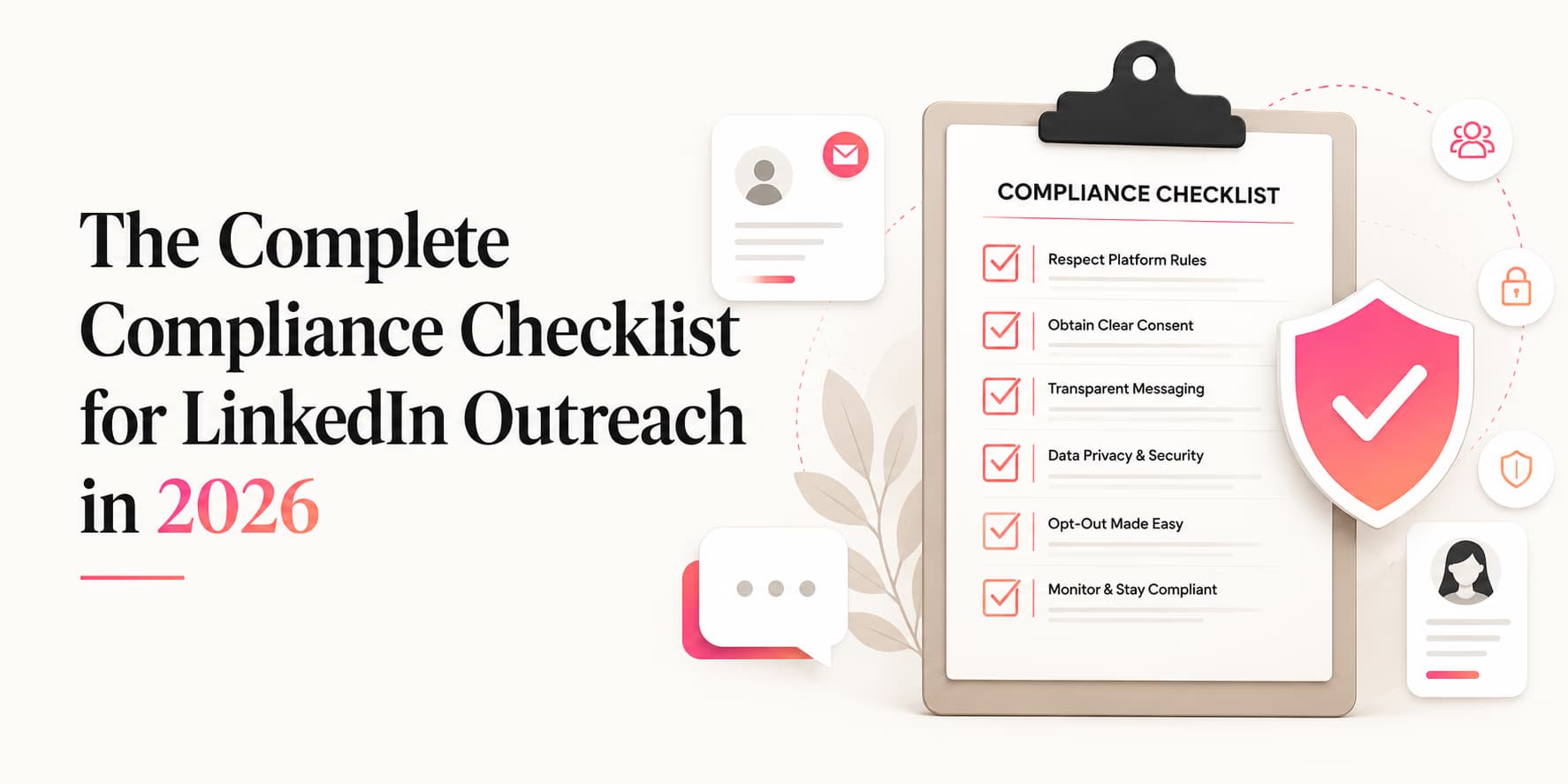
Outbound B2B campaigns still generate pipeline. Growth teams set targeting filters, write prompts, and launch campaigns at hundreds of prospects a day. Those campaigns only last if they stay inside the law and the platform's rules.
In 2026, regulators and platform filters are stricter than they were a few years ago. Teams that ignore GDPR or CAN-SPAM, or that use extensions that violate platform terms, risk fines and permanent account bans.
You do not have to stop outbound. You do have to match campaigns to data privacy rules, keep integrations honest, and send at a human pace.
Compliance here is not a legal PDF. It is the daily habits that keep a real account usable: consent, honest identity, paced sending, and a way to stop when someone asks.
GDPR: European data privacy rules
The General Data Protection Regulation regulates how companies process personal data connected to people in the European Union. In B2B outbound, personal data can include a work email, LinkedIn profile URL, job title, company affiliation, message history, or a note about why you think the person is a fit.
The practical question is not "can we message anyone in Europe?" It is whether you can explain why this specific person, in this specific role, has a professional reason to hear from you. If your only answer is "they match a broad job title," the campaign is too loose.
- Legitimate Interest: Your pitch must be relevant to the prospect's professional role. Messaging unrelated contacts violates GDPR.
- Opt-Out Mechanics: Provide a clear, low-friction way for prospects to opt out of future messages.
- Right to Erasure: If a prospect asks you to delete their details, remove them from your database immediately.
This is why the ICP definition matters for compliance, not just conversion. A narrow ICP lets you show that the outreach is tied to the recipient's job responsibilities. A vague ICP creates a legal and reputational problem because you cannot explain the necessity of processing their data.
For list discovery ideas, see our guide on generating qualified leads from LinkedIn.
Document the lawful basis before sending
Before a campaign goes live, create a short lawful-basis note for the audience. It does not need to be legal poetry. It needs to be specific enough that a teammate can read it and understand why these prospects are being contacted.
A useful note has four parts: the business problem you solve, the roles that reasonably own that problem, the data points used to identify those roles, and the reason the first message is proportionate. If any part feels embarrassing to write down, the targeting is probably too broad.
We contact Heads of Sales at B2B SaaS companies with 10-80 employees because they own outbound pipeline creation. We process name, role, company, LinkedIn URL, and public company context to determine fit. The first message is a short professional note with no sensitive data, no pressure, and a clear opt-out path.
Keep that note next to the campaign brief. When someone asks why they were contacted, your team should not scramble through Slack threads and half-remembered targeting filters. The answer should already exist.
CAN-SPAM: outbox and opt-out rules in the US
In the United States, the CAN-SPAM Act regulates commercial email. LinkedIn messages are not the same channel as email, but the operating standard is still useful: do not mislead people, make it easy to stop future contact, and honor opt-out requests quickly.
To keep campaigns inside the rules, make sure your messages:
- Avoid misleading subject headers or profile details.
- Identify your physical business address in your signature or landing page.
- Process opt-out requests within ten business days.
The FTC's business guide is especially clear on opt-outs: the mechanism should not require payment, extra personal information, or a maze of steps. For a small outbound team, that means "reply stop and I will close the loop" is often better than a clever but fragile unsubscribe process nobody monitors.
Build a real opt-out workflow
Compliance breaks when opt-outs live only in a rep's memory. A prospect says "not interested," the rep moves on, and three weeks later a different campaign touches the same person from another profile. That is how brands start to look careless.
Treat opt-outs as a shared suppression system. The moment someone asks not to be contacted, mark the person, the company domain when appropriate, and the reason. If you sell to larger accounts, keep a note explaining whether the request applies to one person, one department, or the whole company.
- Person-level opt-out: never message that individual again unless they explicitly re-engage.
- Domain-level opt-out: suppress the company when the request clearly represents the business, not just one recipient.
- Campaign-level opt-out: stop only the current campaign when the prospect says the timing or topic is wrong.
This distinction keeps the workflow respectful without overcorrecting. A polite "not right now" is different from "remove our company from your lists." Your system should let the team record the difference.
Platform rules: avoid detectable automation
Legal rules are not the only constraint. Campaigns also have to respect social network policies. Browser extensions that inject code into page DOMs, scrape aggressively, or click at robotic intervals can create account risk even when the message itself is polite.
The safer operating principle is simple: minimize suspicious behavior, keep sending human-paced, and avoid tools that ask you to hand over credentials casually. A compliance checklist should cover the toolchain, not just the copy.
This secure integration is detailed in our guide to how Unipile secures LinkedIn API routing.
Run a platform risk audit
Once a month, audit the sending setup like you would audit billing access. List every connected profile, every tool with access, every campaign currently live, and every teammate who can launch messages. Most account issues start with invisible sprawl.
The most important questions are practical. Is the profile logging in from one stable region? Are daily actions within the account's normal behavior? Are pending invites piling up? Are messages being sent after the prospect has replied? Are follow-ups stopped when the conversation becomes human?
If you cannot answer those questions quickly, pause the campaign and simplify. A slower clean setup beats a faster pipeline that burns the sender profile.
Exclude opted-out domains
Keep campaign settings from messaging domains that already opted out. Pitching someone who asked you to stop hurts the brand and breaks privacy rules.
Session security: cookie encryption and integrations
Outbound platforms have to protect data. Storing raw session cookies or passwords is a real security hole.
Omentir encrypts session data, routing campaigns via secure API layers. For safety details, see our guide on maintaining LinkedIn account health.
Protect profile health with throttling
Compliance requires pacing. A campaign that sends too much too quickly creates two problems at once: prospects feel spammed, and the platform sees behavior that does not look like a real person using the product.
Conservative teams set daily limits by profile age, acceptance rate, and recent complaint history. A new profile should behave like a new profile. A mature profile with strong acceptance can usually carry more activity, but it still needs natural spacing and a mix of normal usage.
Omentir supports human-paced campaign execution so teams can skip the blast-send pattern that causes most outbound damage. Do not squeeze the maximum action volume from a profile. Send enough well-chosen notes to fill the calendar without putting the channel at risk.
For pacing details, see our guide on pacing B2B campaigns safely.
Keep an evidence log
The best compliance habit is boring documentation. Keep a campaign log with the ICP, lawful-basis note, source of lead data, first-message template, opt-out process, daily send limits, and owner. Update it when targeting changes.
This log helps in three ways. It gives operators a clean handoff, helps managers spot risky campaigns before launch, and gives your team a factual record if a prospect or partner asks how the outreach was run.
Do not turn the log into bureaucracy. One page per campaign is enough. The goal is to make responsible outreach repeatable, not to slow the team down with a legal document nobody reads.
SOP: the 2026 outbound compliance checklist
Audit campaigns with these steps:
- Step 1: Verify that target lists contain only roles relevant to your value proposition.
- Step 2: Set up domain exclusions to prevent messaging opted-out domains.
- Step 3: Configure campaign pacing delays and daily invite quotas.
- Step 4: Route campaigns server-side to protect profile assets from detection.
- Step 5: Save a campaign evidence log before launch, including the ICP, lead source, opt-out workflow, and sender owner.
- Step 6: Review replies daily so objections, opt-outs, and buying intent are handled by a human instead of left inside automation.
Omentir handles lead discovery, message drafting, reply collection, and safety limits, but the business still owns the judgment call. No tool can decide whether your offer is relevant to a specific market. The operator must set the ICP, review the copy, and respect the people who reply.
Compliant outbound that still books meetings
Outbound lasts longer when it is legal. Match campaigns to GDPR, run a real opt-out process, and pace sending so the account stays usable.
The teams that win are not the ones sending the most messages. They are the ones that can explain why each prospect was selected, stop immediately when someone opts out, and keep the channel healthy long enough to compound learning.
Use this checklist as an operating standard, not as legal advice. If you sell into regulated markets or run large-volume campaigns across regions, involve qualified counsel. For most early B2B teams, though, the first improvement is obvious: narrow the audience, write down the reason, send like a human, and keep a clean record.
Frequently Asked Questions
Yes, if you respect local data protection laws (GDPR for EU prospects, CAN-SPAM for US email) and skip extensions that violate platform terms of service.
GDPR requires senders to establish a legitimate interest for reaching out, give a clear opt-out, and delete prospect details when asked.
Omentir connects to profiles through API pathways, encrypts login credentials, and uses a throttling engine to keep sending quotas inside safe daily limits.
Remove the prospect from your outreach sequence immediately and mark their domain as excluded in your settings to prevent future automated sends.