
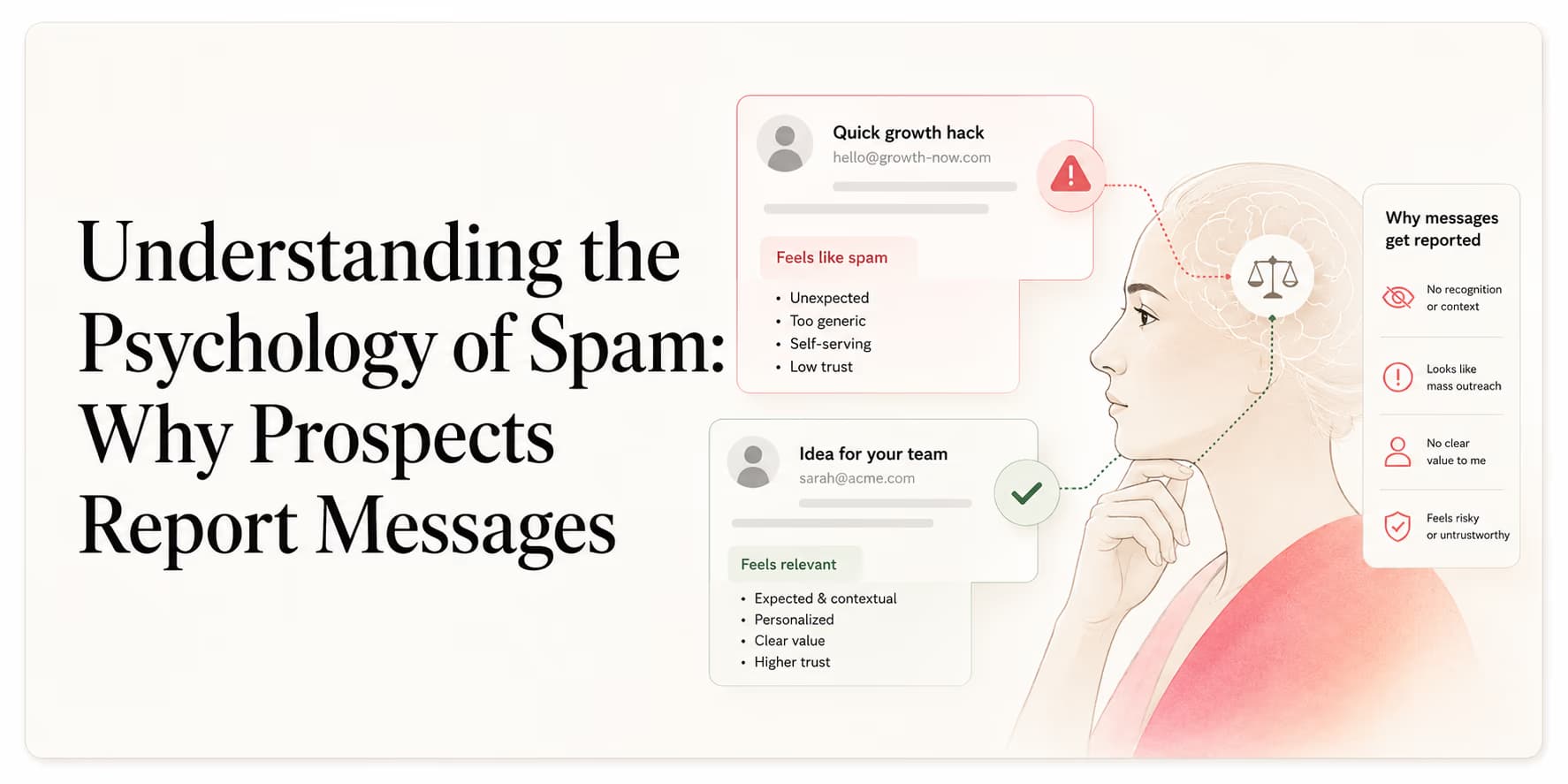
Outbound B2B campaigns require consistent outreach. Sales operations teams build target list databases, configure prompt variables, and launch campaigns targeting hundreds of prospects daily. But if your copywriting is poor, prospects will click "Report Spam."
Clicking the spam button is not a passive action. It is an active, emotional response from a prospect who feels their inbox and time are being disrespected by generic sales automation.
If your profiles receive too many spam reports, platform security filters will restrict your accounts, halting your outbound sales development.
To protect your outbox deliverability, understand the psychology of spam. If you know why prospects report messages, you can rewrite your templates to trigger curiosity instead of irritation.
Omentir helps manage this campaign quality, routing drafted messages to a review queue before delivery, starting at $49/month. The next sections cover the triggers behind spam reports.
The buyer's threat model
A buyer does not open your message with a neutral mind. They have already seen dozens of lazy pitches this month. Their default question is not "what does this person sell?" It is "is this another stranger trying to extract time from me?"
That threat model is why small details matter. A wrong title, a fake compliment, a calendar link, or a message that ignores the buyer's actual role all tell the reader that the sender did not earn the right to be in the inbox. Once that feeling appears, the spam button becomes an easy way to get rid of the message.
Good outbound lowers the perceived threat. It proves the sender chose the recipient for a real reason, asks for a small next step, and makes it easy to say no. That does not guarantee a reply, but it reduces the chance that the prospect feels tricked or cornered.
The three core copywriting spam triggers
Prospects identify spam based on specific copywriting patterns.
We recommend auditing your campaigns to eliminate three core spam triggers:
- Self-Centered Pitches: Outlining your product features instead of referencing their challenges.
- Intrusive Pacing: Sending frequent follow-up messages without adding value.
- Context Mismatches: Targeting roles that do not manage the workflow you resolve.
For profile safety guidelines, see our guide on maintaining LinkedIn account health.
Trigger 1: the self-centered feature pitch
The most common outbound error is the feature dump. Senders write long messages explaining what their software does, expecting prospects to schedule calls to learn more.
When buyers receive these self-centered pitches, they recognize that the sender did not research their company, resulting in immediate spam flags.
To avoid this trigger, focus your copy entirely on the buyer's challenges.
A simple test helps: remove your company name from the message and ask whether the opener still makes sense. If the message collapses without your product description, it is probably centered on you. If it still names a real business problem the buyer owns, you are closer to a useful conversation.
Trigger 2: intrusive and over-frequent follow-ups
Intrusive follow-up campaigns damage brand reputation. If you send daily check-ins asking "Did you see my last message?" prospects will feel harassed.
Outbound campaigns must respect human pacing. Space follow-up messages by at least 3 to 5 days, and ensure each follow-up shares a brief resource (like an educational article) rather than asking for a meeting.
The worst follow-ups repeat the same ask with slightly different wording. They communicate impatience, not value. A better follow-up changes the frame: share a short observation, a relevant question, or a useful resource that helps the buyer even if they never book a call.
Copywriting rule: restrict the token length
Keep your messages under 75 words. Long blocks of text look like automated essays in chat interfaces, driving immediate opt-outs.
Trigger 3: context mismatches and irrelevant role targeting
Targeting precision matters for safety. Senders exporting broad database lists often message irrelevant roles (e.g. pitching lead generation tools to a software developer).
Ensure your campaign prompts verify prospect titles, as outlined in our guide on optimizing LinkedIn targeting.
Context mismatch is the spam trigger most teams underestimate because the copy can be well written and still feel wrong. A polished pitch to the wrong person is still spam. A short, plain message to the right person often feels respectful because the relevance is obvious.
Before and after copy rewrites
The fastest way to reduce spam reports is to remove pressure from the first message. Here is a common before-and-after pattern.
Before: high-friction pitch
We help companies like yours automate outbound and generate more meetings. Do you have 15 minutes this week for a quick demo?
After: low-friction question
Saw your team is adding SDRs this quarter. Are you already scoring LinkedIn prospects before reps start sending, or is that still manual?
The second message is not magic. It is simply easier to answer. It names a visible trigger, asks about an owned workflow, and gives the buyer room to respond without committing to a meeting.
Copywriting: designing low-friction conversations
To prevent spam reports, write conversational outreach copy that opens by referencing a specific trigger and leads into a soft question.
A low-friction message has three pieces: proof that you selected the person intentionally, a problem that plausibly belongs to their role, and a question they can answer in one sentence. If your message needs a paragraph of explanation before the buyer understands the point, it is too heavy for a cold channel.
- Specific trigger: a hiring post, new market, funding announcement, product launch, or public role change.
- Owned problem: a workflow the recipient can reasonably influence, not a vague company-wide issue.
- Soft question: a yes/no or either/or question that does not force a calendar commitment.
For copy templates, see our guide to B2B copywriting frameworks.
The message empathy test
Before launching a sequence, read the opener as if you were the buyer on a busy Monday morning. Would you understand why this person chose you? Would you know what they are asking? Would saying no feel easy? If the answer to any of those questions is no, the message is likely to create resistance.
Then run the same test on the follow-up. A respectful follow-up should add context, not guilt. Remove lines like "just bumping this" or "following up again" unless they are paired with a genuinely useful reason to re-open the conversation.
Create a review rhythm
Spam prevention gets easier when the team reviews real conversations every week. Pick ten recent outbound threads: three positive replies, three ignores, three objections, and one opt-out. Read them together and ask what the buyer likely felt at each step.
This review should change the campaign. If the same objection appears repeatedly, address it earlier. If prospects misunderstand the offer, simplify the opener. If the best replies come from one segment, shift more volume toward that segment instead of forcing the broader list.
The point is not to shame the person who wrote the copy. The point is to build a shared sense for what respectful outbound sounds like in your market.
Over time, those reviews become your team's private swipe file: not a library of templates to copy blindly, but a record of the situations, tones, and questions your buyers actually respond to.
Respect the reply you get
Spam psychology does not end when the first reply arrives. If a prospect says "not now" and the sequence keeps pushing for a meeting, the sender has taught them that replying was a mistake. That is when mild annoyance becomes a report.
Treat every reply as a state change. Positive replies should move to a human conversation. Neutral replies should get a useful, brief answer. Negative replies should stop the sequence immediately. Opt-outs should update the suppression list as well as the current thread.
This is where a shared inbox and intent sorting matter. The goal is not to automate past the buyer's signal. The goal is to make sure the right human sees the signal quickly enough to respond appropriately.
SOP: the spam-prevention copywriting audit
Audit your campaign copy using these steps before launching:
- Step 1: Verify that copy templates focus on the buyer's pain points.
- Step 2: Limit connection notes and openers to under 75 words.
- Step 3: Replace direct meeting calls to action with soft, conversational questions.
- Step 4: Route all message drafts to Omentir's review queue to check casing.
- Step 5: Confirm the target role actually owns the workflow mentioned in the message.
- Step 6: Pause the sequence automatically when a prospect replies, objects, or opts out.
Omentir updates these variables, keeping your outbound campaigns personalized and safe. Still, the final quality bar should be human: would you feel comfortable sending this message from your own name to a buyer you respect?
Prioritize relevance over outreach volume
Outbound works best when it is relationship-focused. Senders who rely on high-volume template campaigns will trigger frequent restrictions and bans.
By understanding the psychology of spam and writing low-friction, relevant copy, you protect your profile assets. The real advantage is restraint: send fewer messages to better-fit people, and make every message easy to decline without a calendar link in the first note.
Frequently Asked Questions
Prospects report messages when they feel their time is being disrespected, typically triggered by long self-centered pitches, generic templates, or intrusive follow-ups.
A high volume of spam flags (even 2-3 reports per 100 invites) triggers platform security algorithms, resulting in temporary profile restrictions or permanent domain blocks.
Omentir pulls website metadata and career updates to draft relevant copy templates, routes drafts to a review queue, and uses a Throttling Engine to manage pacing.
A CTA that asks a simple, non-intrusive question (e.g. "Are you experiencing issues with list bounce rates?") rather than asking to book a meeting immediately.