
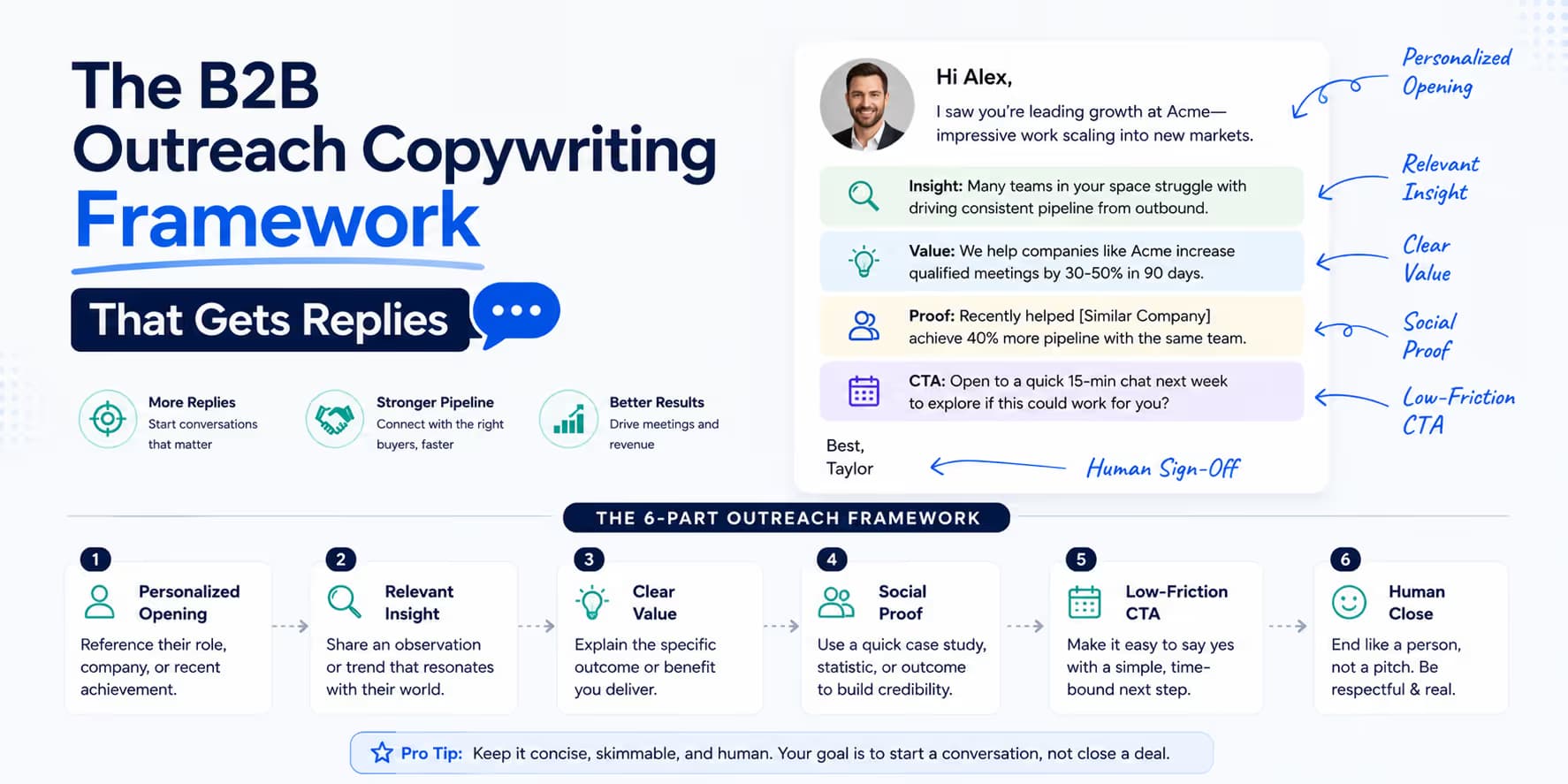
B2B outreach copywriting is closer to applied psychology than creative writing. Decision makers already get hundreds of generic automated pitches a day, so the first impression of a cold message is make-or-break. When a prospect opens LinkedIn, they do not read sentence by sentence. They scan the layout in a split second. A dense block of text, heavy jargon, or a self-centered intro gets deleted.
To raise positive reply rates, write copy that is brief, disarming, and low-friction. Understand the psychology of outbound copy, then use a strict sentence-by-sentence framework. That is how you turn cold connections into actual conversations.
The physics of modern B2B outreach copywriting
The primary failure point of B2B outreach is the violation of cognitive load. Every additional word, adjective, or link you inject into your message increases the mental effort required from the buyer. In outbound sales, friction is your greatest enemy. If your message demands that a prospect scrolls, clicks external links, or decipher complex corporate speak, you have already lost.
High-converting copy relies on three strict foundational laws of sales physics:
- The law of mobile optimization: Over 70 percent of B2B buyers read LinkedIn messages on mobile devices. A paragraph that looks like three short lines on your desktop monitor expands into a dense, intimidating wall of text on a mobile phone screen. Keep your paragraphs to a maximum of two sentences.
- The law of symmetry and whitespace: Use line breaks aggressively. A clean layout with generous whitespace looks elegant, is highly scannable, and invites the reader's eye down the page.
- The law of peer-to-peer authority: Never write like a salesperson begging for a demo. Frame your tone as an industry peer noting a shared operational pattern. You are not trying to sell a product; you are validating a common business challenge.
The Three-Sentence Rule
Restrict your initial outbound message to exactly three sentences: Sentence 1 establishes contextual relevance; Sentence 2 makes a specific B2B operational observation; Sentence 3 poses a low-friction, conversational question. Messages adhering to this structure consistently outperform long pitches by over 200 percent.
The QAB copywriting framework
Traditional copywriting frameworks like AIDA (Attention, Interest, Desire, Action) were designed for marketing pages and direct-response emails. In social messaging, AIDA is too slow and too promotional. Use the shorter QAB (Question / Context, Alignment / Observation, Benefit / Low-Friction Call to Action) framework instead.
Here is how to construct a QAB message sentence by sentence:
- Sentence 1: The Context Bridge (Q). This sentence answers the prospect's immediate question: "Why are you messaging me?" It must reference a highly specific, publicly observable trigger event on their profile or company page.Example: "Hi [FirstName], saw your recent post regarding your team's expansion of [Specific Department] projects."
- Sentence 2: The Alignment Observation (A). Here, you make a peer-level observation that highlights a common operational challenge. Avoid talking about your product's features. Instead, frame the pain point as a natural consequence of their current growth stage.Example: "Usually, scaling those initiatives quickly introduces severe bottlenecks in [Specific Operational Bottleneck]."
- Sentence 3: The Conversational Call to Action (B). This is your closing question. The mistake most reps make is asking for a call. Instead, ask a simple, low-pressure question that requires a simple "yes" or "no" reply.Example: "Are you guys experiencing this friction internally, or have you bypassed it?"
Analyzing high-converting copy vs. traditional spam
To see why QAB works, compare a traditional spammy sales pitch with a conversational QAB alternative:
| Message Element | Spammy Sales Pitch (Low Conversion) | Conversational QAB Model (High Conversion) |
|---|---|---|
| The Greeting | "I hope this message finds you well during these busy times!" | "Hi [FirstName]," |
| The Intro Hook | "We are an award-winning B2B SaaS platform that specializes in..." | "Saw that your team is currently expanding your [Department] efforts." |
| The Pain Point | "Our tool features AI-driven analytics, real-time sync, and enterprise security that will save you hours..." | "Usually, expanding that fast makes [Specific Challenge] a major focus area." |
| The Call to Action | "Let's book a 30-minute demo. Here is my Calendly link, let me know when you are free next Tuesday!" | "Worth a quick look, or is your roadmap already full right now?" |
The spammy model reads as a sales pitch. The prospect archives it. The conversational model reads like a peer commenting on their industry, which is easier to answer.
Adjusting outreach copy tone by buyer persona
A single message template will never convert across different buyer personas. Tailor the observation and the value metric to the daily priorities of the role you are targeting.
"Hi [FirstName], noticed you guys recently launched your new B2B features. As a founder, I know managing outbound pipeline while balancing product development is incredibly tough. We mapped out a lean workflow that automates connection setups safely. Open to a 60-second video of how we did it?"
"Hi [FirstName], saw you are currently scaling your SDR team. Usually, onboarding new reps introduces massive challenges with domain deliverability and prospect data cleaning. We built an automated safeguard that blocks bounce risks. Open to taking a look?"
"Hi [FirstName], noticed your engineering team is expanding your server infrastructure. Usually, that makes data compliance and secure tool integrations a top priority. We developed an outbound framework that integrates directly without storing sensitive customer keys. Worth checking out?"
Technical limits, safety safeguards, and optimization boundaries
Even the best copywriting framework fails if LinkedIn's safety algorithms flag the account. Modern B2B prospecting has to stay inside platform limits:
- Strict Character Boundaries: LinkedIn connection requests are strictly limited to 300 characters. For standard DMs, the technical limit is much higher, but you should keep your conversational messages below 500 characters to maximize readability on mobile screens.
- Outbound Frequency Limits: Keep your daily manual outbox activity below 40 connection invites and 30 direct messages per day. Exceeding these thresholds triggers automatic spam detection, putting your account health at risk.
- Data Cleanliness and Variable Cleansing: When using automated CRM databases, always clean your variable fields. If your message contains raw corporate designations like `[Company LLC]` or `[Company, Inc.]`, your prospects will instantly identify the automation and ignore you.
Outreach Compliance Checklist
- No Links in Connection Invites: Never send links inside connection request notes. It is a major spam trigger that will result in a quick decline.
- Zero Corporate Suffixes: Clean all company names to remove "Inc.", "LLC", or "Co." suffixes before launching campaigns.
- Verify Active Status: Only message prospects who have been active on the platform in the last 30 days to avoid wasting valuable connection limits.
The framework in one realistic example
The easiest way to understand the framework is to see it applied to a normal B2B outreach situation. Imagine you sell a workflow tool to agencies that are hiring account managers.
A weak opener says: "We help agencies save time with AI automation. Would you like a demo?" It is short, but it gives the buyer no reason to believe the message was written for them. A stronger opener says: "Saw you are hiring two account managers right now. That usually means client handoff quality is about to get harder to manage. Are you already standardizing that workflow internally?"
The second version works because it connects a visible trigger to a specific operational problem and asks a question the buyer can answer. It does not force a product pitch into the first sentence. That is the core of reply-driven copywriting: show that you understand the moment, name the likely friction, and invite the prospect to confirm or correct your read.
Frequently asked questions
Absolutely not. Inserting links into your initial message is a major technical spam indicator and signals desperation. Focus entirely on opening a conversational thread first, and only share links when the prospect explicitly requests them.
Do not double-pitch. Instead, wait 7 to 10 days and send a low-friction value follow-up. Share a relevant industry update or comment thoughtfully on their feed post to re-ignite the relationship naturally.
The highest reply rates occur on Tuesdays and Thursdays between 8:30 AM and 10:30 AM, or between 1:30 PM and 3:30 PM in the prospect's local timezone. Avoid sending outbound outreach on Friday afternoons or weekends.
Use safety-first B2B outreach workflows that let teams coordinate tailored variables, manage daily limits, and review conversational copy before scaling. Account health matters more than maximum send volume.