
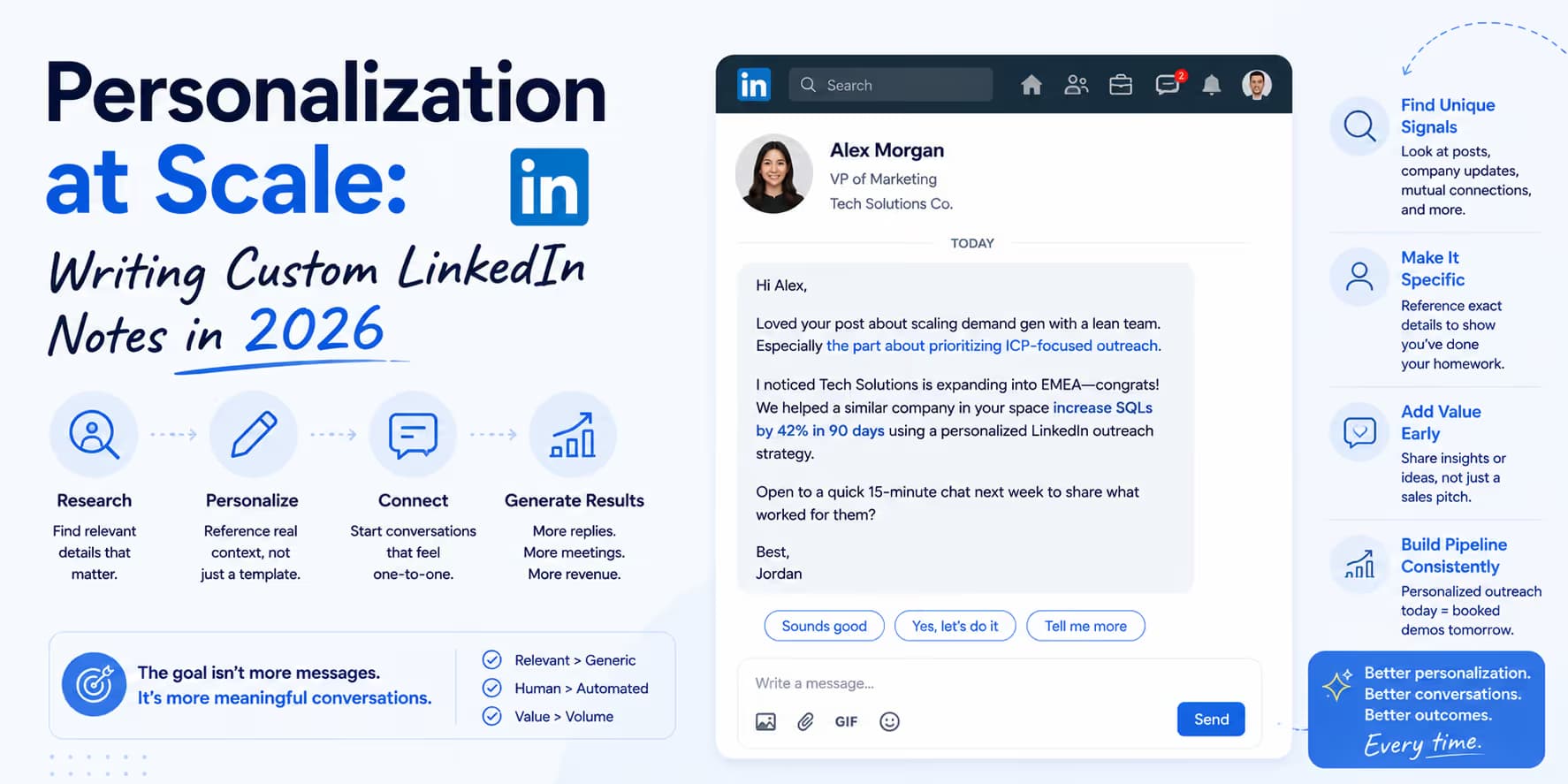
The B2B outbound problem in 2026 is operational: how do you scale pipeline without dropping personalization? C-suite leaders and enterprise directors get dozens of cold messages daily, so high-volume blast campaigns barely work. Robotic, low-context pitches get blocked, and accounts that run them get restricted within days.
Conversely, manual, deep-dive prospecting represents a severe bottleneck. If a sales rep spends 20 minutes researching a single prospect, cleaning their profile data, and writing a customized note, they can only contact 15 leads per day. At that pace, generating enough pipeline to support high-growth targets is impossible. To win today, sales teams must resolve this paradox by combining programmatic scraper tools, real-time intent filters, and automated context engines to write highly customized invitations and follow-ups at scale.
The personalization vs scale paradox
To escape this operational trap, we must redefine what personalization actually means. In the early days of social selling, "personalizing" a message simply meant populating basic fields like `[First_Name]` and `[Company_Name]`, or referencing a superficial detail like their alma mater or location. ("Hey [Name], saw you went to UT Austin, hook 'em!")
In 2026, buyers see this "lazy personalization" as manipulative. It signals that you scraped their profile simply to deliver a generic pitch.
True personalization does not focus on superficial details. It focuses on immediate business context. Relevance is the ultimate form of personalization. The goal is to show the buyer that you understand the exact operational challenge, hiring bottleneck, or technographic friction they are navigating right now.
The relevance rule
Never praise a prospect superficially. Referencing hiring campaigns, technographic stack changes, or recent industry regulatory shifts generates up to three times more positive response rates than generic flattery. Keep your outreach focused entirely on business outcomes.
Sourcing real-time intent triggers
To execute personalization programmatically, you must feed your outbound engine with high-intent social and corporate signals. Instead of blasting a static database of job titles, build dynamic lists that update automatically when prospects trigger specific operational events:
- 1. Active Hiring Postings: When a company posts job openings for a specific department (e.g., hiring 3 Senior SDRs), it signals two things: they have budget, and they are experiencing operational bottlenecks in that department.
- 2. Sales Navigator Lead Updates: C-suite executives and VP-level leaders change roles frequently. Reaching out to a newly hired VP of Sales within their first 90 days is incredibly effective, as they are actively evaluating new processes, tools, and partners.
- 3. Social Activity & Content Engagements: Monitor industry influencers and competitors. If a target prospect likes or comments on a post discussing a specific challenge (e.g., "managing outbound deliverability limits"), they have highlighted their current focus area.
- 4. Technographic Stack Shifts: Utilize tracking tools to detect when a prospect installs a competitor's product, or when their digital stack undergoes changes. Highlighting a known limitation of their current stack is a highly effective hook.
The programmatic copywriting framework
To scale personalized messaging safely, you must abandon single-use manual copy in favor of structured templates. By structuring your templates with dynamic context placeholders, you can compile highly customized messages programmatically:
| Message Block | Placeholder Variable | Purpose & Strategy | Compiled Copy Example |
|---|---|---|---|
| 1. The Hook | [Trigger_Observation] | Establishes instant, non-sales relevance. | "Hi Sarah, saw your team is currently expanding your remote AE team." |
| 2. The Bridge | [Problem_Hypothesis] | Introduces a highly specific pain point. | "Usually, rapid hiring introduces massive duplicate lead errors in Sales Navigator." |
| 3. The Asset | [Value_Asset] | Shares a frictionless, disarming solution. | "We put together a clean 1-page playbook showing how to automate list cleaning." |
| 4. The Close | [Soft_CTA] | Presents a low-pressure question. | "Worth a quick look, or are you fully sorted there?" |
Clean vs dirty dynamic variables
The fastest way to ruin a programmatic campaign is using uncleaned data. Scraped lists are filled with messy formatting-all-caps names, corporate suffixes (Inc., LLC), and long job titles. If you input these raw values into your templates, the prospect will instantly recognize the script:
"Hi SARAH, saw your team at Acme Corp Inc. - US division is currently expanding your REMOTE ACCOUNT EXECUTIVE (mid-market) team. Usually, rapid AE hiring introduces massive list scraping friction..."
"Hi Sarah, saw your team at Acme is currently expanding your remote AE team. Usually, rapid hiring introduces massive list scraping friction..."
To maintain a premium brand image, you must clean your databases aggressively. Strip out corporate suffixes like "LLC," "Corp," and "Ltd." Capitalize names correctly, and simplify complex titles (e.g., change "Mid-Market Enterprise Business Development Director" to "revenue leader").
Case study: scaling outbound safely to 80 custom DMs daily
TechStack, a B2B SaaS startup, scaled its sales pipeline using Omentir's context engines. The outbound team was two reps, running a manual workflow: researching and sending 15 highly personalized connection requests daily.
While their connection acceptance rate was decent (40%), the low volume generated only 2 qualified demos weekly. They needed to scale their outbound output to support their aggressive growth targets, but they could not afford to hire more SDRs.
TechStack integrated Omentir's context engines to automate their outbound research pipeline:
- Step 1: Automated intent scraping. Omentir monitored their target accounts daily, scraping active hiring posts, role changes, and content engagements.
- Step 2: Programmatic data cleansing. The platform ran automated regex and AI-cleansing scripts to strip corporate suffixes, capitalize names, and clean job titles.
- Step 3: AI context drafting. Omentir's context engine combined the intent signals and clean variables to draft highly disarming, conversational, 70-word outbound drafts.
- Step 4: Human-in-the-loop review. The sales reps reviewed and approved the drafts daily, taking only 15 minutes to verify 80 personalized messages.
Results showed up quickly. TechStack scaled daily outreach from 30 to 80 personalized direct messages. Connection acceptance climbed to 48%, and the positive reply rate doubled. TechStack booked 8 qualified demos weekly, building a predictable sales pipeline while keeping profiles off restriction.
Review each personalization layer
Use the personalization layers above to decide what must be human-reviewed and what can be templated. Good scale preserves judgment instead of hiding generic copy behind variables.
Personalization levels: what to use and when
Personalization at scale does not mean writing a 300-word custom essay for every lead. It means choosing the right depth of research for the value of the account and the strength of the signal.
- Level 1 personalization: Use role, industry, and company category. This is enough for low-value testing but not enough for high-ticket outreach.
- Level 2 personalization: Add a recent company trigger such as hiring, funding, expansion, new product pages, or leadership changes.
- Level 3 personalization: Reference the buyer's own language from a post, interview, podcast, or comment. Use this for executives and strategic accounts.
- Level 4 personalization: Combine buyer language with a custom insight about their business. Reserve this for the accounts where one meeting can materially change pipeline.
The mistake is applying the same personalization depth to every lead. Use automation to find and summarize signals, but let account value determine how much human review the final message deserves.
Quality control rules for scaled notes
Every scaled note should pass a simple quality check. It must reference a real signal, connect that signal to a business problem, and make one easy ask. If the note only swaps first name and company name, it is not personalization.
Review a random sample before each campaign goes live. Remove notes that invent details, overstate familiarity, mention irrelevant facts, or sound too polished for a LinkedIn DM. Good personalization feels observant and restrained. It should make the buyer think, "This person actually looked at our situation," not "This template scraped my profile."
Frequently asked questions
Yes, if you rely on cheap, unmonitored AI tools. Standard language models often struggle with complex professional contexts, generating awkward sentences that look robotic. To prevent this, always utilize a "human-in-the-loop" review process. Omentir drafts the copy automatically, but lets your reps quickly verify and edit the drafts before they are sent.
You can integrate specialized technographic scraping tools (such as BuiltWith, Wappalyzer, or Omentir's built-in technographic crawlers) into your CRM. These tools scan target websites daily, detecting specific scripts, databases, and tags to identify exactly what software they use.
Keep connection notes under 120 characters total. Brevity is a strong disarming signal. It shows the recipient that you are making a quick, professional observation rather than pitching a product. If you cannot fit your trigger observation within 120 characters, leave the connection request completely blank.
It is extremely difficult. Sales Navigator is an absolute prerequisite to sourcing high-intent lead signals. It allows you to build narrow filters based on hiring activity, tenure, department growth, and feed engagements, which form the bedrock of your programmatic personalization.