
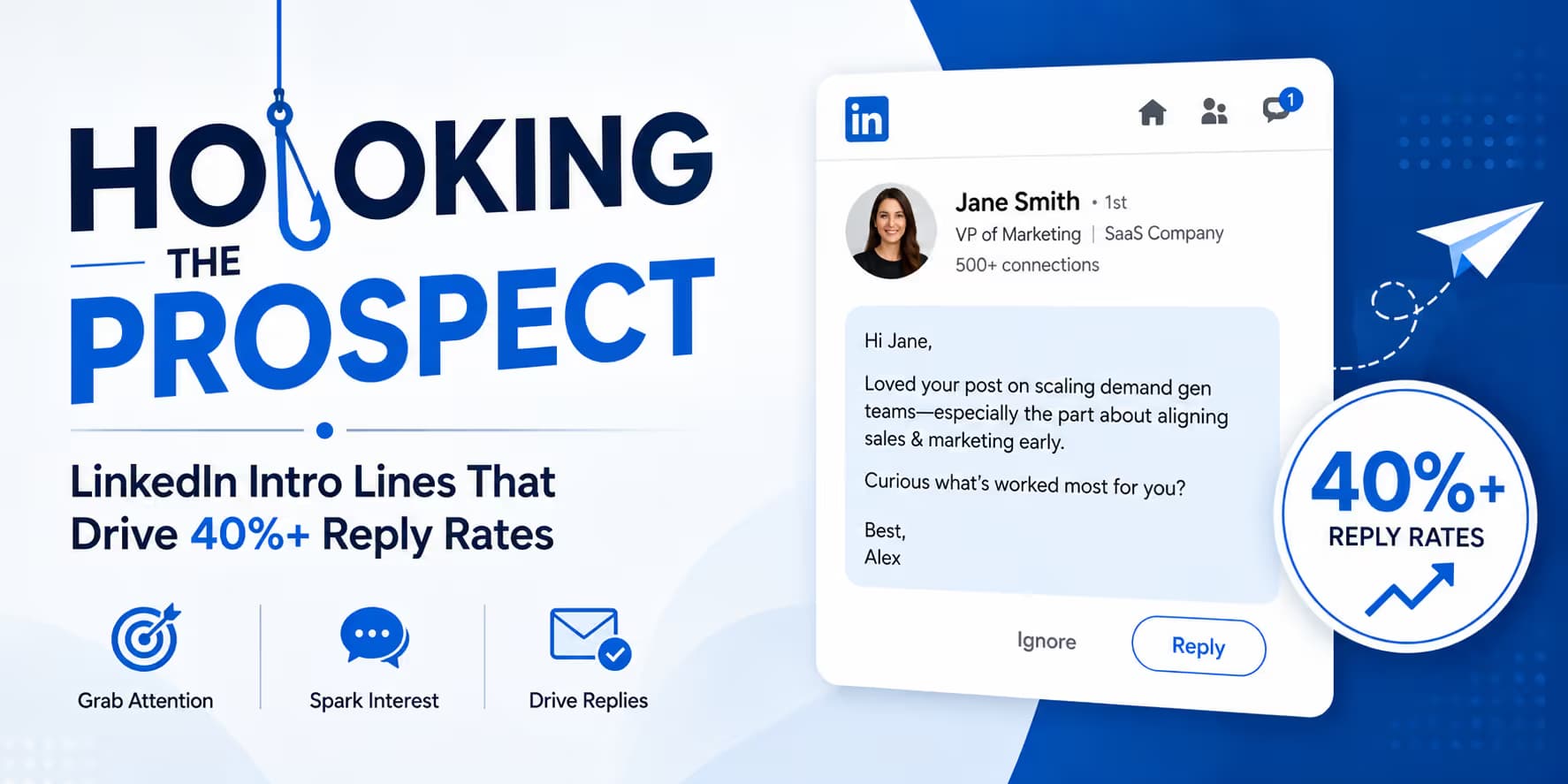
The first sentence of your LinkedIn cold message carries 90 percent of the conversational weight. When a prospect receives a message notification, their desktop notifications or phone lock screen displays only your name, headshot, and the opening 10 to 15 words of your message.
If those first words read as a sales pitch, the message stays unopened, ignored, or flagged as spam. B2B decision-makers already get hundreds of automated sequences a week. The opening line is the gatekeeper. To push reply rates past 40 percent, the intro has to earn attention, prove relevance, and lower the usual sales defense.
The psychology of the mobile lock screen
To understand why old-school hooks fail, we must look at how modern professionals consume their messaging inbox. Over 70% of LinkedIn users read their incoming messages first on a mobile device. On an iPhone or Android screen, a LinkedIn message preview exposes exactly 65 to 75 characters.
When a prospect looks at their screen, their brain is running a rapid binary sorting process: Is this a peer/customer conversation, or is this commercial spam?
Pleasantries like "Hope you're having a great week!" or "I wanted to reach out because..." consume lock screen real estate with no value. Worse, they announce: "This is a cold sales message from a stranger." The prospect does not need to open the app to decide to ignore it. A better hook skips the greeting and goes straight to a specific context.
The 65-Character Phone Test
Before sending any cold sequence, copy the first sentence of your message and paste it into a blank document. Look at the first 65 characters. If that snippet does not contain the prospect's name, their company, or a highly specific trigger unique to their world, scrap it. If it reads like something that could be sent to 10,000 other people, it will fail.
The anatomy of a high-performing hook
A high-converting opening line is a bridge that establishes peer status. It is not clever wordplay or clickbait. It has to satisfy three copywriting rules:
- No Flattery: Flattery is cheap. Writing "I saw your impressive profile and..." is transparent and patronizing. High-value buyers spot this immediately. Instead of complimenting their background, show that you actually understand their work by referencing a specific initiative or action.
- Zero friction: Omit all formal, corporate throat-clearing. You do not need to introduce your name or your company in the opening line. Your profile header does that automatically. Jump straight to the context bridge.
- Disarming Peer-to-Peer Tone: Write exactly how you would message a respected colleague on Slack. Keep it casual, brief, and lowercase where appropriate. Lowercasing minor elements makes the message feel like a quick note typed on a phone, rather than a polished template from a marketing automation server.
5 hook categories with real-world examples
Depending on the data and intent signals you track, pick one of these five categories. Here are the structures, exact templates, and why each works.
"Hi [FirstName], saw your recent comment on [InfluencerName]'s post about [Topic]. Spot on about [Specific_Insight]..."
Why it works: It proves you are active in the same communities and are referencing a real public conversation they initiated. It is impossible to automate this without genuine research.
"Hi [FirstName], saw you guys are scale-hiring for [RoleName] on your team right now. Typically that means..."
Why it works: Hiring is a massive operational stressor. By referencing their open roles, you establish immediate business relevance and set up a pain point that they are actively feeling today.
"Hi [FirstName], noticed you guys use [TechTool] to run your [Process]. How are you handling [Known_Tech_Friction]?"
Why it works: It demonstrates deep technical context about their environment. It bypasses generic introductions and positions you as an expert who understands the unique flaws of their current tools.
"Hi [FirstName], listened to your guest appearance on [PodcastName]. Loved your framework about [FrameworkName]..."
Why it works: Everyone loves having their expertise acknowledged. By quoting a specific, non-obvious takeaway from their audio or written content, you show that you've invested real time in their perspective before reaching out.
"Hi [FirstName], saw we are both in the [GroupName] Slack channel. Are you guys navigating the new [Industry_Change] too?"
Why it works: It relies on the "in-group" bias. Shared community membership breaks down professional barriers instantly, making the interaction feel safe and collaborative.
How to run A/B hook tests safely
You should never guess which hook works best. Modern B2B sales require a highly empirical, data-driven approach to messaging optimization. To find your winning opening line, implement a structured A/B testing methodology.
Divide a clean list of 100 prospects within the exact same ICP into two equal batches of 50. Keep the rest of your sequence (Step 2, Step 3, and Step 4) identical. The only variable you change is the opening hook.
Structure, analyze, and adjust your tests using these criteria:
| Test Metric | Red Flag Limit | Target Goal | Operational Adjustment |
|---|---|---|---|
| Connection Acceptance Rate | < 30% | > 45% | If low, your profile landing page lacks authority or your connection request note is too salesy. |
| Message Open Rate | < 50% | > 75% | If low, the first 65 characters visible on mobile previews look automated or dry. |
| Inbox Reply Rate | < 15% | > 35% | If low, your conversational question lacks relevance or has high psychological friction. |
Case study: from 12% to 46% reply rates
Here are the real-world metrics of an enterprise cyber-security SaaS provider that was struggling with cold outbound on LinkedIn.
Originally, their team used a standard, product-heavy hook: "Hi [FirstName], I'm reaching out because we help companies secure their cloud endpoints against Zero-Day exploits. I wanted to see if you have 10 minutes..."
This campaign yielded a disappointing 32% connection acceptance rate and a 12% response rate, booking only 2 demos across 200 targeted accounts.
The team retooled their campaigns, using Omentir's automated technology crawlers to identify prospects running legacy cloud environments. They deployed a specific Technology Stack hook:
"Hi [FirstName], noticed you guys are running hybrid cloud nodes alongside AWS. How are you preventing credential leakage during developer rollouts?"
The results moved quickly:
- Connection Acceptance: Jumped from 32% to 54%.
- Reply rate: Moved from 12% to 46.2%.
- Demos Booked: Secured 18 qualified demos from the same volume of accounts.
- Sales Cycle Reduction: Because the hook started a deep technical conversation instantly, qualified prospects moved through the discovery stage twice as fast.
Review personalization before scaling
Use the intro-line patterns above to pressure-test relevance. A good hook should name a real situation the buyer recognizes, not just personalize a first name.
Common hook mistakes that trigger archival
Even experienced sales reps make copywriting mistakes that turn prospects off. Avoid these:
- The "Pitch-Slap" (Pitching on Connection Acceptance): Sending a massive sales pitch the second a prospect accepts your invite. This breaks the social contract of the platform and results in immediate unfriending or blocks.
- Stale Intent Triggers: Referencing an event that is too old. If you write "Congrats on raising your Series A!" but that funding round happened 9 months ago, you look completely out of touch. Keep triggers under 30 days old.
- AI Hallucinations: Relying on low-quality AI scraping tools that generate nonsensical personalization hooks like "I love how your company is located near a Starbucks." If you automate, use high-precision crawlers built for B2B variables.
- Over-customization to the point of creepiness: Referencing highly personal details like their family vacation photos or non-professional hobbies. Keep your hooks strictly tied to professional topics, business intent, or industry discussions.
Frequently asked questions
Use corporate/company level triggers instead. Look for company-level news, open hiring roles in their department, or technographic details (what tools their website runs). You can bridge to their role: "Hi [Name], saw your department is scale-hiring node developers right now. How are you..."
Yes, provided you clean your lead lists thoroughly beforehand. Ensure names are properly capitalized, corporate designations like "LLC" or "Inc." are stripped, and the intent triggers are highly verified. Poor data quality is the main cause of failed automation.
Keep it under 25 words. Your hook is merely the conversation starter. Its purpose is to bridge to the core operational pain point, not tell your life story. The shorter and cleaner the hook, the more professional it feels.
Absolutely not. This is a conversion killer. Booking a calendar demo requires a major cognitive commitment from the lead. Establish relevance, build micro-trust, and verify interest first.