
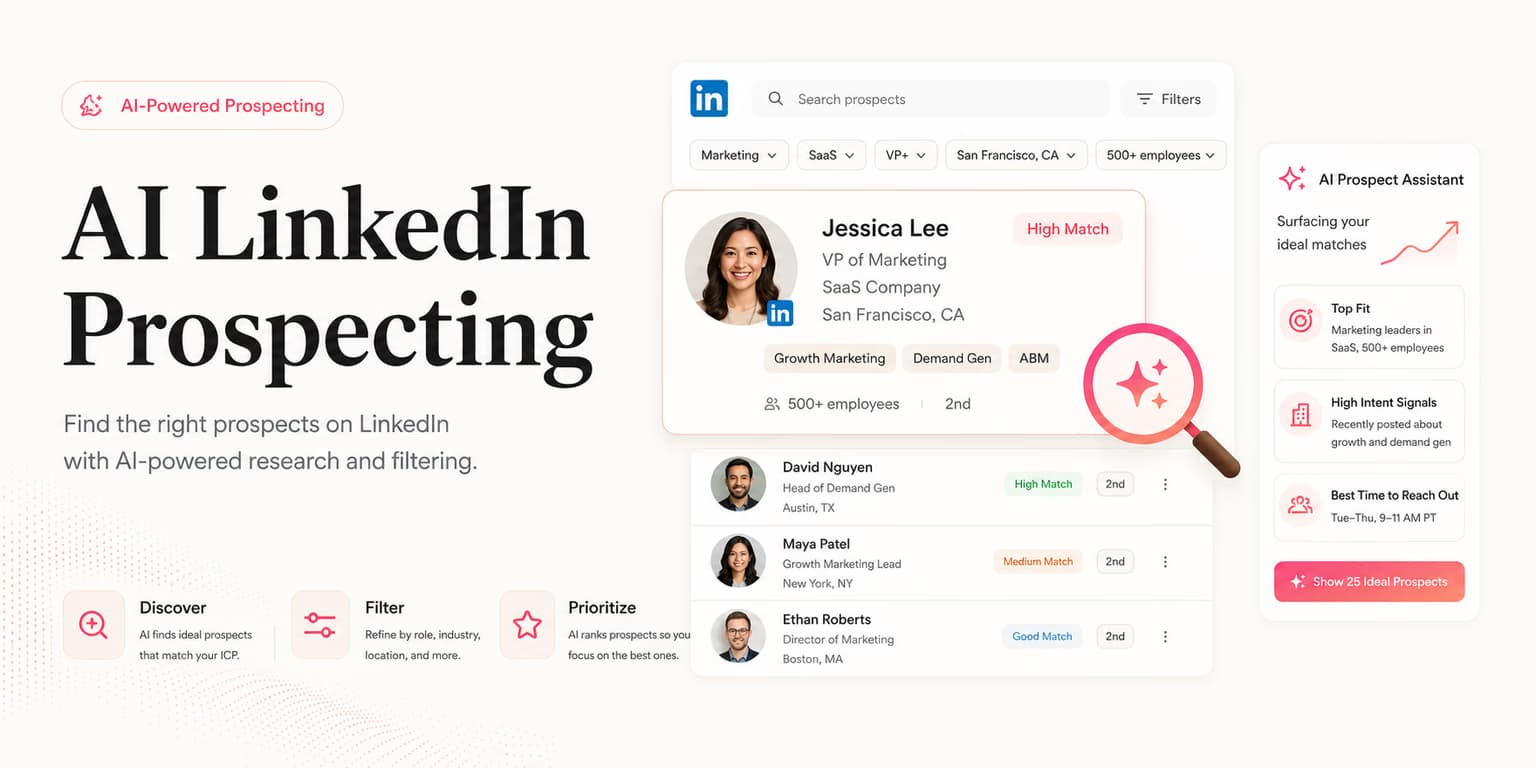
AI LinkedIn prospecting works when it helps you decide who is worth a thoughtful message. It fails when teams use it to inflate a list and call the list "qualified."
Prospecting is the judgment layer before outreach. The job is to find people whose role, company, timing, and public signals suggest a real reason to start a conversation on LinkedIn. If that reason is weak, no amount of personalization will make the message feel relevant.
This guide is not a ChatGPT prompt pack or an agent orchestration tutorial. For manual scoring, use the ChatGPT LinkedIn leads workflow. For agent-led operation, use the OpenClaw LinkedIn leads guide. Here, the focus is the prospecting system itself.
Prospecting is not messaging
Many teams collapse prospecting and messaging into one AI task: "Find leads and write messages." That sounds efficient, but it creates muddy output. The model tries to find fit, invent context, and pitch in the same breath.
Split the work. Prospecting should produce a ranked queue with evidence. Messaging should use that evidence only after the lead is approved. This separation makes it possible to audit why each person entered the campaign.
A strong prospecting output includes four things: who the person is, why the company fits, what signal suggests timing, and what still needs review. If any of those are missing, the lead belongs in research, not outreach.
The prospecting rule
Do not ask AI to write a message until it can explain why this buyer deserves one. The explanation should be specific enough that a teammate could review it tomorrow.
Map the market
AI needs a narrower map than "B2B SaaS founders" or "heads of sales." Start with a prospecting lane, which combines account fit, person fit, timing, and a reason the channel makes sense.
A good lane sounds like this: "Founders of 10 to 80 person HR SaaS companies that are hiring sales or customer success roles and likely need a more consistent founder-led outbound process." That is narrow enough for AI to rank evidence without drifting into unrelated companies.
Write the lane before opening any search tool. Then list disqualifiers. Disqualifiers are what keep the queue clean.
- Bad account: wrong market, wrong size, wrong geography, or business model mismatch.
- Bad person: title is near the problem but does not own the work.
- Bad timing: no visible trigger, no recent activity, or problem is likely not urgent.
- Bad message fit: you would need to make a claim you cannot support.
If you are unsure about the fit rules, run a deeper rubric first with the AI lead qualification framework. Prospecting improves quickly once the reject rules are clear.
Collect signal sources
Do not start by scraping everything. Start with a few signal sources that match your lane. Good sources include saved LinkedIn searches, post commenters, people who viewed your profile, event attendees, job-change alerts, hiring posts, and company pages.
LinkedIn Sales Navigator can be useful for structured filters, but it should not replace judgment. A perfect title filter still produces people with different priorities, budgets, and current problems.
Give AI the smallest useful evidence package for each candidate. A useful row usually includes role, company, company description, recent public signal, why the candidate appeared in the source, and any visible disqualifier.
Avoid collecting fields just because they are available. More data does not automatically mean better prospecting. The best fields are the ones that change the decision to message, research, nurture, or skip.
Rank in batches
AI is more useful when it compares a batch than when it scores one profile at a time. Batch review exposes patterns. You can see whether the source is producing the wrong roles, whether all the timing signals are weak, or whether one company type keeps rising to the top.
Ask the AI to return a ranked list with fit reason, signal strength, risk, and next action. Keep the actions simple: message now, research more, nurture, or skip.
"Rank these 50 LinkedIn candidates for the HR SaaS founder lane. For each, return action, fit reason, strongest signal, missing evidence, and a safe message angle. Reject anything that depends on guessing budget or internal pain."
The "safe message angle" is important, but it is not the message yet. It is the bridge between prospecting and outreach. It tells the copy step what is safe to reference.
For example, "recently hired two CSMs, likely onboarding handoffs are getting more complex" is a safe angle. "They must be losing customers because onboarding is broken" is not.
Create work queues
A prospecting system should not produce one giant lead list. It should produce work queues. Queues tell you what to do next.
- Message now: strong fit, clear timing, safe opening angle, and no obvious risk.
- Research more: likely fit, but missing person ownership or timing evidence.
- Nurture: good account, weak timing, or a buyer worth following before outreach.
- Skip: bad fit, wrong person, weak evidence, duplicate, or risky assumption.
The research queue is where many teams win. Instead of forcing every maybe-fit lead into outreach, you give the AI a second task: find the missing evidence or recommend a better contact at the same company.
This keeps the daily sending queue small and high quality. A founder does not need 500 names. A founder needs enough good prospects to create real conversations without turning LinkedIn into a volume channel.
Review before outreach
Before any approved lead moves into messaging, review a sample manually. Look for three problems: invented evidence, title-only scoring, and weak timing. Those are the most common signs that AI prospecting is drifting.
The review does not need to be slow. Read the top ten and the bottom ten. If the top ten feel weak, the whole batch likely needs a better source or lane. If the bottom ten include obvious good fits, the scoring rule is too strict or missing a signal.
Review note: "The AI is overvaluing founder title and undervaluing hiring signals. Tighten the rule: founder alone is not enough unless the company is hiring revenue roles or publicly discussing pipeline."
This review step is why prospecting evidence must stay visible. AI can find and rank, but a human should still approve the prospecting logic before a lead moves into outreach.
Use a quick quality checklist before the batch leaves prospecting. First, can every approved lead be explained in one sentence? Second, is the signal visible to the buyer, not just something your team inferred? Third, would the opening message still feel respectful if the buyer forwarded it to their team? Fourth, does the lead match the campaign lane closely enough that a reply would create a useful sales conversation?
The answer should be yes before the lead enters outreach. If a lead only passes because the company is famous, the title is senior, or the AI wrote an impressive paragraph, keep it out of the sending queue. Status is not fit. Seniority is not urgency. A polished explanation is not evidence.
Here is the difference in practice. A weak prospecting note says, "VP Sales at a fast-growing company, likely interested in automation." A stronger note says, "VP Sales at a 65-person B2B SaaS company, hiring three SDRs this month, public post mentions outbound quality slipping as volume increases. Safe angle: ask whether they are already standardizing lead review before messages go out."
The strong note gives the outreach step a grounded path. It names the person, the company stage, the timing signal, the likely problem, and the line not to cross. The message can now be specific without pretending to know private pain.
Also watch for source drift. If a saved search starts producing mostly agencies, recruiters, students, or people outside the ownership path, do not keep tuning the prompt around a bad source. Fix the source. AI can rank a weak batch, but it cannot turn the wrong market into the right one.
A good weekly review asks, "Which source produced the most approved leads that later replied?" That connects prospecting quality to actual conversations instead of vanity lead counts.
Weekly operating rhythm
AI LinkedIn prospecting improves when the loop is boring and repeatable. Do not reinvent the prompt every day. Keep the lane stable long enough to learn which signals create replies.
- Monday: choose one lane and collect 40 to 80 candidates from one or two signal sources.
- Tuesday: rank the batch and review the top, middle, and bottom examples.
- Wednesday: move approved leads into the message queue and keep maybes in research.
- Thursday: inspect replies and accepted connections for signal quality.
- Friday: update the lane, reject rules, and source list before the next batch.
Omentir can run the repeatable parts of this loop: finding ICP-fit buyers, scoring them against your criteria, drafting outreach, following up at human-paced limits, and collecting replies in one inbox sorted by intent. The useful part is keeping the evidence attached from prospecting through reply handling.
Once a lead is approved, the outreach step should continue the same context. The guide to building an AI outreach playbook covers that handoff from ranked prospect to message system.
FAQs
AI can help rank, summarize, and organize public signals, but it still needs real data sources, clear ICP rules, and human review before outreach.
Prospecting decides who deserves attention. Outreach decides what to say and when to say it. Keep those steps separate so bad-fit leads do not receive polished messages.
A practical starting range is 40 to 80 candidates per week, narrowed to a smaller set of high-fit people for actual connection requests and messages.
It should hand off the fit reason, safe message angle, disqualifiers checked, and next action to the outreach workflow. It should not erase the evidence used to approve the lead.