
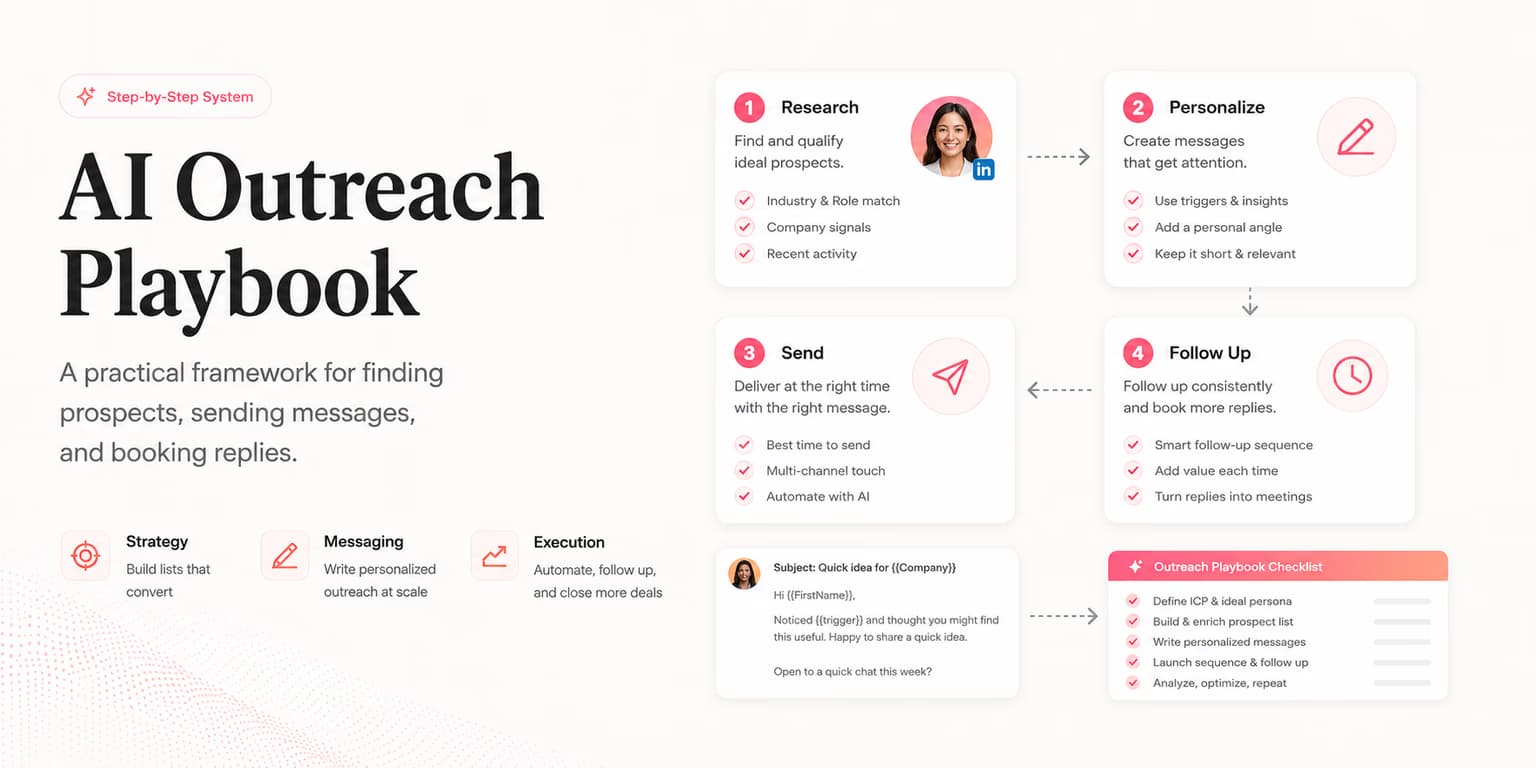
AI outreach fails when teams use the model to send more bad messages. It works when the model helps a human run a sharper sales process: better targets, clearer context, better drafts, and more consistent follow-up.
This playbook is for B2B founders and lean sales teams using LinkedIn, email, or agent-driven workflows to start qualified conversations. The goal is not to automate your personality away. The goal is to remove the repetitive work that stops you from having enough good conversations.
A strong AI outreach system has five parts: a specific sales problem, a narrow prospecting lane, a message system, a quality gate, and a feedback loop. Skip any one of those and the campaign starts drifting toward generic automation.
Start with the sales problem
Do not start by asking, "How many leads can AI find?" Start with the problem your outbound campaign exists to solve. Are you validating a new ICP, booking founder-led demos, reviving old pipeline, or testing a new offer?
Each objective changes the campaign. Validation campaigns need tighter learning loops and fewer prospects. Demo-booking campaigns need stronger qualification and clearer call handoffs. Nurture campaigns need patience and better memory.
Write the campaign objective in one sentence before opening any AI tool. If the sentence is fuzzy, the agent will optimize for activity because it has no better definition of success.
Campaign objective: Book 6 qualified founder demos this month with B2B SaaS companies that sell to HR teams, have 10-80 employees, and are actively hiring sales or customer success roles.
That objective tells the AI what matters: buyer type, company size, timing signal, and business outcome. It also tells you what to ignore.
Turn the objective into a campaign worksheet before you ask AI to act. The worksheet should include the buyer's daily pain, the event that makes the pain urgent, the proof you can offer, and the line you will not cross. For example, you may allow the AI to mention public hiring activity, but not infer private budget or internal performance.
This boundary keeps the campaign honest. AI is strongest when it organizes visible context; it becomes dangerous when it fills missing context with confident guesses.
- Buyer pain: the expensive problem the recipient already recognizes.
- Urgency signal: the public event that suggests the pain is active now.
- Proof asset: the example, workflow, benchmark, or customer story you can safely reference.
- Forbidden claim: anything the AI must not imply unless the prospect confirms it.
Build the prospecting lane
A prospecting lane is narrower than an ICP. Your ICP might be "B2B SaaS founders." A lane is "founders of HR SaaS companies hiring their first sales hire this quarter." Lanes give AI something concrete to search and score.
Good lanes combine fit and timing. Fit tells you whether the company could buy. Timing tells you whether a conversation makes sense now.
- Fit: role, company category, size, geography, budget, and operating model.
- Timing: hiring, funding, product launch, tool change, team expansion, or public problem discussion.
- Access: whether the person is reachable through a real channel where your profile has enough trust.
- Disqualifier: signals that make the account a poor use of outreach even if it looks close.
If you need a deeper lead-scoring structure, use the guide on ChatGPT LinkedIn leads for a manual scoring pass before you automate.
Once the lane is defined, ask AI to score leads in batches rather than one by one. A batch view makes patterns visible. You will notice when every recommended lead comes from the same weak signal, when job titles are too broad, or when one company category consistently produces better reasons.
Keep three buckets: message now, research more, and skip. "Research more" is the bucket most teams forget. It protects you from sending too early while keeping promising accounts from disappearing.
A good weekly target for a founder is not a giant list. It is a manageable set of people whose fit can be explained in one sentence. If the explanation takes a paragraph, the signal probably is not clean enough.
Write the message system
AI should not produce one-off clever messages forever. It should work inside a message system: a hook, a relevance bridge, a low-pressure question, and a follow-up logic.
The hook points to a real signal. The bridge explains why that signal matters. The question invites a small reply instead of pushing for a meeting too early.
Three-Part Message Rule
Signal, problem hypothesis, simple question. If the message needs more than that, the lead probably needs more research or the offer needs a simpler angle.
You can still use templates, but templates should define structure rather than erase context. The existing list of LinkedIn cold message templates is best used as a pattern library, not a copy-paste script for every buyer.
Give AI a voice rule as well as a structure rule. A useful voice rule might be: "Write like a founder asking a practical question, not a vendor announcing a solution." That one sentence removes a lot of inflated language.
Also give the model a length target. For LinkedIn, a first message that looks small is usually easier to answer. If the draft needs four paragraphs to make sense, the offer or trigger is probably too complicated for cold outreach.
The best first messages often leave room for the buyer to correct you. Phrases like "is that a focus right now?" or "are you already sorted there?" create an easy out, which makes the message feel less like a trap.
Quality control
AI outreach needs a quality gate before it reaches prospects. The gate should check list fit, evidence quality, message clarity, claim safety, and sending pace.
The fastest audit is to ask, "Would I send this manually if there were only ten prospects in the campaign?" If the answer is no, AI should not send it at scale.
- Fit check: every prospect has a clear buyer role and company fit.
- Signal check: every opener references something visible and relevant.
- Claim check: no invented customer names, fake metrics, or unsupported promises.
- Tone check: the message sounds like a professional peer, not a marketing blast.
- Pace check: outreach stays within a human-paced daily routine.
Before and after
A weak AI draft sounds polished but interchangeable: "I help SaaS companies optimize operations and drive revenue growth. Would you be open to a quick call?" Nothing in that message proves why this person is being contacted.
A stronger draft uses a real signal: "Saw you are hiring two customer success managers after launching your enterprise plan. Are you already happy with how onboarding handoffs are tracked, or is that still a bit manual?"
The second message is not longer or louder. It is better because it ties the outreach to a visible change in the buyer's business and asks a question they can answer without taking a meeting.
When reviewing AI drafts, read them aloud once. Awkward phrasing becomes obvious when spoken. If you would not say the sentence in a normal conversation with a founder, rewrite it before it goes out.
Then run one final specificity test: remove the prospect's company name and ask whether the message could still apply to 500 other companies. If yes, the draft is not personalized enough yet.
Follow up without pressure
AI follow-up should extend the original context, not restart the pitch. If the first message was about onboarding handoffs, the follow-up should add a small useful angle on that same problem.
Keep follow-ups short and spaced out. A founder-led LinkedIn sequence often works best with one connection note, one first message after acceptance, and two or three thoughtful follow-ups over a few weeks.
A good follow-up adds one new useful angle. That could be a short observation, a one-line example, a question that narrows the pain, or a polite close-the-loop note. It should not repeat the first message with different wording.
AI can help you maintain memory across touches. Ask it to summarize the original signal, the previous message, and the next best follow-up angle before drafting. That prevents the sequence from feeling like unrelated automated nudges.
The guide on re-engaging ghosted LinkedIn leads goes deeper on follow-up language, but the principle is simple: add value, reduce pressure, and give the buyer an easy way to clarify fit.
Measure and adjust
Do not judge an AI outreach campaign only by reply rate. Reply rate can rise because the campaign is controversial, vague, or attracting the wrong people.
Track the full chain: accepted connections, positive replies, wrong-person replies, confused replies, demo interest, booked meetings, and qualified opportunities. Each metric diagnoses a different part of the system.
- Low acceptance: profile trust, connection note, or targeting is weak.
- High acceptance but low replies: first message is too generic or too pitch-heavy.
- Many wrong-person replies: the prospecting lane needs tighter role ownership.
- Interest but no demos: the handoff to calendar or next step is too abrupt.
Omentir is built around this kind of controlled loop: it finds ICP-fit buyers, drafts personalized outreach, follows up automatically, and collects replies in one inbox sorted by intent. If you want the agent-connected version, the MCP LinkedIn outreach guide explains how to expose that workflow to an AI agent safely.
Review metrics every Friday, not after every individual reply. One reply is a story; a week's worth of replies is a pattern. The pattern tells you whether to change the lane, the hook, the proof, or the call to action.
If you change everything at once, you lose the lesson. Adjust one variable per batch whenever possible. Keep the same lane and test a new hook, or keep the hook and test a narrower lane.
Frequently asked questions
AI should help with research, lead scoring, first-draft messages, follow-up reminders, and reply triage. Keep strategy, final approval, sensitive claims, and live relationship handling under human judgment.
Use enough personalization to prove relevance, not to show that you researched every corner of the prospect's profile. One real business signal and one clear reason for reaching out is usually better than a long custom essay.
For most founder-led LinkedIn outreach, no. The safest version is automated research and drafting with human approval before messages send from your own profile.
Using AI to scale weak targeting. If the prospect list is wrong, better writing only makes the campaign fail more politely.