
Building a great B2B software product is only the first step. To build a sustainable business, you need predictable channels to acquire users. Teams that rely on organic page traffic or word-of-mouth referrals will see flat growth curves.
To grow monthly recurring revenue (MRR), build structured sales funnels. A funnel is a step-by-step pathway that moves cold prospects from discovery to paid subscriptions.
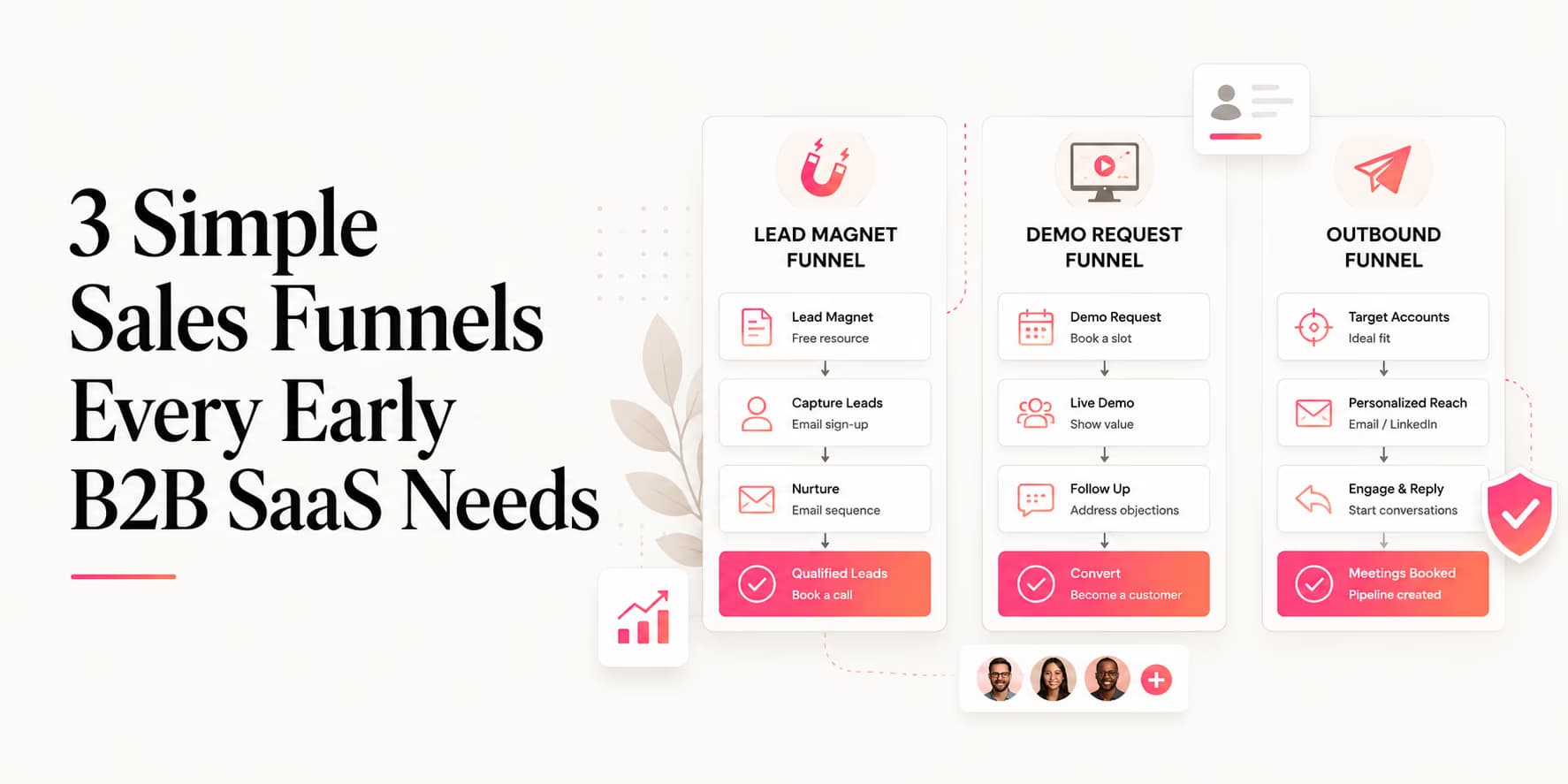
Many early SaaS teams fail because they try to manage too many acquisition channels. Start with three core funnels: sales-led outbound, product-led trials, and inbound content.
Most early teams only need one working funnel. The rest of this piece is about picking that first path and knowing when a second one is actually earned.
The mistake is trying to make every funnel work at the same time. Early teams do not need a full growth department. They need one primary way to learn from buyers, one easy way for interested people to try the product, and one way to turn what they learn into public trust. These three funnels do different jobs.
A funnel is useful only if it tells you what to do next. If a funnel produces traffic but no conversations, it is not teaching enough. If it produces demos but no customers, it is not qualifying well enough. If it produces signups but no activation, the product experience needs work.
How to choose the first funnel
Choose the first funnel based on your biggest unknown. If you do not know who the buyer is, start with direct outbound. If you know the buyer but prospects need to feel the product before they understand it, build a product-led trial. If you have strong insight but not enough trust in the market, build content that turns that insight into conversations.
Most early B2B SaaS teams should start with direct outbound because it creates the fastest feedback. You can put a specific offer in front of a specific buyer and learn from the response. That learning then improves the self-serve funnel and the content funnel.
Use this rule:
- Unclear buyer: Start with outbound so you can test segments directly.
- Clear buyer, unclear activation: Improve the product-led funnel and onboarding path.
- Clear insight, low trust: Publish content that proves your expertise and creates conversations.
Funnel 1: the direct outbound funnel (sales-led)
The Direct Outbound Funnel is the most useful channel for early-stage B2B startups. It requires no advertising capital and lets you target ideal buyers directly.
A professional outbound funnel coordinates four steps:
- Discovery: Using search filters to locate prospects matching your Ideal Customer Profile (ICP).
- Copywriting: Writing personalized messages based on career triggers, avoiding generic templates.
- Review: Auditing message drafts in a queue to verify tone and fit.
- Pacing: Sending messages spaced out with random human-like delays to protect profile health.
The direct outbound funnel is not only a meeting-booking machine. It is your buyer-discovery loop. Every outbound batch should answer one question: which buyer segment has the clearest pain right now? That means your list quality matters as much as your message.
A simple outbound funnel looks like this:
- Account selected: The company matches your ICP and has a visible trigger.
- Contact selected: The person likely owns or feels the workflow problem.
- Message sent: The note references the trigger and asks a diagnostic question.
- Conversation started: The prospect replies with useful context, not just politeness.
- Qualified next step: The conversation becomes a demo, audit, pilot, or referral to the right owner.
Measure each step separately. If accounts are poor fit, fix targeting. If contacts are wrong, fix titles and seniority. If conversations start but no next steps happen, fix the offer.
For outreach copy blueprints, see our guide to the B2B copywriting framework.
Funnel 2: the product-led free trial funnel (self-serve)
The Product-Led Growth (PLG) funnel uses a free trial or low-tier plan to reduce signup friction.
Omentir offers self-serve Pro pricing, plus Enterprise support for teams with more advanced needs:
- Pro ($49/month): Includes one user, one LinkedIn account, unlimited AI agents, leads, campaigns, AI automated campaigns, API access, email customer support, and a minimum of three bookings per week or you pay nothing.
- Enterprise: Includes unlimited users, unlimited LinkedIn accounts, all Pro features, plus SSO, dedicated onboarding, and priority support. Book a call to discuss your setup.
Offering this plan allows prospects to sign up and start campaigns with minimal administrative friction.
A product-led funnel only works when the product can deliver a meaningful first result without a long sales process. For early teams, the goal is not to build every PLG feature at once. The goal is to help a new user reach the first valuable moment quickly.
Define that first valuable moment in plain language. For Omentir-style outbound software, it might be: "the user sees a qualified prospect list and approves a message that feels specific enough to send." For a reporting tool, it might be: "the user connects one data source and sees the metric they came for." If you cannot name the moment, your trial will feel vague.
Track product-led funnel stages:
- Signup: Did the user create an account from a relevant source?
- Setup: Did they complete the minimum configuration?
- Activation: Did they reach the first meaningful result?
- Habit: Did they return and use the workflow again?
- Conversion: Did the trial turn into a paid account or sales conversation?
PLG fails when teams celebrate signups without activation. A smaller number of activated users is more valuable than a large free-user list that never reaches value.
Funnel 3: the content-to-conversation funnel (inbound-led)
The Content-to-Conversation funnel turns readers into sales leads. Senders write detailed, educational articles on how to solve specific challenges (such as list cleaning or outreach safety).
When readers engage with your content, start a conversation thread:
Write a short message referencing the article they read and ask a conversational question about their current setup. This approach builds trust before introducing your software.
Content should not be a pile of keyword pages. It should document the problems your best buyers are already trying to solve. A strong content-to-conversation funnel starts with sales notes: objections from demos, questions from prospects, repeated pain points, failed workflows, and teardown examples.
A practical article should give the reader something they can use without buying. For example: a scoring checklist, a message rewrite, a workflow map, a teardown template, or a decision framework. That generosity builds enough trust for a conversation later.
When someone engages with the article, do not pitch immediately. Ask about the workflow:
Saw you commented on the lead-scoring checklist.
Curious: are you reviewing LinkedIn prospects manually today,
or do you already have a scoring step before outreach starts?
This keeps the content funnel conversational. The article creates context. The message turns that context into a useful diagnostic exchange.
How the three funnels work together
These funnels should not operate as isolated projects. Outbound tells you which pains buyers mention. Content turns those pains into useful public resources. Product-led onboarding turns interested readers and prospects into users who can experience value. Each funnel feeds the next.
The loop can look like this:
- Outbound discovers that founders care more about lead quality than generic automation.
- You write a guide on scoring LinkedIn prospects before sending messages.
- Readers and prospects engage with the guide and ask about their own workflow.
- The product-led flow lets them test one lead-scoring workflow quickly.
- Usage data and sales replies improve the next outbound campaign.
This is how small teams build a real acquisition system without pretending every channel needs to be mature on day one.
Safety Warning: Outbox Pacing 💡
Outbound campaigns must respect platform safety rules. Sending high volumes of connection requests at mechanical speeds will result in profile bans. Limit connection requests to under 20 per day.
Comparing funnel performance: conversion, setup, and costs
Each acquisition funnel has different resource requirements:
Outbound Funnels: Setup can be fast when the ICP is clear. Leads are targeted, feedback is direct, and scale is limited by quality review and safe pacing.
PLG Funnels: Setup takes days of development work. Conversion rates depend on product onboarding flow quality.
Content Funnels: Setup takes weeks of writing work. Conversion rates are lower, but the traffic scales organically.
Combine outbound outreach with self-serve plans so you can capture both high-intent buyers and early trials.
Compare funnels by the question they answer:
- Outbound: Do specific buyers care enough to talk?
- PLG: Can users reach value without heavy sales assistance?
- Content: Can your insight attract and warm the right market over time?
Early teams should review these questions weekly. If outbound creates demand but PLG loses users during setup, fix onboarding. If content gets traffic but no conversations, sharpen the topic or add a better follow-up path. If PLG activates users but outbound cannot find more of them, revisit the ICP.
Manage outbound pacing to protect funnel assets
Outbound campaigns require pacing tools to protect profile health and brand trust. Random sending delays keep activity closer to normal manual behavior and reduce risky sending spikes.
Omentir handles this outbox pacing automatically. For safety guidelines, see our guide on pacing B2B outreach campaigns.
Your profile is a funnel asset. If it gets restricted or associated with poor outreach, the direct channel suffers. Keep batches small, review messages before sending, and watch reply quality. If people reply with confusion or annoyance, slow down and fix the funnel before increasing volume.
SOP: the sales funnel deployment checklist
Configure your acquisition funnels using these steps:
- Step 1: Define target ICP parameters in your campaign settings.
- Step 2: Set up a self-serve trial or billing option that makes the first commitment easy.
- Step 3: Crawl prospect websites to build personalized copywriting prompts.
- Step 4: Route message drafts to Omentir's paced queue to protect profile safety.
Add these operating checks:
- Outbound check: Are qualified conversations increasing by segment?
- PLG check: Are signups reaching the first meaningful product result?
- Content check: Are posts creating comments, DMs, or sales-call references from target buyers?
- Learning check: Did this week's funnel data change your ICP, offer, onboarding, or content plan?
Omentir updates these variables, keeping your outbound campaigns personalized and safe.
Add channels as evidence grows
Outbound outreach works best when it sits inside structured acquisition funnels. Managing sales-led outbound, product-led trials, and content-led inbound gives you a B2B pipeline that is not stuck on one channel.
Start with the funnel that answers your biggest unknown, then connect the three as evidence grows. If outbound is that first funnel, keep the ICP narrow enough that a week of conversations can tell you whether the offer is wrong or the audience is.
Frequently Asked Questions
Begin with the Direct Outbound Funnel. It requires zero marketing budget, allows you to contact ideal buyers directly, and provides immediate feedback to validate your positioning.
PLG is an acquisition model where the software product itself is the primary driver of customer acquisition, retention, and expansion, typically using free trials or freemium plans.
Omentir coordinates outbound campaigns, allowing you to target and message users who engage with your content or sign up for early previews.
No. You can write educational blogs, share them on organic channels (like LinkedIn or relevant forums), and start conversation threads with readers who engage.