
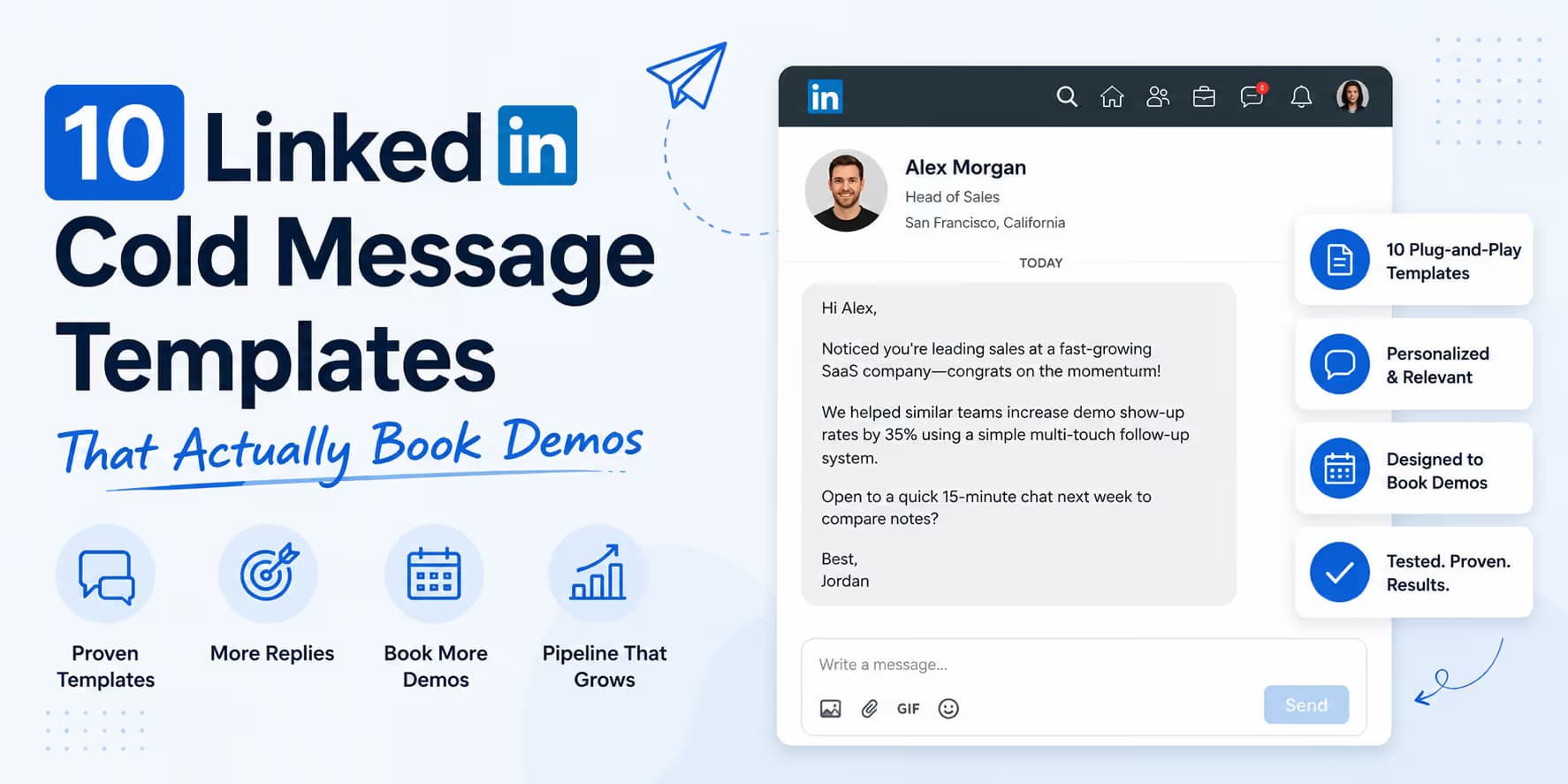
Most cold LinkedIn messages are deleted within three seconds of being opened. Executives, founders, and technical leaders have a low tolerance for generic pitches. The usual failure is the "premature pitch": trying to sell a product or book a 30-minute meeting before there is any trust, mutual relevance, or basic professional respect.
To book demos on LinkedIn in 2026, treat the first message as a peer conversation, not a transaction. You are looking for a shared challenge. Lower the friction of the ask and lead with a specific observation, and cold connections can turn into pipeline.
Shifting B2B outreach psychology
The nature of social selling has changed. Buyers are busier, and spam filters are better. If your outreach copy reads like an automated email that landed in LinkedIn, the conversion rate will approach zero.
Modern cold messaging starts with a different mindset:
- From pitching to observing: Never describe your product's features. Instead, describe a highly specific pattern or trigger you observed on their profile or company page.
- From booking to conversing: Do not ask for a call. Ask a simple, low-friction, conversational question that can be answered in one tap on a mobile device.
- From volume to value: Sending 50 hyper-targeted, well-researched messages will generate more pipeline than blasting 1,000 generic pitches that put your account at risk.
Why most cold message templates fail
The internet is crowded with "plug-and-play" templates. The moment a template becomes widely public, it loses all efficacy. Prospects recognize the sentence structures instantly. When thousands of SDRs send the exact same opening line, the entire strategy collapses.
Templates fail because they focus entirely on the seller rather than the buyer. They highlight company history, platform features, and sales goals, completely ignoring the buyer's current daily constraints and immediate operational bottlenecks.
Templated messages also tend to be long. Long paragraphs are hard to read on a phone. If someone has to scroll to finish, they usually archive it.
Anatomy of a cold message that converts
A cold LinkedIn message that converts behaves like a brief editorial hook, not a sales pitch. The structure is simple and direct:
| Section | Old Model (Spammy) | New Model (Conversational) |
|---|---|---|
| Opening Hook | "I hope this message finds you well..." | "Hi [Name], noticed your team recently launched..." |
| The Bridge | "We are an award-winning agency that..." | "Usually, expanding that fast makes [Problem] a major focus..." |
| Call to Action | "Are you free for a 30-min demo next Tuesday?" | "Worth a quick look, or too busy right now?" |
- The Relevance Bridge (0-15 words): Explains exactly why you are reaching out to them specifically, referencing a real trigger.
- The Disarming Observation (15-30 words): Points to a shared industry observation or trend without mentioning your product.
- The Low-Friction Offer (30-50 words): Shares a valuable resource, ideas, or poses a conversational question instead of pushing for a demo.
The Golden Rule of Friction
Never ask for a 30-minute calendar booking in your first message. A conversational request like "Open to seeing a 60-second video of how we did this?" lowers friction and increases positive response rates by up to 300 percent.
10 proven B2B outbound LinkedIn templates
These structures are meant to start a conversation. Swap the bracketed values for your market.
"Hi [FirstName], noticed that your team is currently expanding [Department] initiatives. Usually, that makes [SpecificOperationalProblem] a real challenge. We recently mapped out a 3-step checklist to make this process easier. Open to seeing the PDF?"
Why it works: Extremely contextual. It matches an initiative they are already thinking about, so the resource feels timely.
"Hi [FirstName], saw your comments on [Topic] last week. As a fellow [Role], I have been seeing a lot of teams struggle with [CommonPainPoint] in this market. Are you guys running into this as well, or have you found a way to bypass it?"
Why it works: It frames you as a peer seeking advice or comparing notes, completely removing the "sales rep" guard that executives put up.
"Hi [FirstName], saw you guys are utilizing [CompetitorProduct] for your [Process]. Usually, teams switch because they get tired of [CommonCompetitorFlaw]. We built a lean alternative specifically to solve that issue. Worth a look?"
Why it works: Highlights a known irritation in their daily stack. If they are actively experiencing that specific frustration, they will jump at a solution.
"Hi [FirstName], saw your focus on scaling [Metric]. We recently helped [SimilarCompany] drive a [Percentage]% increase in [Metric] using a lean outbound framework, without hiring more SDRs. I recorded a quick 90-second teardown of how we did it. Open to checking it out?"
Why it works: Social proof combined with extremely low friction. "90-second teardown" signals that they don't have to commit to a sales conversation to get the value.
"Hi [FirstName], saw you are also tracking the latest shifts in [IndustryTrend]. We have been building a custom model that simplifies [Process] under these new guidelines. Would love to share our findings if you are open to a brief chat."
Why it works: Positioned around industry education and joint interest. It invites collaboration, making it feel less like outbound sales and more like professional networking.
"Hi [FirstName], saw you guys are hiring for [JobRole] roles. Congrats on the growth. Usually, onboarding new reps makes [ManagementProblem] highly visible. We built a framework to automate this context delivery. Worth a quick look?"
Why it works: Hiring is a strong intent signal. It indicates new budget, but also new pains (training, tooling, infrastructure lag). Solving a hiring-related pain point works incredibly well.
"Hi [FirstName], with [Regulation/TrendName] taking effect, many [TargetIndustry] companies are rewriting their [Process] strategies. Are you guys adjusting internally, or keeping things as they are for now?"
Why it works: Creates slight FOMO (fear of missing out). It forces the prospect to evaluate if their competitors are adopting changes that they are ignoring.
"Hi [FirstName], noticed we are connected to [MutualConnection]. They have been doing incredible work with [Topic]. I noticed you guys are scaling [RecipientMetric] and wanted to connect peer-to-peer."
Why it works: Utilizes tribal trust. By mentioning a highly trusted mutual contact, your message immediately escapes the generic spam classification.
"Hi [FirstName], saw you registered for the upcoming [EventName]. I am hosting a small post-event discussion on [Topic] with a few B2B founders. Thought you might want to join us. Let's connect so I can drop the link."
Why it works: Connects onto an existing commitment on their calendar. You are providing an immediate community-driven benefit centered around a topic they are already investing time to attend.
"Hi [FirstName], saw you are an expert in [IndustryProcess]. I wrote a brief framework outlining how B2B teams can run this more cleanly in 2026. Would love to get your brutal feedback on it. Let's connect so I can send the outline?"
Why it works: Compliments their expertise and asks for a real opinion. People like sharing professional feedback.
Before you automate this workflow
Use the framework above to tighten targeting, message quality, and follow-up rules first. Automation should only be added after the manual version is clear enough to review and measure.
Technical setup and safety rules
To scale LinkedIn cold outreach without risking account suspensions, prioritize quality over volume. Large automation blasts trigger LinkedIn's heuristics quickly, and you get temporary locks or captchas.
Follow these core technical guidelines to keep your LinkedIn account safe:
- Respect the Weekly Connection Limit: Keep connection requests under 100 per week. Aim for an acceptance rate of over 35 percent by maintaining highly specific targeting.
- Spacing & Delays: Never allow automated tools to trigger events consecutively. Ensure delays between messages range randomly between 90 and 300 seconds, matching natural human cadences.
- Clean Pending Invitations: Periodically withdraw invitations that have been pending for more than 14 days. Keeping pending invites under 150 protects your domain authority and indexing.
- Use Intent Signals Carefully: Trigger sequences only when buyers publish relevant events, such as hiring, restructuring, product launches, or meaningful post engagement. This keeps outreach grounded in context instead of volume.
Frequently asked questions
Not necessarily. Data shows that a generic note actually decreases your acceptance rate compared to leaving the invitation blank. Only include a note if you have a highly personalized, specific trigger observation (e.g., matching one of the playbooks above). Otherwise, a blank request is safer.
Keep follow-up sequences to 3-4 steps total. Leave at least 3-4 days between steps. If a prospect hasn't engaged after four messages, move them to a long-term nurturing cycle rather than spamming their inbox.
Always exit gracefully. A response like "Completely understand, [Name]. Thanks for letting me know. I'll keep an eye on your updates from afar!" leaves a positive impression, keeping the door open for future outreach if their priorities shift.