
B2B SaaS inboxes are crowded. Executives, technical leaders, and founders get a constant stream of automated LinkedIn pitches that boast features like "AI-powered data models," "all-in-one dashboards," and "workflow integrations." Because every SaaS sales representative uses the same jargon, buyers have checked out.
To cut through the noise and book product demos in 2026, your LinkedIn outreach must discard software buzzwords completely. You must pitch the outcomes, not the tool. Your primary objective on LinkedIn is not to sell your software in the first message; it is simply to sell the conversation.
Navigating the SaaS outreach noise
Traditional SaaS outreach operates on a flawed assumption: that prospects care deeply about your product's underlying database speed, user interface design, or technical architecture. They do not. A VP of Sales does not buy CRM extensions because they love databases; they buy them to stop their sales reps from wasting five hours a week on manual logging.
When you send a cold message that outlines your platform's features, you are forcing the prospect to do the heavy mental lifting of figuring out how those features map to their daily business problems. Most prospects will simply delete the message to save themselves the effort. To capture their attention, you must start the conversation by describing their specific operational friction in their own language.
Outcome-based selling vs feature pitching
Frame your SaaS solution entirely around the specific operational pain points of the exact persona you are reaching. Different personas within the same company value entirely different outcomes. If you send the same feature-focused copy to every department, you will fail.
Consider how a single B2B SaaS tool needs to be framed across different stakeholders:
- The CTO / Tech Leader: Cares about data compliance, security architecture, API flexibility, and reducing developer maintenance overhead.
- The Head of Sales / Operations: Cares about increasing reps' daily output, eliminating manual admin bottlenecks, and pipeline visibility.
- The CFO: Cares about consolidation, tool redundancy, and driving immediate return on investment (ROI).
- The CEO: Cares about market validation, faster customer acquisition, and what each hire can produce.
The Jargon Purge Rule
Eliminate abstract verbs and buzzwords like "revolutionize," "disrupt," or "synergize" from your outreach copy. If a normal human being would not say a sentence in a casual conversation at a coffee shop, do not include it in your LinkedIn message.
Anatomy of a non-spammy SaaS pitch
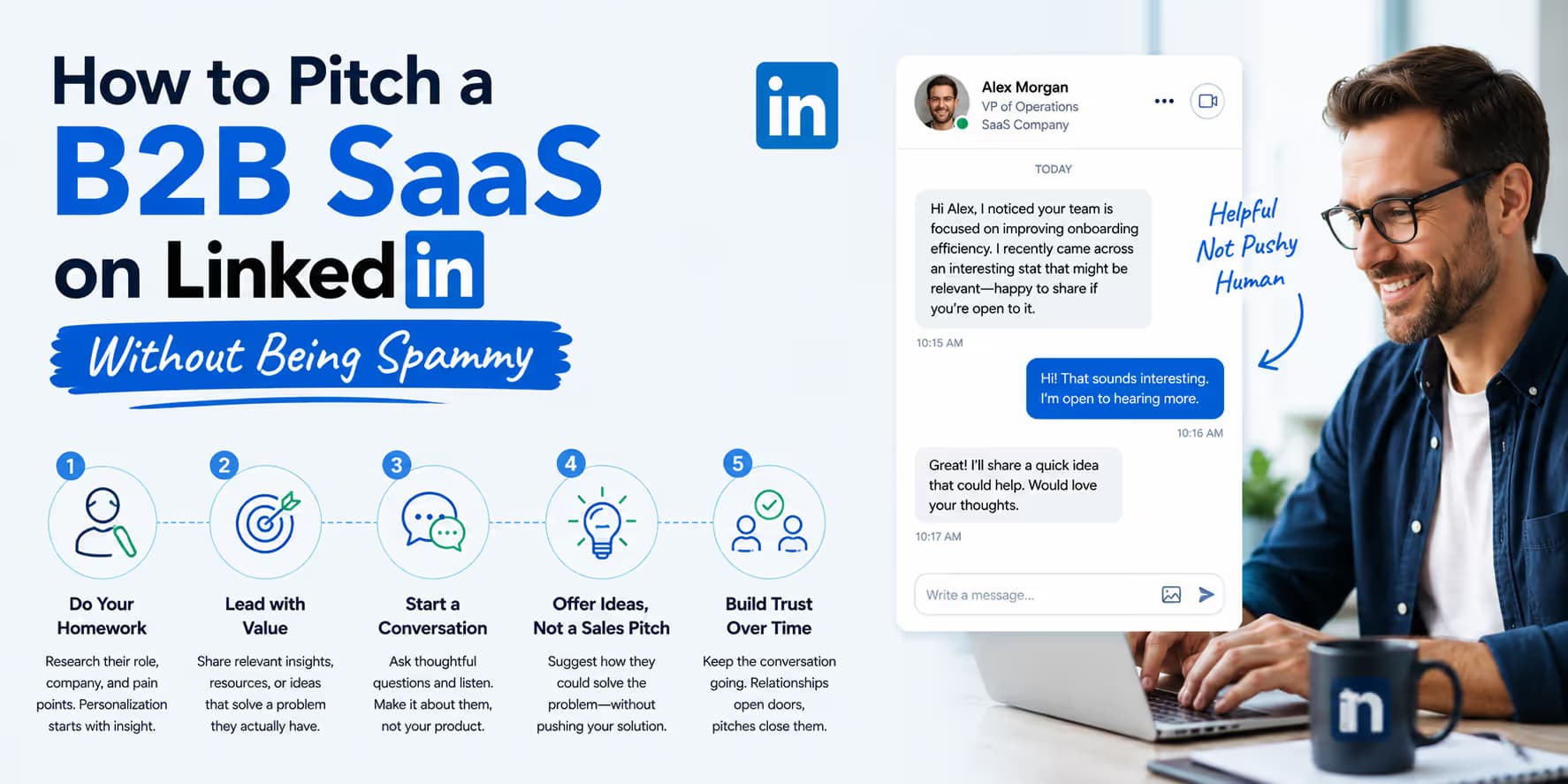
A highly effective B2B SaaS sales pitch on LinkedIn is concise, direct, and structured. It consists of exactly three targeted sentences:
Sentence 1: The Context Bridge (Why Them, Why Now)
Reference a concrete intent trigger, like a department hiring signal, a recent public launch, or a tech stack indicator. This answers the immediate question: "Why is this person in my inbox today?"
Sentence 2: The Core Metric Output (The Solution)
Explain exactly what metric you change, for whom, and how much. Keep this outcome-driven, utilizing specific numbers and removing all vague fluff.
Sentence 3: The Conversational Call to Action
Ask a disarming, low-pressure question to start a dialogue instead of pushing for a live calendar booking. Keep the exit path safe.
Using intent triggers
Before hitting send, verify you have a real operational reason to reach out to this specific account today. Sending a blind pitch without an intent signal is the fastest way to get classified as spam.
High-value intent signals include:
- Hiring Spikes: If a team is actively hiring multiple sales reps or developers, it indicates both allocated budget and upcoming operational pain (onboarding lags, tooling updates).
- Tech Stack Modifications: A shift in their public scripts (e.g., adding HubSpot, changing payment gateways, installing analytics) signals a major internal process rewrite.
- Content Signals: When an executive posts or comments about a specific operational issue on LinkedIn, they are raising their hand and requesting insight.
Omentir automates this entire process by crawling real-time B2B buying signals, scoring them against your ideal customer profile (ICP), and feeding personalized triggers directly into your outreach cadences.
3 conversational SaaS pitch templates
These templates prioritize dialogue-building over forced sales targets. Adapt each placeholder to match your prospect's exact profile:
"Hi [FirstName], noticed your team at [CompanyName] is running [DepartmentProcess] manually. Usually, handling this leads to [CommonError] or massive time leaks. We built a lightweight integration that cuts this process down to under 60 seconds. Worth a quick look?"
Scenario: Perfect for operational and technical roles who suffer from manual administrative fatigue. It focuses entirely on productivity gains.
"Hi [FirstName], saw your team is focused on [MetricGoal] this quarter. We recently helped [SimilarCompany] cut the manual work in their outreach, resulting in a [Percentage]% increase in demo bookings without adding any new headcount. I put together a quick video of the setup. Can I send it over?"
Scenario: Ideal for VPs, Directors, and executive decision makers who are heavily measured by department metrics and budget efficiency.
"Hi [FirstName], saw your team is rapidly scaling up your [Department] headcount. Usually, onboarding new hires makes [ManagementPainPoint] highly visible. We designed a clean, shared workspace specifically to automate this transition. Open to checking it out?"
Scenario: Works wonders when targeting founders or division heads who are experiencing rapid organizational expansion and the friction that accompanies it.
Keep the pitch useful before scaling
Use the pitch structure above to stay specific, useful, and low pressure. The right message should feel like a relevant business conversation before it feels like a sales motion.
A non-spammy B2B SaaS pitch workflow
A reader searching this title wants a practical way to pitch without sounding desperate. Use the following workflow before every LinkedIn pitch. It forces you to earn relevance before mentioning your product.
- Find the business trigger: Identify why this company might care now. Good triggers include hiring for a role your product supports, launching a new team, raising capital, changing tools, or publicly discussing a painful workflow.
- Translate the trigger into a problem: Do not say, "I saw you are hiring." Say, "Hiring three outbound reps usually creates pressure around lead quality and message consistency."
- Offer one narrow outcome: A spammy pitch lists features. A clean pitch offers a specific operational improvement, such as fewer manual research hours, cleaner handoffs, or more qualified replies.
- Ask for permission instead of forcing a demo: Close with a low-pressure question like, "Worth sending the short workflow?" or "Useful if I share the checklist?"
The final message should feel like a useful observation, not an ad. If the prospect could reply with "yes, send it" without booking a meeting, the pitch is low-friction enough for LinkedIn. Once they engage, you can earn the right to explain the product in more detail.
Three spam checks before sending
Even good SaaS products sound spammy when the message asks for too much too early. Run every pitch through these three checks before sending it on LinkedIn.
- The relevance check: Can you point to one public reason this buyer is likely to care right now? If the answer is no, do more research or skip the lead.
- The burden check: Are you asking them to book a call, watch a demo, read a long page, and evaluate your tool in the first message? Cut the ask to one small reply.
- The language check: Did you write phrases like "revolutionary platform," "quick call," or "synergy"? Replace them with plain language about the buyer's workflow.
A strong LinkedIn pitch should pass all three checks. It should feel timely, easy to answer, and written in the same language a real founder or sales leader would use in a one-to-one conversation.
Good pitch vs spammy pitch examples
A spammy pitch starts with the seller. A good pitch starts with the buyer's situation. Compare the difference. Spammy: "We built an AI platform that can help your team automate prospecting. Do you have 15 minutes this week?" Better: "Saw you are hiring two growth roles right now. Teams at that stage often struggle to keep outbound research consistent. Are you already solving that internally?"
The second version works because it is specific, tied to a public trigger, and easy to answer. It does not force the buyer into a demo before they have confirmed the problem. If the prospect replies, the next message can introduce the SaaS product as a relevant option rather than a surprise pitch.
Use the same rewrite process for every campaign. Remove the product claim, name the observed trigger, connect it to a likely business friction, and ask one question. That is the difference between pitching a B2B SaaS and spamming a buyer with a feature list.
B2B SaaS pitching FAQs
No. Free trials still represent a time commitment for busy professionals. They have to sign up, configure settings, and learn a new tool. Instead of pushing a trial, offer a brief, value-packed piece of content (like a checklist or case study) to build trust first.
Acknowledge and validate their choice immediately: "Great choice, [Name]. [Competitor] is an excellent tool. Usually, companies use them when they need [CompetitorStrength]. If you ever run into issues with [CompetitorWeakness], we'll be here. Mind if I send over a comparison chart for your future reference?"
Keep your initial outreach message under 75 words. Long, text-heavy paragraphs are extremely intimidating, especially when read on a mobile screen. Short, punchy messages drive up reply rates.