
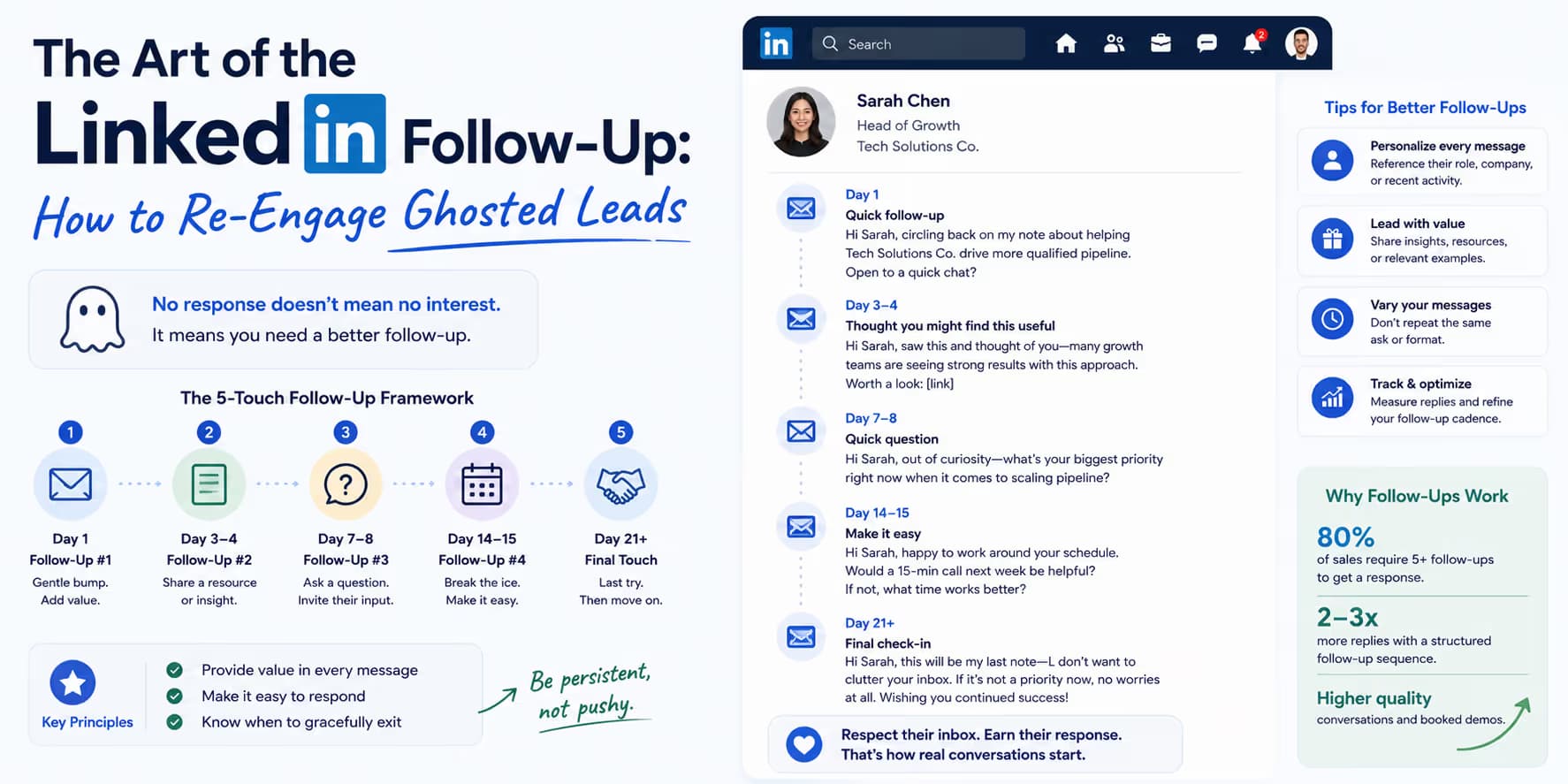
Getting ghosted on LinkedIn is a normal part of B2B sales. Decision makers are juggling projects, Slack, and a constantly updating inbox. A prospect who stops replying is rarely doing it out of malice. They got distracted, or an internal issue pulled them away.
The mistake most sales reps and founders make is sending generic check-in messages like "Just bumping this up" or "Checking if you saw my last message." Those lines offer nothing, add friction, and make archiving the easy choice. To restart a ghosted thread, make the reply cheap: less thinking, and a concrete reason to resume.
The psychology of the ghosted lead
To write an effective follow-up, you must first understand the mental state of the buyer who ghosted you. A busy decision maker receives dozens of notifications daily. If your last message required them to open a link, review a calendar, or make a complex strategic decision, they likely put it off until "later in the week." Over time, that thread sinks lower in their LinkedIn inbox as new messages pile on top.
When you send a follow-up that says "just checking in," you are essentially adding another item to their to-do list. You are asking them to do the work of reviewing your previous message, figuring out what you wanted, and drafting a thoughtful response.
A follow-up that actually gets replies bypasses this friction by:
- Reducing Cognitive Load: Posing questions that can be answered with a simple "yes", "no", or a single digit.
- Injecting New Context: Introducing a fresh, relevant observation or resource rather than rehashing the old hook.
- Restoring Agency: Making it safe for them to say "not right now" so they don't feel backed into a corner.
Three destructive follow-up mistakes to avoid
Before you send another message, verify your follow-up sequence is free of these standard outbound red flags that kill relationships instantly:
- The Guilt Trip: Messages like "I see you read my message but didn't reply" or "I guess you're too busy" create immediate defensive friction and permanently damage rapport.
- The Repetitive Bump: Repeating the same request over and over implies you have no additional insights to offer the prospect. "Any thoughts?" or "Bumping this!" signals low effort.
- The Immediate Breakup: Threatening to "close your file" in the second follow-up looks dramatic, manipulative, and unprofessional. Breakups should only be used as a final, clean exit.
| Mistake Type | What to Avoid | Better alternative |
|---|---|---|
| The Value-Free Bump | "Just bumping this up your inbox!" | "Saw this new data on [Topic] and thought of you..." |
| The Guilt Trigger | "Checking why you haven't responded yet." | "Assuming [Topic] is on the back burner for now. Totally fine." |
| The Calendar Push | "Let's book a call. Is Thursday at 2 PM free?" | "Would you be open to a 2-page PDF checklist outlining this?" |
The Golden Interval
Never follow up within 24 hours unless a specific meeting time was missed. Leave a minimum of 3 to 4 business days between touches to give prospects breathing room and avoid looking desperate.
The value-first follow-up framework
Every follow-up should bring new information or a fresh perspective to the table. Instead of requesting something from the prospect, present them with value. This could be a new industry case study, a relevant news article, a brief tactical idea, or a low-friction question about their current initiatives.
A standard Value-First follow-up consists of three steps:
- The Acknowledgment (Optional): A brief, disarming line that excuses their silence (e.g., "Hi [Name], assuming you're heads-down scaling [Department]...").
- The Value Pivot: Presenting a fresh asset, insight, or observation that directly relates to their business model or challenges.
- The Micro-CTA: Asking a conversational question that requires very little effort to answer.
4 actionable re-engagement templates
Use these exact re-engagement frameworks to safely restart stuck conversations in your outbox:
"Hi [FirstName], saw a lot of [Industry] leaders talking about [Topic] today. It reminded me of a project where we drove [Result] for [SimilarCompany]. I put the metrics in a 1-page summary. Would it be useful for your team?"
Strategy: Soft-re-engagement using third-party validation. If they were mildly interested before, seeing concrete metrics from a similar peer company will rekindle their interest.
"Hi [FirstName], completely understand you are swamped. To save you time, is [ProblemTopic] currently: 1) A priority for Q2, 2) On the back burner, or 3) Not relevant at all right now? Just reply 1, 2, or 3."
Strategy: Absolute lowest possible friction. This works extremely well on mobile devices because a busy executive can reply with a single character in less than three seconds.
"Hi [FirstName], thought you might enjoy this. We just released a short video breaking down how B2B teams can automate [Process] using intent crawlers. No gate, here's the direct link: [Link]. Hope it helps!"
Strategy: Selfless value delivery. By providing a link directly with no forms or meeting requests, you build enormous goodwill.
"Hi [FirstName], assuming this isn't a priority for [CompanyName] right now. I'll stop mapping out ideas for your [Department]. If things change down the road, feel free to reach out. Keep crushed!"
Strategy: Pulling away. Loss aversion is the idea: when you take the offer off the table, the prospect sometimes replies to reclaim it.
A practical sequence timeline
Following up is a game of strategic timing. Blasting messages too quickly looks like spam; waiting too long allows the prospect's memory of your brand to cool down completely.
We recommend a structured four-touch re-engagement cadence spread over three weeks:
Step 1: The Initial Outreach (Day 1)
Your high-context, trigger-based opening message offering a conversational entry point.
Step 2: Value Pivot (Day 4)
Three days later. Share a relevant third-party asset or case study that validates your original premise.
Step 3: Low-Friction 1-Click Option (Day 9)
Five days later. Offer a multiple-choice triage message to make it incredibly easy for them to self-select their interest level.
Step 4: Clean Breakup (Day 15)
Six days later. Withdraw the offer politely. This is where up to 25% of stuck opportunities respond to keep the conversation alive.
Avoid overlapping follow-ups
Use the follow-up rules above to avoid accidental pressure. Pause active follow-ups when a prospect replies, engages, or shows that the timing is not right.
Follow-up rules by ghosting scenario
Not every ghosted lead should receive the same follow-up. The right re-engagement message depends on where the conversation stopped and how much intent the prospect already showed.
- Accepted but never replied: Send one short context-based note. Do not reference the silence, and do not ask for a meeting immediately.
- Replied once, then disappeared: Follow up by returning to the exact problem they mentioned. Make it easy to answer with one sentence.
- Asked for information, then vanished: Send a summarized takeaway instead of another attachment or long resource.
- Booked a call, then no-showed: Avoid blame. Offer two simple paths: reschedule or close the loop if priorities changed.
This scenario-based approach keeps follow-ups relevant. The goal is not to pressure the buyer into responding. The goal is to make the next reply feel easy enough that ignoring you is no longer the lowest-friction option.
Follow-up copy quality checklist
Before sending a follow-up, check whether the message gives the prospect a real reason to reply. A good follow-up references the previous context, adds one useful detail, and asks a question that can be answered quickly.
- Specific: It names the problem, trigger, or resource from the earlier conversation.
- Brief: It can be read on a phone without opening a long text block.
- Useful: It adds a new angle, not just "checking in."
- Easy: It gives the buyer a low-effort way to answer, delay, or decline.
When to stop following up
Good follow-up also requires knowing when to stop. If a prospect has ignored multiple relevant, spaced-out messages and has shown no new trigger, continuing to push will damage the relationship. Move them into a passive nurture bucket instead of sending another direct message.
Stop active follow-up after three thoughtful attempts unless the account is strategically important or a new signal appears. A new signal could be a funding round, leadership change, hiring push, public post about the problem, or direct engagement with your content. Without a new signal, another message usually feels like pressure rather than value.
This boundary protects your reputation. Re-engagement works when the buyer feels respected. The goal is to restart a useful conversation, not to force a response from someone who has clearly chosen silence.
Frequently asked questions
Wait 24 to 48 hours after they accept before sending your first value message. Sending a sales pitch the exact millisecond they accept your invite looks extremely automated and will prompt them to remove you immediately.
Yes! A multi-channel approach increases booking rates significantly. If a lead has accepted your connection but ignored your messages, wait 7 days, then send a highly contextual email referencing your LinkedIn connection request to move the thread to a more formal channel.
Standard practice is to reply: "Will do, [Name]. To make sure I only reach out with relevant updates, is there a specific goal or blocker your team is tackling in [Month]?" This qualifies the lead so your future follow-up is highly targeted.