
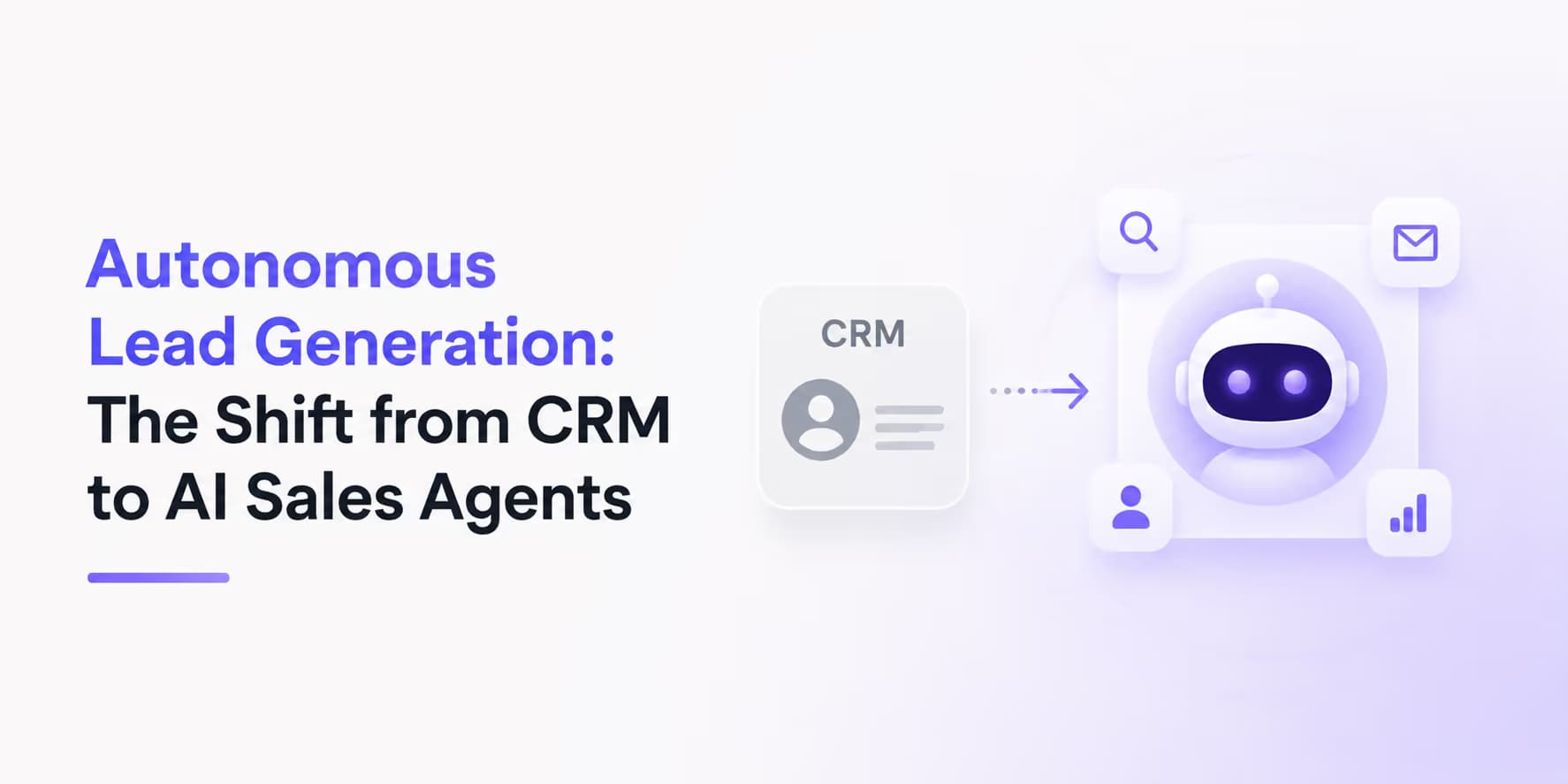
B2B sales technology is going through its largest change in decades. For years, the Customer Relationship Management (CRM) database sat at the center of sales. Organizations spent millions implementing, customizing, and maintaining databases like Salesforce and HubSpot. Those systems were digital filing cabinets: they cataloged contacts, tracked pipelines, and logged activity history.
However, traditional CRMs are inherently passive. They do not discover leads, research target company websites, write personalized pitches, or execute multi-channel campaigns. To generate pipeline, companies were forced to hire teams of Sales Development Representatives (SDRs) whose days were consumed by manual, repetitive tasks: exporting databases, cleaning CSV sheets, writing cold emails, and navigating social platforms.
As the cost of acquiring customers has skyrocketed and B2B buyers have become increasingly resistant to generic, high-volume automation, sales organizations are moving toward an active, AI-first model. Rather than relying on passive CRMs, growth teams are adopting autonomous AI sales agents. These systems connect lead discovery, enrichment, multi-channel outreach, and conversational qualification in a single, self-optimizing workspace.
The architectural limits of traditional CRM systems
To understand why the B2B sales stack is consolidating, we must evaluate the core structural limitations of legacy CRM architectures. CRMs were designed in an era of centralized databases and predictable sales cycles. Their primary purpose was record-keeping: providing management with visibility into sales activity.
This passive design introduces three major operational bottlenecks for modern sales teams:
- Data decay and administrative overhead: B2B data decays rapidly. Leads change companies, domains are retired, and roles change. Sales reps spend up to 40 percent of their time manually cleaning contacts, updating deal stages, and copying activity logs.
- Disjointed sourcing and execution: CRMs do not handle active prospecting. To build campaigns, teams must integrate external search databases, scraping tools, email verification APIs, and sequencing platforms. This multi-tool approach leads to data fragmentation, broken sync lines, and high subscription fees.
- Linear sequencing constraints: Legacy sequencers are built on rigid, linear drip campaigns. If a prospect replies with a vague objection, the sequencer is paused, and a human rep must manually read, classify, and follow up, slowing down the sales cycle.
Cross-linking notes
Before deploying an active sales agent, ensure your personal brand is positioned to build trust. Read our step-by-step playbook on Crafting a LinkedIn Profile That Doubles Your Outbound Acceptances to optimize your landing page for cold leads.
The rise of autonomous AI sales agents
Autonomous AI sales agents change how B2B sales development works. Instead of a static directory, an AI agent is an active, context-aware salesman that runs the pipeline generation loop on its own.
Instead of forcing you to build data pipelines, an AI agent like Omentir unifies the entire sales loop in a single workspace:
- Prompt-to-Lead Sourcing: Define your ideal customer profile in simple English prompts. The AI salesman automatically crawls company sites, job listings, and news sources to discover highly targeted leads matching your criteria.
- Context-Aware Research: The agent crawls every target company's website, scans recent press releases, and reviews decision-makers' social profiles to identify specific business triggers and challenges.
- Autonomous Multi-Channel Execution: The system writes personalized messages and coordinates campaigns across LinkedIn and cold email, managing safety limits, domain health, and follow-up cadences automatically.
Traditional CRM stack vs. autonomous AI salesman
Compare the operational capabilities of a CRM-centric sales stack with an active AI salesman workspace:
| Feature / Dimension | Traditional CRM Stack | Omentir (AI Salesman) |
|---|---|---|
| System Type | Passive record-keeping database | Active autonomous outbound salesman |
| Lead Sourcing | Requires external database subscriptions | Native prompt-driven real-time lead discovery |
| Data Hygiene | Manual updates and third-party API cleanups | Real-time enrichment and validation prior to sending |
| Outreach Channels | Requires separate email sequencers and LinkedIn tools | Fully unified LinkedIn actions and cold email |
| Reply Management | Manual classification and follow-up updates by reps | AI-driven intent categorization and automated nurturing |
The operational economics of AI-first sales
Beyond technical capabilities, transitioning to an autonomous sales layer completely restructures outbound economics. Sourcing leads, verifying contact details, and coordinating campaigns across separate tools represents a major monthly expense.
By consolidating these disjointed systems into a unified, autonomous SDR workspace, organizations reduce software costs and eliminate hours of manual data administration. This efficiency lets your sales team focus on what they do best: building relationships and closing high-value deals.
Human-in-the-loop supervision and safety throttles
While AI agents can save a lot of time, brand reputation and safety still matter. Outbound campaigns should never run on autopilot.
High-performance teams deploy a Human-in-the-Loop model. In this setup, the AI salesman handles lead discovery, crawls company sites, and drafts highly personalized pitches. Before campaigns are sent, a human operator reviews the matches, makes adjustments, and approves the pipeline, combining AI scale with human oversight.
A roadmap to autonomous pipeline scaling
Ready to run sales development without the administrative burden of a traditional CRM stack? Follow this three-step blueprint:
- Map sourcing intent signals: Look for target triggers such as job listings, fundraisings, technology stack changes, and product launches to guide your campaigns.
- Consolidate sourcing and execution: Choose a unified, autonomous workspace that keeps lead generation, data verification, and outreach tightly integrated to protect sender health.
- Design conversational, low-friction sequences: Keep messages concise and focus on building relationships rather than pitching features immediately.
What changes when the agent owns the workflow
The move from CRM to AI sales agents is a change in where the work happens, not a software upgrade with a new label. In a CRM-first motion, the system records what a human already did: a contact was added, a note was written, a task was created, or a deal stage moved. In an autonomous lead generation motion, the agent performs the early work before a human ever opens the account record.
That creates four practical changes for a growth team. First, lead research becomes continuous instead of quarterly. The agent can keep checking target markets for newly funded companies, new job posts, leadership changes, and fresh product launches. Second, qualification becomes evidence-based. Instead of accepting every contact that matches a title filter, the agent can reject prospects that lack a relevant pain signal. Third, messaging becomes dynamic. The first message can reference the reason the lead was sourced in the first place. Fourth, reporting becomes more useful because every reply can be tied back to the signal, channel, and message angle that produced it.
- Old workflow: Buy a list, upload contacts to the CRM, assign tasks, and hope reps personalize before sending.
- New workflow: Define the ICP, let the agent source qualified accounts, review risky messages, and spend human time only on interested replies.
- Old success metric: Number of new records created.
- New success metric: Number of context-rich conversations opened with accounts that fit the buying profile.
A CRM still matters after the conversation becomes real. It remains the system of record for opportunities, revenue forecasts, and customer history. The mistake is expecting a CRM to create pipeline by itself. Autonomous sales agents sit before the CRM, turning market signals into qualified conversations that are worth recording.
Migration roadmap from CRM-first to agent-first
Teams do not need to abandon their CRM to benefit from autonomous lead generation. The safer move is to shift the earliest part of the funnel first. Keep the CRM as the revenue record, then let the AI sales agent own the discovery, qualification, and first-touch workflow before a deal exists.
Start with one narrow segment and compare the agent against your current list-building process. Measure how many sourced accounts pass manual review, how many messages require edits, how many prospects reply, and how many replies turn into meetings. This controlled test prevents the team from judging the system on volume alone.
- Phase 1: Keep CRM ownership unchanged, but feed it only qualified conversations rather than raw scraped contacts.
- Phase 2: Let the agent enrich and score accounts while humans review the first 50 messages for tone and accuracy.
- Phase 3: Expand to additional segments only after reply quality, meeting quality, and account safety are stable.
This roadmap keeps the shift practical. The goal is not to replace every sales process at once. The goal is to move repetitive research and first-touch work away from humans while preserving human judgment where revenue risk is highest.
Agent-first lead generation checklist
Use this checklist to make the shift concrete. A lead generation system is truly agent-first only when it can define the target account, search for evidence, reject weak matches, draft a context-aware message, and route replies without a human manually moving data between tools. If humans still need to copy contacts into a spreadsheet, enrich each row, write every opener, and remember every follow-up, the workflow is still CRM-first with an AI label attached.
- ICP clarity: The agent has a written definition of good-fit and bad-fit accounts.
- Signal depth: The agent can explain why each account is relevant now.
- Message control: Humans can review or edit high-risk drafts before launch.
- Routing: Interested replies are separated from objections, referrals, and not-now responses.
- CRM handoff: Only useful conversations and qualified accounts enter the CRM.
When all five conditions are true, the CRM becomes cleaner because it receives fewer low-intent records. Sales leaders also get a more honest view of pipeline because the top of funnel is measured by qualified conversations, not raw contacts.
Autonomous sales FAQs
No. CRMs remain the system of record for active customer relationships, contract management, and closed revenue. AI sales agents replace the fragmented outbound stack, automating lead generation, prospecting, and early qualification, and then push qualified deals directly into your CRM.
Outreach channels enforce strict activity limits. Blasting hundreds of messages daily triggers account reviews. Autonomous agents feature built-in safety throttles, gradual account warm-ups, and natural spacing to mimic human behavior and protect account health.
Yes. Omentir functions as an active outbound workspace that qualifies B2B leads autonomously and pushes hot prospects, conversational history, and booked demo information directly into your central CRM system.