
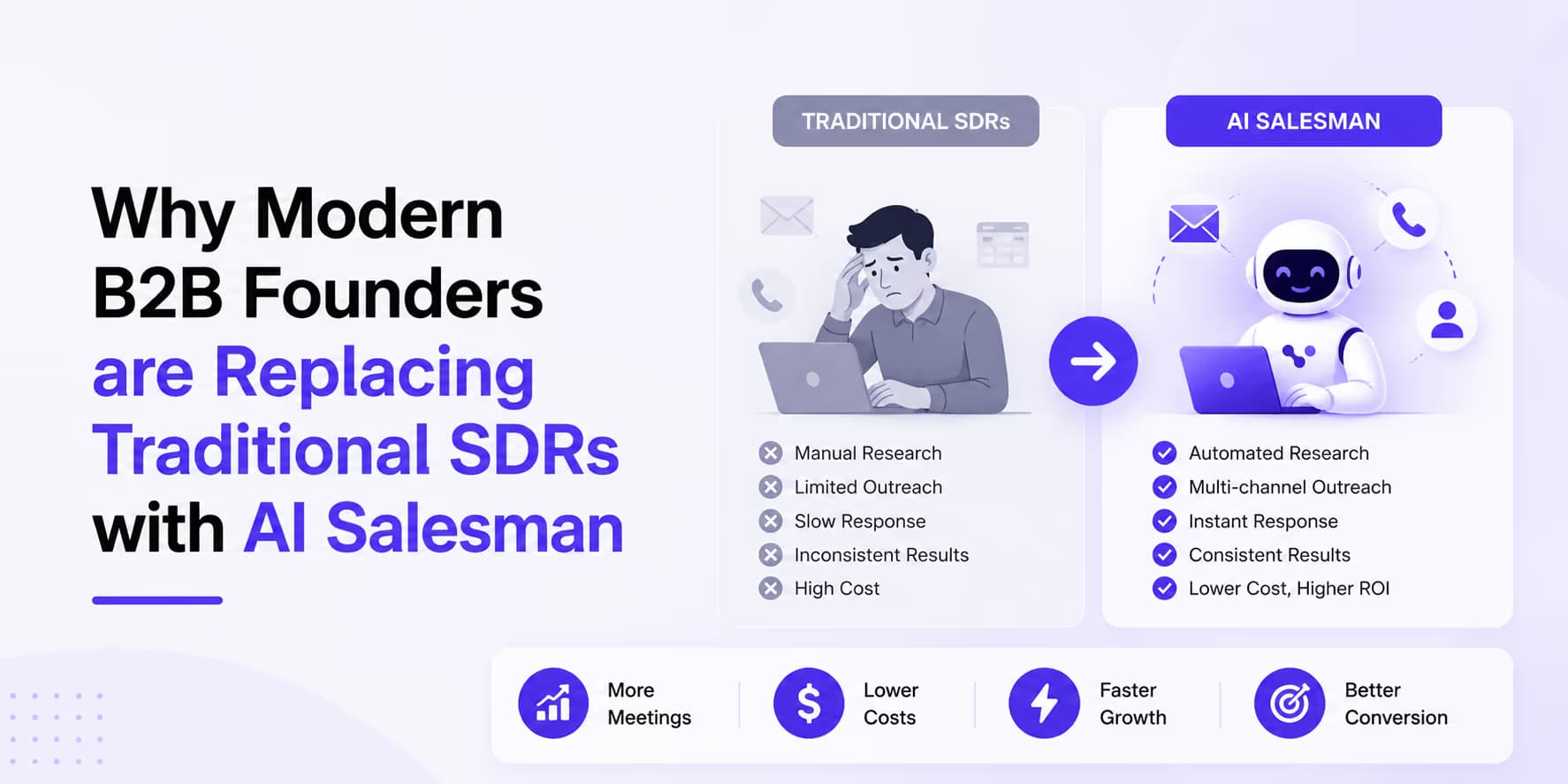
B2B customer acquisition is under pressure from declining conversion rates, higher labor costs, and spam filters. For over a decade, the standard playbook for growing a B2B SaaS startup or service agency was to scale outbound volume. Founders built large, junior teams of Sales Development Representatives (SDRs) whose job was manual prospect discovery, list enrichment, and copy-paste messaging.
That labor-heavy playbook is failing. Email providers have implemented strict spam regulations, LinkedIn actively restricts profiles using low-grade automation, and buyers are tired of templated outreach. Scaling headcount is no longer the obvious path to scaling revenue. Founders are replacing traditional SDR structures with autonomous AI salesman: software-defined prospecting that can run faster, write more specific first drafts, and cost less than another hire.
The economics of human SDRs vs autonomous systems
To understand why founders are making this transition, one must analyze the total cost of ownership (TCO) associated with a traditional human SDR team. An entry-level SDR in the North American market commands a base salary between fifty thousand dollars and eighty thousand dollars. When adding on-target earnings (OTE), health benefits, payroll taxes, recruiting fees, and managerial overhead, the true cost of a single representative regularly exceeds one hundred thousand dollars annually.
Furthermore, a human SDR cannot operate in a vacuum. To perform their daily tasks, they require an expansive and expensive subscription software stack. This stack typically includes database access like Apollo.io, Lusha, or Cognism, list enrichment engines like Clay, sequence delivery systems like Instantly or Smartlead, and premium LinkedIn accounts. This tooling adds an additional ten thousand dollars to fifteen thousand dollars per year per seat.
The operational math becomes even more challenging when considering performance metrics. The average tenure of a human SDR is currently under fifteen months, with a ramp-up period of three to four months before reaching full productivity. This high turnover means founders are constantly stuck in a loop of hiring, onboarding, and training, only to have representatives depart just as they become productive.
Autonomous AI sales software operates with different economics from hiring an SDR. The cost is usually a software subscription plus usage, not salary, benefits, management time, and ramp time. The table below outlines the operational comparison between these two models:
| Operational Metric | Traditional Human SDR Team | Omentir Autonomous AI Agent |
|---|---|---|
| Annual Fully-Loaded Cost | $100,000 to $130,000 per representative | Fraction of software subscriptions and API tokens |
| Prospecting Capacity | 50 to 100 prospects researched per day | Thousands of records analyzed in seconds |
| Process Consistency | Variable (highly dependent on mood and energy) | Absolute (24/7/365 operational uptime) |
| Onboarding and Setup Time | 3 to 4 months of training and market ramp-up | Immediate configuration and instant deployment |
| Data Hygiene and Flow | Manual, error-prone data entry across multiple tools | Fully automated, native enrichment and validation |
An autonomous system does not require sick leave, does not suffer from cold outreach rejection fatigue, and maintains absolute process consistency twenty-four hours a day. It conducts prospect research and processes intent data with mathematical precision, ensuring that no lead is dropped or ignored.
Output per person for lean teams
Managing outbound sales as a small team requires extreme efficiency. See the tactical frameworks in our guide on Outbound Sales for Solo Founders to optimize your resource allocation.
Consolidating the fragmented B2B sales stack
Traditional outbound workflows are plagued by severe data fragmentation. A standard SDR spends up to sixty percent of their working day performing administrative data entry and managing disjointed data pipelines. They must export leads from a database, import them into an enrichment sheet to find contact information, run technographic queries, verify email deliverability, upload the verified list into an outreach tool, and manually track replies.
This fragmented workflow creates massive inefficiencies. Every manual step is a point of failure where data can be lost, incorrectly formatted, or misaligned. For example, a mismatch in column mapping can lead to sending an email with a broken tag, instantly destroying a company's brand reputation. Managing multiple individual software subscriptions also increases administrative complexity and recurring billing costs.
To attempt to solve this fragmentation, some teams attempt to use platforms like Artisan AI, 11x.ai, or Gojiberry. However, many of these systems still function as basic scrapers layered with superficial email integrations, requiring heavy external configurations.
Autonomous systems can reduce this bottleneck by consolidating more of the outbound workflow into one workspace. The useful capabilities are plain-English ICP descriptions, enrichment cascades, account scoring, draft generation, and reply intent detection. The buyer should evaluate whether consolidation genuinely reduces work or simply hides complexity behind another tool.
Rather than buying and stitching together separate licenses, founders can evaluate whether a single system can manage enough of the lifecycle to be worth the tradeoff. Consolidation can reduce data silos and handoff errors, but only if the team still has visibility into targeting, messaging, and reply handling.
The hidden overhead of multi-tool outbound setups
When you rely on separate databases and delivery tools, your team can become system integrators instead of sales professionals. Custom scripts, brittle automations, and enrichment failures can break the pipeline. A unified workflow is valuable only when it reduces this overhead while keeping the underlying data and messaging decisions auditable.
Linguistic precision and personalization at scale
Modern B2B decision-makers are highly skilled at identifying automated outreach. Traditional sequencing platforms rely on basic merge tags to insert a prospect's first name or company name into a generic template. This shallow personalization is no longer effective. Buyers receive dozens of these formulaic messages daily and systematically ignore them.
To break through the noise, outreach must demonstrate genuine context and deep understanding of the prospect's business challenges. Achieving this depth of personalization manually is incredibly slow. A human SDR can spend thirty minutes researching a single prospect's profile, recent posts, website, and technographic stack to write one highly custom email. This manual speed limits outbound volume to a maximum of fifteen or twenty accounts per day.
This is where autonomous AI agents can help. An agent can read a prospect's public profile, scan company announcements, analyze active technology signals, and produce a first draft quickly. The draft still needs human judgment, because concise peer-level messaging is more important than producing a large volume of AI-written copy.
The danger of over-automation and how to prevent it
Unregulated AI writing tools often generate robotic, excessively polite, or overly long messages that trigger skepticism. To improve reply quality, the system should produce short, problem-centric inquiries rather than long product pitches, and the team should review examples before trusting the workflow at scale.
To optimize your opening lines, check out our guide on Writing High-Converting LinkedIn Connection Requests, which outlines the core rules of personalized hooks. You can also use our curated list of 10 LinkedIn Cold Message Templates to quickly structure your initial messaging flows.
Putting humans on late-stage sales work
Replacing SDRs with autonomous agents does not mean eliminating human involvement from the sales process. It raises the bar for what humans spend time on. In a traditional outbound model, junior representatives spend eighty percent of their energy on tedious prospecting and administrative tasks, leaving only twenty percent for actual buyer interaction.
By automating parts of top-of-funnel discovery, enrichment, and first-draft outreach, founders can shift more human effort toward late-stage pipeline management. When a system identifies a warm lead and classifies reply intent, a founder or senior account owner can step in to guide the conversation.
That shift raises output per person. Humans are better at building relationships, running custom product demonstrations, answering integration questions, and negotiating contract terms. Software agents handle the repetitive volumes of cold outreach. People handle the high-touch conversions.
This hybrid approach allows early-stage startups to maintain a lean headcount while driving enterprise-level sales volume. A single founder, backed by an autonomous outbound agent, can generate and manage a sales pipeline that would normally require a team of three or four human SDRs.
Establishing a scalable founder-led sales routine
Startups do not need to hire a full-scale sales team to build a healthy pipeline. By integrating intelligent software into your morning workflow, you can handle lead generation in minutes. For an efficient breakdown of this daily process, review The 15-Minute Daily Outreach Routine. This structured workflow ensures you stay focused on revenue-generating actions without losing hours to manual administration.
A blueprint for autonomous outreach campaigns
Transitioning to an autonomous sales model requires a structured, process-driven approach. Founders cannot simply turn on an agent and expect immediate results; they must establish clear parameters and strategic guardrails.
First, define your Ideal Customer Profile (ICP) using plain-English descriptions rather than rigid database filters. Traditional platforms require precise keywords, but autonomous agents can search and interpret abstract requirements, such as \"B2B SaaS companies that recently migrated to cloud caching.\"
Second, set up structured enrichment cascades. Verify email deliverability and gather relevant technographic details before outreach. This keeps targeting grounded in current data instead of assumptions.
Third, construct multi-touch sequences that combine LinkedIn social actions and cold email outreach. A balanced approach that blends social touchpoints with direct email is far more effective than relying on a single channel. For a detailed comparison of these channels, consult our analysis on LinkedIn Outbound vs. Cold Emailing in 2026.
Ensure you adhere to safe daily volume limits to protect your domain and profile reputation. Keep daily cold emails below fifty per inbox and LinkedIn connection requests below twenty. This conservative approach, combined with hyper-personalized messaging, is key to building a healthy, sustainable pipeline.
To structure your messaging sequences effectively, utilize our Sequence Setup Blueprint to design high-converting outreach flows. When leads inevitably go quiet, you must also master the art of re-engagement. Learn how to recover slipping opportunities in our playbook on Re-Engaging Ghosted Leads.
- Define Plain-English ICPs: Stop relying on simplistic title and region filters. Instruct your autonomous agent to search for companies based on specific buying signals, technographic stacks, or company-wide transitions.
- Configure Enrichment Cascades: Verify contact details, social profiles, and technographic markers without relying on a single stale source. Use a unified tool if it reduces operational complexity, but keep the verification rules visible.
- Implement Safety-First Sequencing: Scale your volume gradually. Avoid bulk blast tools that endanger your email domains and social accounts. Focus instead on highly targeted, staggered campaigns.
- Route Intent Alerts to Active Workspaces: Connect response streams directly to your team's primary workspace, such as Slack or Discord, so warm leads can be addressed immediately.
Evaluate the workflow before automating it
Use the framework above to decide which SDR tasks should be automated, reviewed, or kept human-owned. The best setup depends on deal size, market size, and brand risk.
Frequently asked questions
No. Omentir integrates lead discovery, detailed list enrichment, and verification cascades into a single subscription. This eliminates the need to purchase separate accounts for databases, email finders, or validation tools.
The system relies on advanced semantic parameters to study real-time technographic profiles, public announcements, and website text. It then structures highly concise, conversational messages modeled on peer-level dialogue, avoiding excessive marketing pitch copy.
Yes, provided you strictly avoid massive bulk volumes. Omentir prioritizes profile security by scaling interactions gradually and utilizing random, staggered delay timing intervals, keeping all activity well within native system limits.
The agent continuously monitors message streams, categorizing responses by buying intent. When a warm reply is received, the system routes an alert to your Slack or workspace, allowing your team to instantly step in and share scheduling links.