
If you run outbound sales for a B2B startup, you have probably noticed a sharp decline in response rates over the last two years. The tools that once built pipeline reliably - databases loaded with emails, connected to bulk sending tools - now generate little more than spam flags and ignored requests.
The reason is simple: buyers are overwhelmed. Inboxes are flooded with automated messages that look identical because they are built from the same static templates. Security filters on platforms like LinkedIn and email providers have adapted, flags are easier to trigger, and ignore rates are at an all-time high.
The traditional sequencer was built for a different era of sales. It assumes that outreach is a linear game of volume: import more leads, send more emails, and wait for a meeting. Today, this high-volume approach only hurts your domain reputation. To land meetings with qualified buyers, you must shift your focus from raw volume to context-aware, human-paced engagement.
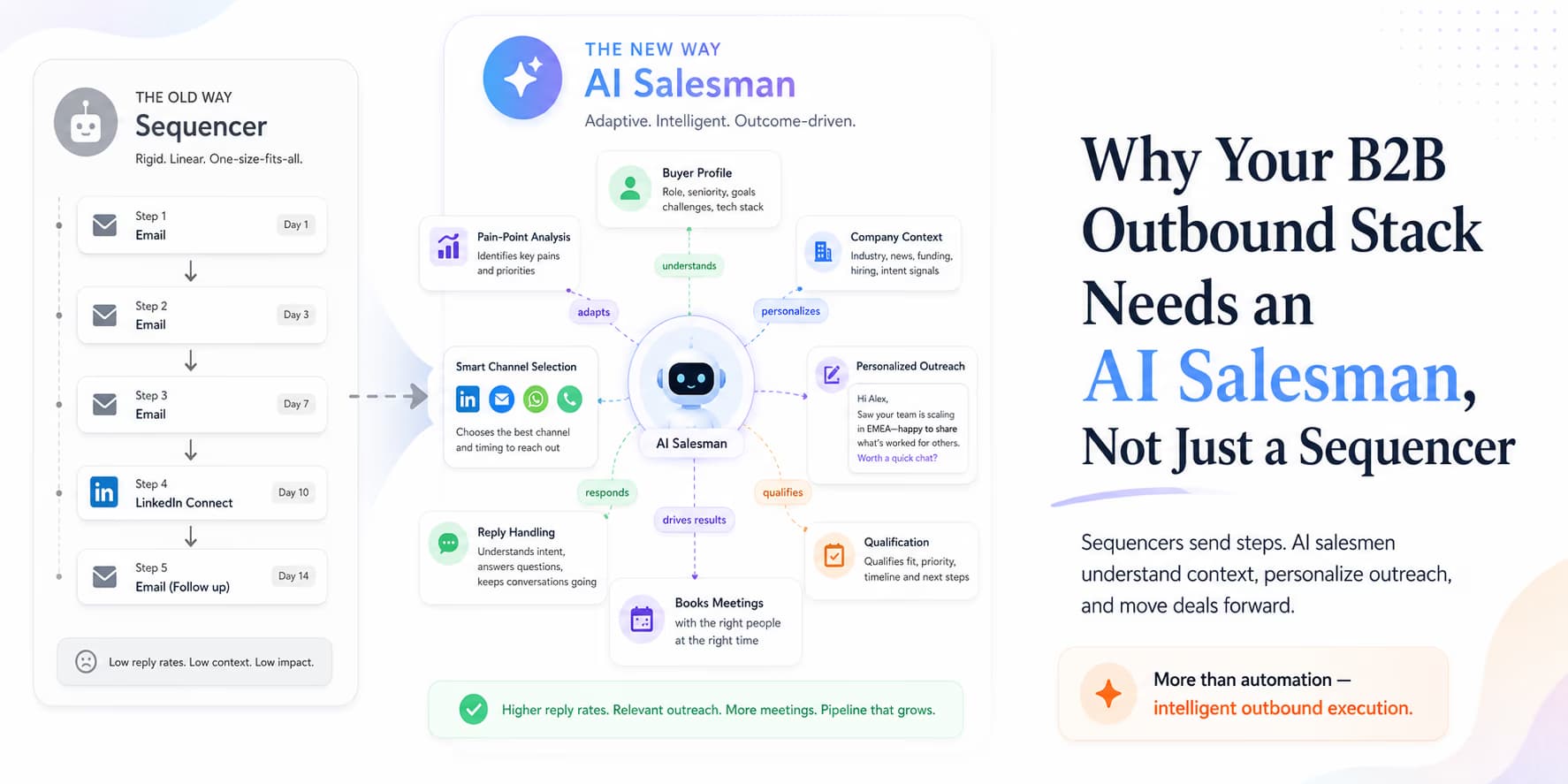
This is where an AI salesman comes in. Platforms like Omentir replace static sequence steps with execution loops: discover, verify, and message prospects while keeping the profile inside safe limits. Linear sequencers fail for a simple reason. They cannot inspect context before they send.
The shift is not from humans to robots. The shift is from rigid steps to context-aware assistance. Your team still owns positioning, approval, and sales judgment; the agent handles the repetitive research and drafting that slow everyone down.
What is the difference between a sequencer and an AI salesman?
To see why outbound has to change, separate a sequencing tool from an autonomous AI agent.
A sequencer is a dumb execution engine. It relies entirely on rules set by a human operator: send email 1 on day 1, send connection request on day 3, send follow-up on day 5. If a lead does not fit your Ideal Customer Profile (ICP), the sequencer does not care. If the lead is actively hiring for a competitor, the sequencer does not adjust. It simply blasts the pre-programmed copy.
An AI Salesman, by contrast, is a context-driven operator. It is built to analyze the environment before taking action. Instead of executing fixed steps, it runs an execution loop:
- Research: The agent reads your target's corporate website, reviews their job postings, and skims their recent social updates.
- Evaluation: It scores the prospect against your specific ICP criteria, rejecting low-fit accounts before sending a single note.
- Personalization: It drafts copy from scratch using verified product details rather than plugging name variables into generic templates.
- Handoff: It places the drafted campaigns in a review queue, allowing you to edit and approve every touchpoint.
This level of context ensures your messages read as peer-to-peer conversations, not automated filler.
The Core Value Rule: Context Wins
A static sequencer asks: "How many contacts can we message today?" An AI Salesman asks: "Which of these high-fit prospects are facing the specific challenges we solve right now, and what is the best way to open a relationship?"
From raw scraping to intent-driven discovery
The first stage of any outbound campaign is lead generation. Most teams use large databases like Apollo.io or scrapers to build lists. The result is a static spreadsheet containing thousands of names that are often outdated or cold.
When you feed these unverified lists into email sequencers like Instantly.ai or Smartlead, you burn your sender reputation. A high bounce rate or spam flag index will trigger filters that send your emails straight to the promotions tab.
An agentic system handles that decay. Instead of exporting lists once a month, Omentir runs daily discovery agents that search for active signals. It checks whether companies are expanding, using specific technologies (technographics), or posting about relevant pain points.
By filtering for these active signals, your campaign targets only warm prospects. This targeted approach keeps bounce rates low and response rates high. For a deeper look at list setup, read our guide to ICP-based lead discovery workflows.
How AI salesmen personalize messages without templates
Traditional sequencers rely on merge tags like `{first_name}` and `{company_name}` to personalize messages. This basic approach no longer fools modern buyers. Anyone with an inbox can spot a templated message in seconds: "Hi {first_name}, I saw you are the {title} at {company_name}. We help {industry} companies grow..."
To get replies from busy executives, you must write conversational, specific copy. Omentir accomplishes this by training generative models on a verified product profile. Rather than using pre-written templates, the system drafts custom messages based on the prospect's profile data.
That engine writes pitches that read like a founder spent 10 minutes on the profile. The agent combines product facts with specific context hooks. See sales pitch personalization structures.
Handling LinkedIn replies and objection routing
The biggest failure point of traditional sequencing is reply handling. When a prospect replies to a sequencer email or LinkedIn note, the sequence stops, but the conversation often stalls. The sales rep must manually log in, read the message, draft a reply, and book the meeting. If the rep is busy, replies can sit for days, killing momentum.
If the prospect replies with an objection like "not interested right now," a linear sequencer simply stops. The lead is archived, and the potential value is lost.
An AI Salesman manages this entire reply lifecycle. Omentir monitors your LinkedIn threads and collects incoming replies in one unified inbox. The system reads the message, classifies the prospect's intent (e.g., interested, objection, bad timing), and drafts an appropriate reply.
If a prospect says, "We don't have the budget this quarter," the agent does not quit. It drafts a soft reply acknowledging the timing and asks if it can share a relevant resource in 3 months. This keeps the relationship alive without requiring manual updates from your team. For a step-by-step reply playbook, check out our article on AI reply classification playbooks.
The math: SDR costs vs autonomous systems
Compare the cost of a traditional human SDR team with an autonomous outbound workspace.
A human SDR in the United States costs between $60,000 and $80,000 per year, plus commissions, benefits, and sales software subscriptions. When you factor in CRM licenses, databases, and sequencer tools, the actual cost of a single sales rep can exceed $9,000 per month.
Despite this high cost, a human SDR's daily output is limited. They can send 50 to 100 personalized messages per day, log details in the CRM, and handle basic follow-ups. Much of their time is spent on administrative tasks rather than speaking with qualified buyers.
Omentir offers Pro for self-serve teams and Enterprise for teams that need SSO, dedicated onboarding, and priority support:
- Pro ($49/month): Includes one user, one LinkedIn account, unlimited AI agents, leads, campaigns, AI automated campaigns, API access, email customer support, and a minimum of three bookings per week or you pay nothing.
- Enterprise: Includes unlimited users, unlimited LinkedIn accounts, all Pro features, plus SSO, dedicated onboarding, and priority support. Book a call to discuss your setup.
By automating lead research and message drafting, Omentir reduces your acquisition cost while keeping your team focused on booking demos.
Pace invites safely under platform throttles
The most common reason automated outreach campaigns fail is account restriction. If a system blasts 100 connection requests in an hour, LinkedIn's security filters will flag the activity as bot-like behavior, resulting in account limits or bans.
Omentir uses a throttling engine to protect the profile. It applies random delays between connection requests and messages so the activity looks like a person, not a blast.
The platform enforces daily activity budgets, keeping your outreach volume well within safe platform guidelines. By spacing out your campaigns, you build pipeline consistently without putting your account at risk. Read our safety reference guide to human-paced sales safety rules.
A step-by-step move to agentic outbound
Moving from linear sequences to autonomous sales agents is a short setup:
- Step 1: Document your value profile. Write down your target titles, company parameters, main value statements, and product integrations.
- Step 2: Connect your LinkedIn workspace. Integrate your LinkedIn account securely via Omentir's API layer.
- Step 3: Define your search parameters. Configure your discovery agents to look for active buyer signals like hiring posts or website stack updates.
- Step 4: Enable the review queue. Ensure all generated drafts are held in your workspace for manual validation before launch.
- Step 5: Monitor the reply inbox. Set aside 10 minutes daily to review draft replies and schedule demo requests.
By establishing this routine, you can run a targeted, personalized B2B outbound campaign in under 15 minutes a day, leaving you free to focus on product development and closing deals.
Treat that routine as a starting point, not a promise. Some days require more review because the lead queue is noisy or replies need thoughtful handling. The point is that the agent removes repetitive work so your time goes into the decisions that actually shape pipeline.
A sequencer can still be useful for simple, fixed campaigns. But when your market changes, your ICP evolves, or buyers respond in unpredictable ways, you need a system that can inspect context before acting. That is the real reason the outbound stack is moving toward AI sales agents.
Frequently Asked Questions
An AI Salesman uses a verified product profile to reference standard pricing ranges, but pauses automated campaigns when a prospect asks a custom or complex question, flagging it in the shared inbox for a human team member to review.
No. You can keep your existing databases for raw data, but insert Omentir as the context-aware layer that filters leads, checks active website signals, and handles outreach pacing on LinkedIn.
It can be safe when the tool enforces conservative daily quotas, reviewable drafts, and human-paced queues. You should avoid bulk sending, browser hacks, and sudden spikes in account activity.
Omentir ships a Model Context Protocol server that lets engineering teams connect custom agents such as Claude or ChatGPT to their workspaces for lead discovery, lead inspection, scheduled-outreach visibility, and existing reply conversations.