
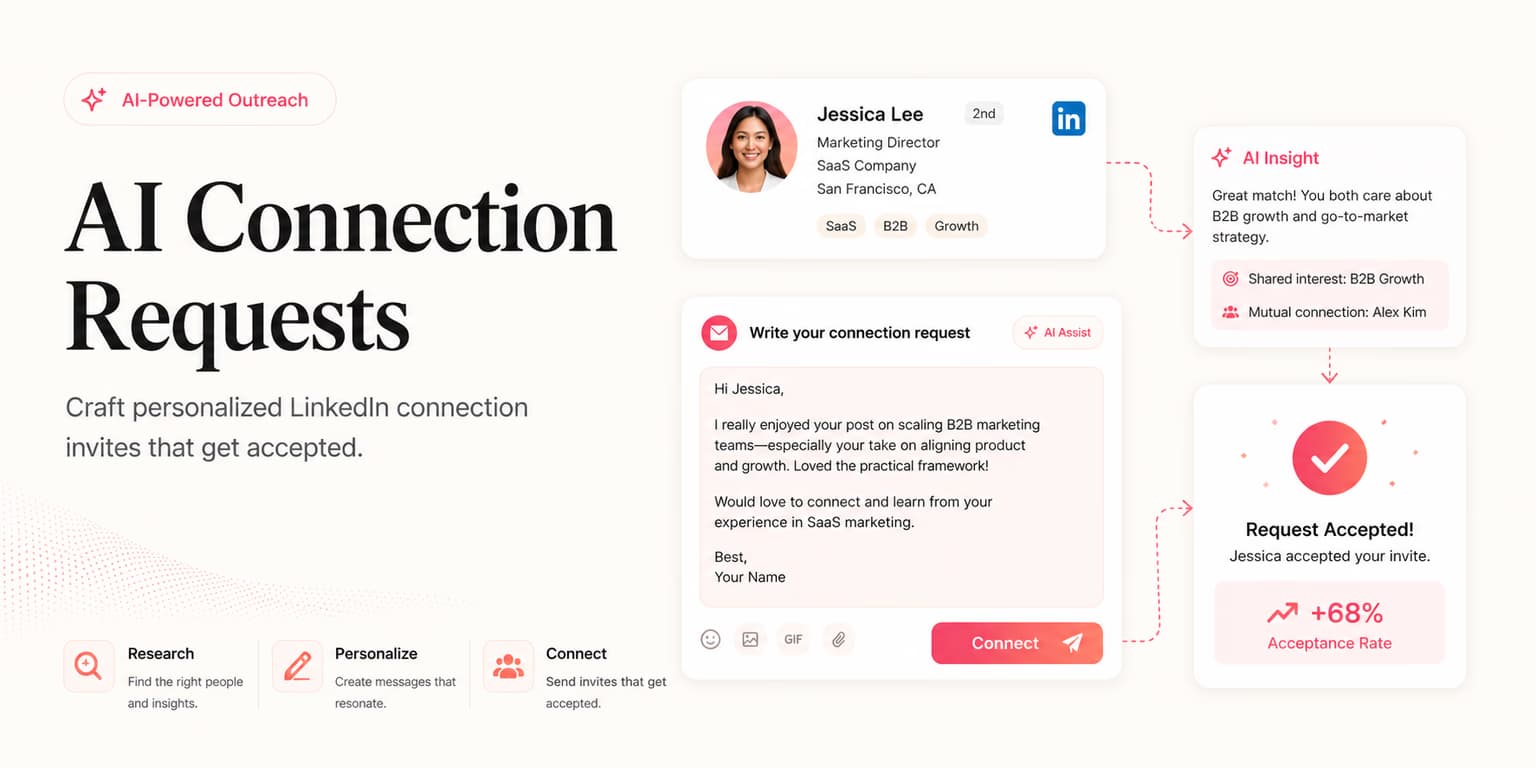
AI connection requests fail when they try to sell. The invite note is not the pitch. It is the tiny trust bridge that makes accepting you feel reasonable.
On LinkedIn, that distinction matters. A prospect sees your name, headline, profile photo, and maybe a short note. If the note smells like automation, they do not need to evaluate your offer. They can simply ignore the request.
This guide is about using AI to decide whether a connection request should include a note, what the note should say, and how to review batches before sending. For a broader non-AI version, read the guide on writing LinkedIn connection requests that get accepted.
The invite has one job
A LinkedIn invite has one job: earn the accept. It does not need to explain your product, prove your company, show social proof, ask for a meeting, or deliver your entire value proposition.
That is where AI often goes wrong. It tries to make the note helpful by adding too much: compliments, product claims, niche observations, and a call to action. The result is a cramped sales pitch in a space meant for a simple connection.
Your connection request should feel like a professional reason to be connected, not a disguised campaign step. If the prospect accepts, the first message can carry more context later.
Invite rule
If the note would make the prospect brace for a pitch after accepting, shorten it or send the request blank.
Blank or personalized
The first AI decision should not be "what should the note say?" It should be "should this invite include a note at all?"
A blank request can be the better choice when the profile, mutual context, or target audience makes the connection understandable without extra copy. A generic note can reduce trust because it proves the sender had nothing specific to say but forced personalization anyway.
Use a note when there is a clean signal that can be referenced without sounding invasive. Skip the note when the only available context is a job title, industry label, or vague compliment.
| Situation | AI decision | Why |
|---|---|---|
| They posted about a problem you know well. | Send a short note. | There is real context and a respectful reason to connect. |
| They only match a title filter. | Consider blank or research more. | Title alone is not personalization. |
| You share an event, group, or public discussion. | Send a short note. | Mutual context lowers the stranger effect. |
| The lead is high value but evidence is thin. | Research before sending. | A weak note to a strong account is costly. |
Signals AI can use
AI should use signals that are visible, professional, and easy for the prospect to recognize. It should not use anything that feels like surveillance or requires an assumption about private pain.
- Good signal: a recent post, comment, event participation, hiring announcement, company launch, or shared professional topic.
- Weak signal: job title, company category, or generic "we both work in SaaS."
- Risky signal: guessing they have budget, churn, poor pipeline, broken process, or internal problems.
The note should only reference the good signal. The problem hypothesis belongs in the first message after acceptance, not inside the invite.
This separation keeps the request clean. It also prevents AI from stuffing the note with everything it knows about the lead.
The request prompt
A good AI prompt should produce two outputs: the decision and the note. That lets you reject notes that should never exist.
"Decide whether this LinkedIn connection request should include a note. Lead context: [role, company, source, visible signal]. Rules: no pitch, no product claim, no calendar ask, no private assumptions, under one short sentence if a note is justified. Return: send blank, send note, or research more. If send note, provide three options."
The "research more" output is important. It gives the AI permission to avoid a bad note instead of forcing a draft every time.
Ask for three options because invite copy is sensitive to tone. One version can be too warm, one too stiff, and one just right. Pick the one that sounds most like your actual profile.
Worked request example
Suppose the lead is a head of customer success who commented on a post about onboarding handoffs. A weak AI output says, "I help customer success teams automate onboarding and increase retention. Let's connect." It is short, but it is still a pitch.
A stronger output says, "Saw your comment on onboarding handoffs. I work around that problem too and wanted to connect." That note is not trying to win the sale. It simply explains why the request exists.
The first version makes the prospect wonder what sales sequence they are about to enter. The second version gives them a professional context for accepting and leaves room for the actual conversation later.
Invite note patterns
Keep invite notes short enough to feel casual. These patterns are intentionally simple.
Shared topic
"Saw your take on [topic]. I am working around the same problem and would enjoy staying connected."
Event context
"Noticed we both followed the [event/topic] discussion. Would be good to connect here."
Founder peer note
"Founder building in a related space. Your work around [area] caught my eye, so I wanted to connect."
Warm comment note
"Appreciated your comment on [topic]. Sent a request so I can keep up with your posts."
Notice what is missing: no demo ask, no link, no "we help companies like yours," and no product pitch. The note only gives the accept a reason.
Batch review
AI connection requests should be reviewed in batches. Individual notes can look fine while the batch feels repetitive. If every note starts with "Saw your post," the pattern becomes obvious.
Review a batch for four issues: repeated structure, weak signals, sales language, and over-familiar tone. The safest invite notes usually sound calm and slightly understated.
- Repeated structure: vary the shape, not just the nouns.
- Weak signals: remove notes that only reference title or industry.
- Sales language: delete product outcomes, pitches, and meeting asks.
- Over-familiar tone: avoid acting like you know the prospect personally.
Omentir's workflow is designed for this kind of controlled review. It can help find ICP-fit buyers, draft context-aware outreach, and keep sending human-paced, but the connection request should still pass a trust check before it goes out.
Track acceptance quality, not just acceptance rate. A batch with many accepts but no replies may be too broad. A batch with fewer accepts but more thoughtful replies may be stronger because the notes are attracting the right people.
Review ignored invites as well. If many high-fit prospects ignore requests, inspect the profile headline, note quality, and source signal. Sometimes the copy is fine but the profile looks too sales-heavy. Sometimes the profile is credible but the signal is not strong enough to justify a note.
Also watch pending invites. A growing pile of stale requests is a sign that the campaign is pushing too broadly or sending too quickly. Human-paced outreach means slowing down when the market is not responding.
Weekly review: accepted requests, ignored requests, stale pending requests, replies after acceptance, and notes rejected during review.
This review turns invite writing into a learning loop. The AI does not just create notes. It helps you see which signals make people comfortable enough to connect.
After acceptance
The worst move after a thoughtful connection request is an instant pitch. The invite created a small amount of trust. Do not spend it all in the next message.
After acceptance, continue the same context. If the note mentioned a post, the first message can add a short observation about that topic. If the request was blank, the first message should establish context before any product mention.
Store the invite context on the lead record. The AI should know whether the request was blank, which note was sent, what signal justified it, and when the prospect accepted. That memory prevents the first message from feeling disconnected.
A clean after-acceptance message might say, "Thanks for connecting. The reason I noticed your profile was your comment on onboarding handoffs. Curious, is that mostly handled by CS ops on your team, or still manager-owned?" It continues the original thread without rushing into a pitch.
If the prospect accepted a blank request, the first message should be even more careful. Start with why you reached out and ask one low-pressure question. Do not pretend the connection alone created buying intent. The accept is permission to start a conversation, not permission to pitch everything.
Use the guide to ChatGPT sales messages for the next step, and pair it with the AI follow-up playbook once the conversation starts moving.
The sequence is simple: qualify the lead, decide blank versus note, send at a human pace, wait for acceptance, then continue the context. AI keeps the process consistent. Human judgment keeps it respectful. Review the batch weekly so the notes stay easy to accept and easy to continue.
FAQs
No. If there is no specific signal, a blank request can be better than a generic AI-written note. Use a note only when it earns its place.
One real context signal and a simple reason to connect. It should not include a product pitch, calendar link, or long value proposition.
Yes, if the AI uses public, verified context and avoids private assumptions. Human review is especially important for high-value accounts.
Do not pitch instantly. Continue the same context with a short first message after a natural delay, or move the lead into a human review queue.