
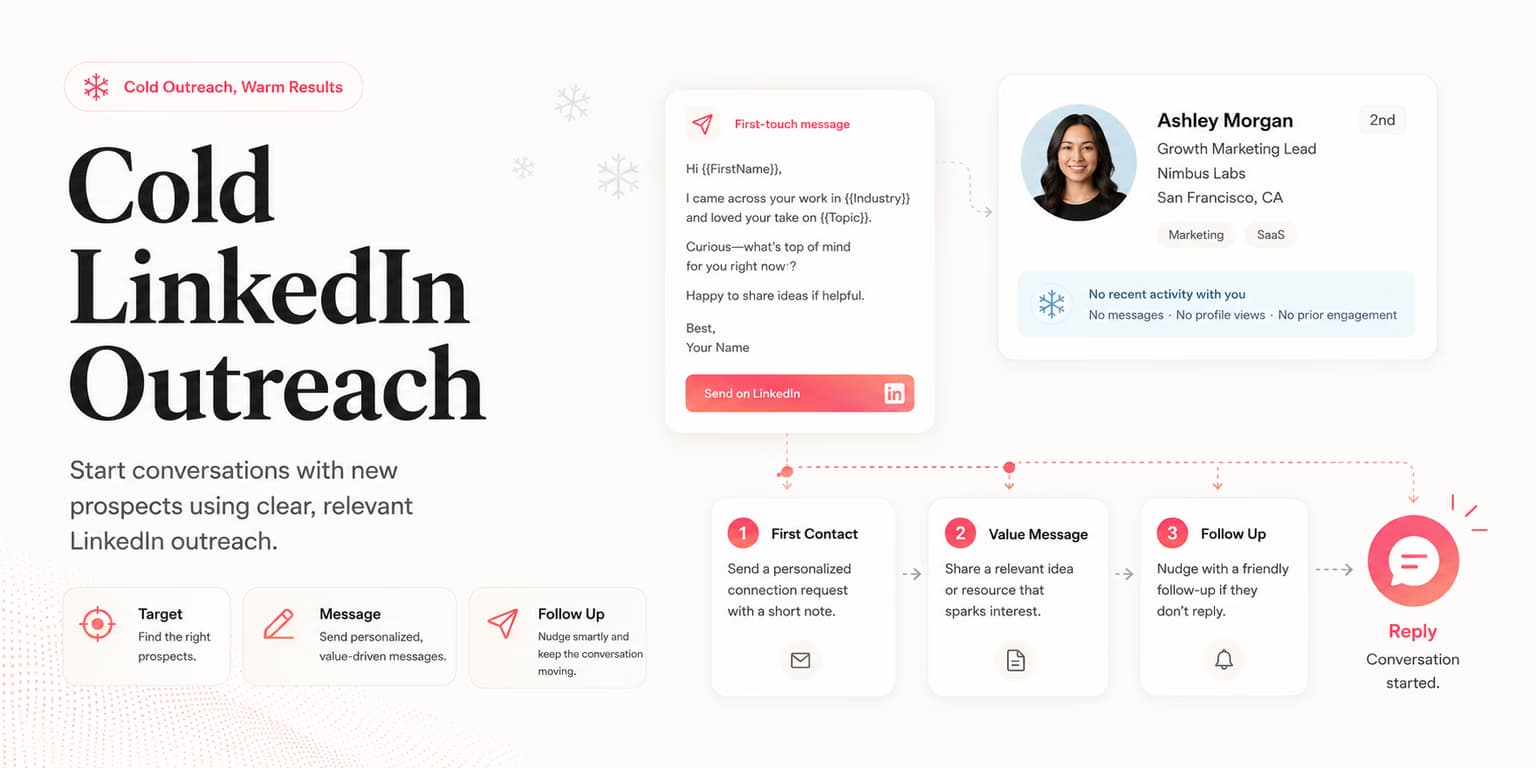
Cold LinkedIn outreach is not dead. Lazy cold LinkedIn outreach is. The difference is whether the buyer can tell why you chose them before they feel like they are being pushed into a sales funnel.
On LinkedIn, cold outreach has a built-in advantage over anonymous channels: the prospect can inspect your profile, mutual context, posts, and company in seconds. That trust surface helps only if your message earns the click.
This guide covers the full cold motion from zero: pick a narrow lane, warm the edge, send a non-pitchy invite, write the first message, follow up respectfully, and measure where the process breaks. If you only need copy examples, start with the LinkedIn cold message templates.
Cold does not mean random
A cold prospect is someone who has not raised their hand to talk to you. That does not mean they should be selected randomly. Cold outreach still needs a reason.
The reason can be a company trigger, a role responsibility, a public post, a hiring signal, a team expansion, or a workflow pattern that is common for their stage. The reason should be visible enough that the prospect understands why the message landed.
If the only reason is "they have the right title," your campaign is too broad. Title is a starting filter, not a reason to interrupt someone.
The test I like is simple: could a teammate read the lead row and write one honest sentence about why this person belongs in the batch? If the answer is no, the campaign is not ready for copy. Better data will do more for performance than another clever opener.
Cold also does not mean the prospect has no context for the problem. A finance leader at a company that just raised funding may be cold to you, but not cold to budget pressure, reporting cleanup, hiring plans, or vendor consolidation. Your job is to notice the business moment and approach with restraint.
Cold outreach rule
A cold message should still feel chosen. If the buyer cannot see why they were selected, they will assume they were scraped.
Choose one narrow lane
Cold outreach works better when each batch is built around one lane. A lane is narrower than an ICP. It combines buyer role, company type, timing signal, and problem hypothesis.
For example, "B2B SaaS founders" is too broad. "Founders of 10 to 80 person HR SaaS companies hiring their first sales hire this quarter" is a lane. It tells you who to find, why now matters, and what the first message can reasonably mention.
A narrow lane gives you cleaner learning. If the batch fails, you can diagnose whether the signal was weak, the message was wrong, or the buyer was not active around the problem.
Build the lane before you build the message. Write the lane in plain English, then make every prospect prove they belong. If you cannot define the lane without naming your product, you are probably describing your wish list instead of the buyer's situation.
- Buyer: the role or founder type close to the problem.
- Account: the company stage where the pain is likely real.
- Timing: the public event that makes a conversation reasonable now.
- Disqualifier: the accounts or people you will skip even if they look close.
A good disqualifier saves the campaign. Excluding companies that are too early, too enterprise, too agency-led, or already using an obvious replacement keeps the outreach honest. It also protects the salesperson from wasting time explaining an offer to people who should never have been contacted.
If you need help building the lead queue, the guide to AI LinkedIn prospecting covers the signal-led workflow before outreach begins.
Warm the cold edge
The best cold outreach often includes a light warm-up step. That does not mean pretending to be friends. It means showing up in a relevant way before asking to connect.
A warm-up can be as simple as viewing the profile, reading a recent post, leaving one thoughtful comment, or saving the company context before you write. The goal is familiarity and accuracy, not manipulation.
Use warm-up when the account is high value or the buyer is senior. For lower-priority leads, a clean invite and contextual first message may be enough.
Keep warm-up actions lightweight. Do not like twenty posts, leave generic praise, or comment only because a sequence told you to. One useful interaction beats a trail of activity that makes the prospect wonder why you are hovering around their profile.
The guide on warming up LinkedIn leads before outreach goes deeper on this step. The simple version is: engage only when you can add something useful, not when you need to manufacture a reason.
Connection request
The connection request should not carry the pitch. Its job is to earn the accept. If you have a clean signal, write one short note. If you do not, a blank request may be better than a forced note.
Avoid links, demo asks, product claims, and long value propositions in the invite. Those belong later, if at all.
The safest invite sounds like a person opening a professional door, not a rep trying to compress the entire pitch into the character limit. Mention one signal when it is real. Leave space for the profile to do some of the work.
"Saw your post on onboarding handoffs. I am working around that problem too and wanted to connect."
If you have no genuine signal, do not fake one. A clean, blank request can be more respectful than a flimsy note about being "impressed by your background." Forced personalization is still generic because the prospect can feel that it was assembled from surface details.
For AI-assisted invite writing, use the AI connection requests guide. The core rule is the same: if the note makes accepting feel like entering a sales sequence, it is too much.
First message
After acceptance, do not pitch instantly. Give the connection a little room, then continue the same context that justified the request.
A strong first message has three parts: signal, problem hypothesis, and low-friction question. It should not include a calendar link unless the prospect has already shown strong intent.
The problem hypothesis is the hard part. It should be specific enough to be useful and soft enough to be wrong gracefully. You are not declaring that the buyer has a pain. You are asking whether a pattern you often see is present in their world.
"Thanks for connecting. The onboarding handoff point caught my eye because teams often start feeling that pain once CS grows past founder-owned accounts. Is that already a formal process for you, or still manager-owned?"
This message is cold, but it is not random. It uses the original context and asks a question the buyer can answer without committing to a meeting.
A bad first message tries to create urgency before trust. It says, "We help companies like yours save time. Want to see how?" A better message earns one reply first, then uses that reply to decide whether a product conversation is appropriate.
Follow-up and stop rules
Cold LinkedIn outreach needs follow-up, but only when the follow-up adds something new. Repeating the first message with "just checking in" wastes trust.
Use two or three thoughtful follow-ups at most unless the prospect shows fresh intent. Each touch should add one useful angle: a resource, a specific question, a short example, or a respectful close.
Think of follow-up as diagnosis, not pressure. The first follow-up can clarify the problem. The second can show a short example. The final note can close the loop politely. If none of those produces a response, the next best move is often to stop and learn from the batch.
- Follow up when: the lead fits, the signal is still relevant, and the next message adds context.
- Pause when: the prospect replies, asks for time, raises a sensitive objection, or books a meeting.
- Stop when: there is no reply after a few relevant touches and no new signal appears.
The pause rule matters as much as the send rule. When someone replies with "not now," asks a question, or pushes back, the sequence should stop and the conversation should become human. Automation that ignores replies turns a promising thread into a trust problem.
For a deeper follow-up system, use the AI follow-up playbook.
Measure the system
Do not judge cold LinkedIn outreach only by reply rate. Measure the full chain: candidates sourced, requests sent, accepts, first-message replies, positive replies, wrong-person replies, booked calls, and qualified opportunities.
Each metric diagnoses a different problem. Low acceptance means the profile, invite, or targeting is weak. Low replies after acceptance means the first message is not continuing the context. Many wrong-person replies mean the lane needs tighter role ownership. Interest without demos means the handoff needs work.
Review metrics by lane, not across the whole program. A batch aimed at founders after a funding announcement should not be averaged with a batch aimed at operations leaders after a hiring signal. Blending them hides the lesson you actually need.
Also read the replies, not just the dashboard. "Not my area," "we already solved this," and "circle back next quarter" are three different signals. They should change three different parts of the system: targeting, positioning, and timing.
Omentir is built for this controlled loop: it finds ICP-fit buyers, drafts personalized LinkedIn outreach, follows up at human-paced limits, and collects replies in one inbox sorted by intent. The point is not to send more cold messages. The point is to create more relevant conversations from the right buyers.
Cold outreach works when it is narrow, honest, and patient. If you cannot explain why each person was selected, the campaign is not ready. If you can, the message has a chance to feel like a useful professional note instead of another pitch in the inbox.
FAQs
Yes, when targeting is narrow, the message is contextual, and the sending pace is human. Broad pitch blasts are the part that stopped working.
Usually no. Ask a low-friction question first. Move to a demo only after the prospect confirms the problem is relevant or asks for details.
Use one real signal and one relevant problem hypothesis. More personalization is not automatically better if it makes the message feel researched in a creepy way.
AI can help with lead scoring, drafting, review, and reminders, but campaigns should respect daily limits, approval gates, and reply-aware pause rules.