
Sending a cold connection request to a high-value B2B decision maker is a low-probability play. Busy executives ignore dozens of uninvited outreach notes weekly. The moment they spot a standard sales pitch, they click "Ignore."
To raise outbound conversions, warm people up before you ask to connect. Social selling here means building a little familiarity first so the request looks like a peer extension, not an uninvited pitch.
The psychological shift: cold vs warm outbound
Humans are wired to protect themselves from transactional solicitation. When an unknown user requests access to their professional network, decision-makers experience a brief moment of anxiety. They ask themselves: "What does this person want from me? Are they going to pitch-slap me the second I accept?"
Social selling systematically eliminates this anxiety. It relies on the psychological principle of the Mere Exposure Effect, which proves that individuals develop a natural preference for things or people merely because they are familiar with them.
By interacting thoughtfully in your prospect's digital ecosystem before requesting a formal connection, you transition your profile from a "suspicious stranger" to a "familiar, value-adding peer." When your invite eventually lands, the decision-maker accepts it instantly because your name has already been associated with clean, high-value professional interactions.
The familiarity multiplier
Internal campaign data shows that prospects who have engaged with your profile, comments, or posts prior to receiving a connection invite are 2.5 times more likely to accept your request. Even better, their positive reply rate to your follow-up conversational messages increases by over 180%.
5 tactical warming strategies
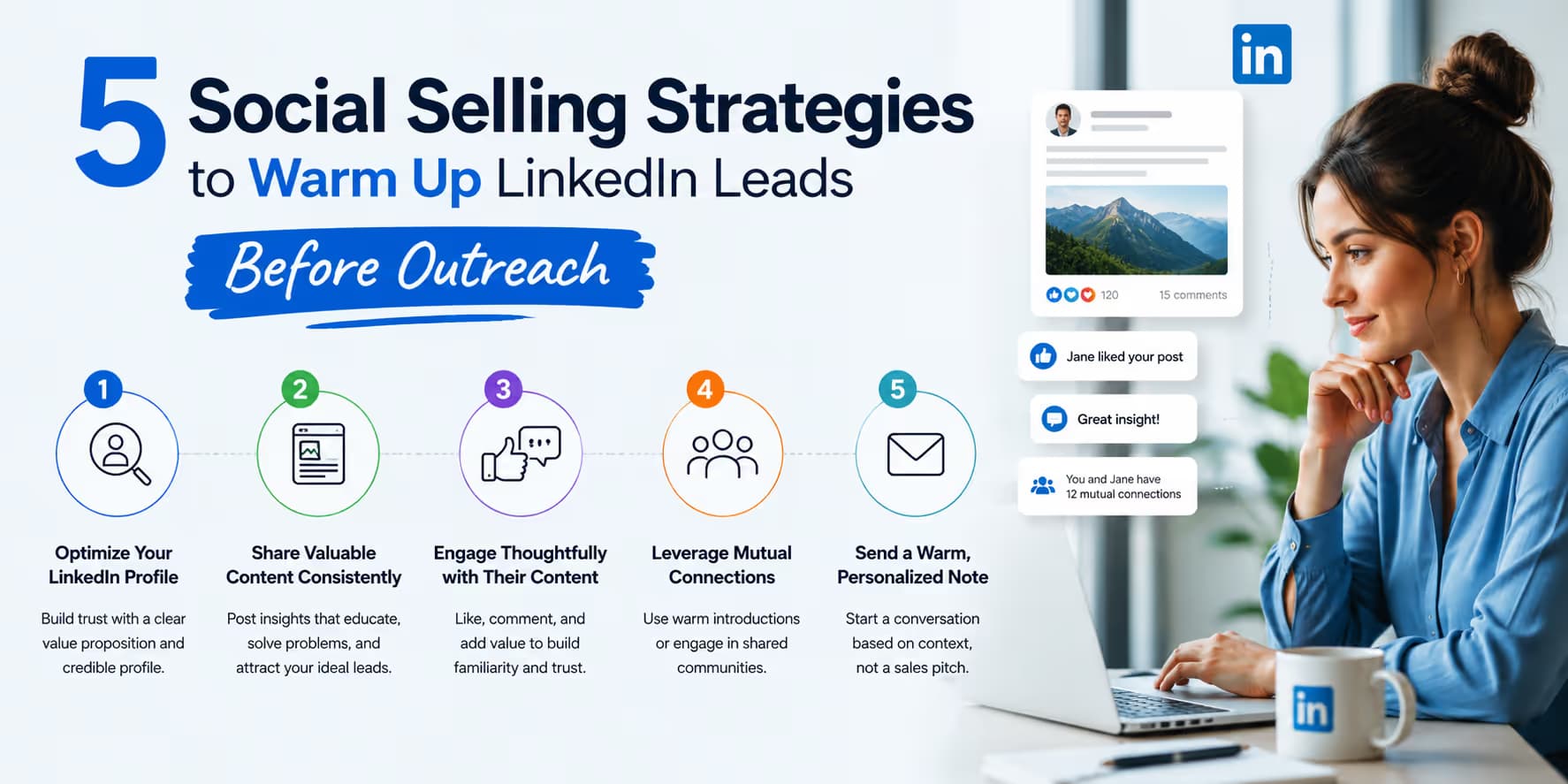
Warming up prospects does not require spending hours manual-scrolling your LinkedIn feed. Instead, implement these five highly structured, repeatable micro-actions:
1. The public profile footprint
The simplest way to initiate contact is by leaving a digital footprint on their profile. Ensure your LinkedIn account safety settings have "Private Mode" disabled. Visit your target lead's profile. This places your headshot and headline directly in their daily "Who viewed your profile" notification feed. Since most B2B professionals check this list weekly, it creates a subtle, low-friction initial touchpoint.
2. The 2-tier commentary framework
Do not leave generic comments like "Great post, thanks for sharing!" That reads as automated and empty. Use this 2-tier commentary framework instead:
- Tier 1: Validation. Acknowledge a highly specific point within their post. ("Loved your framework on structural scaling here, [Name].")
- Tier 2: The Insight Extension. Add a brief, value-add counterpoint or a real-world validation from your own career. ("We saw that applying this to micro-services reduced rollout delays by about 15% too.")
3. The influencer comment hijack
If your target lead is relatively quiet on LinkedIn and rarely posts their own updates, find the prominent industry influencers they actively follow and comment on. Leave highly thoughtful comments on those influencer threads. When your target prospect skims those popular comments, they will encounter your brand organically in a shared community space.
4. The professional endorsement pivot
If your target lead lists clear core competencies on their profile (e.g., "B2B SaaS Growth," "Kubernetes Infrastructure"), endorse them for one of their top skills. A skill endorsement triggers an instant high-priority notification to their mobile device. Since skill endorsements are relatively rare, this micro-action immediately stands out in their notification queue.
5. Authority broadcasting
Your personal profile must act as a clean B2B landing page. Regularly post clean operational frameworks, templates, checklists, or short case studies on your own feed. When a prospect receives your footprint (Profile Visit, Comment, or Endorsement) and clicks through to inspect your page, they must instantly see a feed packed with deep, non-promotional industry authority.
The lead warmth scoring grid
You should never reach out blindly. To maximize your sales efficiency, map your prospects' micro-interactions into a structured warmth scoring grid. This tells you exactly when a prospect has crossed the threshold from "cold target" to "warm qualified lead."
| Prospect Action | Warmth Points | Target Action State | Outreach Action |
|---|---|---|---|
| Views your profile back | 10 Points | Mild Interest | Queue connection request with no pitch. |
| Likes one of your comments | 25 Points | Engaged Lead | Send connection note referencing the specific post. |
| Replies to your comment | 40 Points | Highly Warm | Instantly connect, referencing the conversational thread. |
| Views your organic post | 15 Points | Observant Lead | Engage with their content to create reciprocal value. |
The comment-to-connection playbook
Once a lead achieves 25+ Warmth Points on your scoring grid, you have a green light to initiate direct contact. However, your transition must feel completely organic. If you immediately launch into a generic company pitch, you will erase all the trust you've built.
Use our organic comment-to-connection transition playbook:
- Step 1: The Context Bridge. Start by referencing the specific discussion thread where you interacted.
- Step 2: The Soft Expansion. Propose expanding the exchange peer-to-peer.
- Step 3: The Pitch-Free Close. Wrap up without making any requests on their calendar.
"Hi [First_Name], really enjoyed our exchange on Sarah's thread yesterday about Kubernetes rollouts. Your point about localized caching was spot on.
Would love to connect here to follow your scaling insights peer-to-peer!"
Running social selling safely at scale
Many founders complain that social selling is too slow and hard to scale. If you are manually searching for profiles and commenting all day, it will consume your entire calendar.
To scale social selling safely:
- Curate high-priority lists: Build a clean, narrow list of 50-100 high-value target accounts in Sales Navigator.
- Use automated intent triggers: Monitor these accounts for active signals (hiring announcements, executive hires, corporate updates) to pinpoint the perfect warming window.
- Track notifications automatically: Set up a centralized pipeline that routes views and comments directly to a unified dashboard, preventing inbox clutter.
Before you scale social warmups
Use the warmup steps above as a checklist before adding tools. The goal is to create visible, relevant context before a direct message, not to manufacture fake engagement.
Social selling traps to stay clear of
Warming up leads is a delicate process. If you push too hard or make mistakes, you can permanently damage your brand reputation. Keep your social selling clean by steering clear of these pitfalls:
- Aggressive profiling (Stalking): Viewing their profile 15 times a week or liking 20 of their old posts at 2:00 AM. This looks extremely creepy and unprofessional. Limit visits to once or twice over a 7-day window.
- Insincere praise: Praising an article they wrote that you clearly haven't read. If you reference a post, pull out a highly specific phrase or takeaway to prove your sincerity.
- Spamming the comment feed: Flooding their comments with long, self-promotional pitches about your software. Comments should serve to validate the author and add value, not hijack their thread for your marketing.
- Ignoring negative indicators: If a lead blocks you, deletes your comments, or asks you to stop, remove them from your outreach lists immediately. Never force an interaction that isn't reciprocal.
A weekly social selling operating plan
The five strategies above work best when they are arranged into a repeatable weekly operating rhythm. Without a rhythm, social selling turns into random scrolling. With a rhythm, every prospect receives enough familiarity before the first direct message, but not so much engagement that the sequence feels forced.
- Monday: Review 25 target profiles and save the five strongest context signals. Look for recent posts, hiring announcements, funding news, or comments on industry conversations.
- Tuesday: Leave thoughtful comments on the highest-quality posts. Each comment should add one original point, not a generic compliment.
- Wednesday: View profiles and follow company pages for the prospects who showed the most relevant activity.
- Thursday: Send connection requests only to the prospects where you can reference a concrete signal in under 200 characters.
- Friday: Review accepts, replies, and ignored invites. Move prospects into warm, neutral, or not ready buckets before writing the first sales message.
This process keeps outreach tied to real user behavior. A prospect who posted yesterday should receive a different opener from a prospect whose only signal is a company hiring page. That distinction is what makes the warming sequence feel precise rather than automated.
Frequently asked questions
One or two highly thoughtful comments are typically enough. You do not need to spend three weeks commenting. The goal is simply to establish name recognition so that your eventual connection invite feels familiar.
Use profile views and skill endorsements instead. Alternatively, search for active company pages or post comments on industry-focused hashtags they follow to get noticed organically.
Yes, in fact, it works better for technical buyers than almost anyone else. Technical buyers (VPs of Engineering, CTOs, PMs) hate transactional sales. They heavily value peer validation and deep technical insight shared in public discussions.
Always use your personal profile. B2B professionals connect with other individuals, not with corporate company pages. Personal accounts get up to 8x more engagement and 4x higher acceptance rates than company pages.