
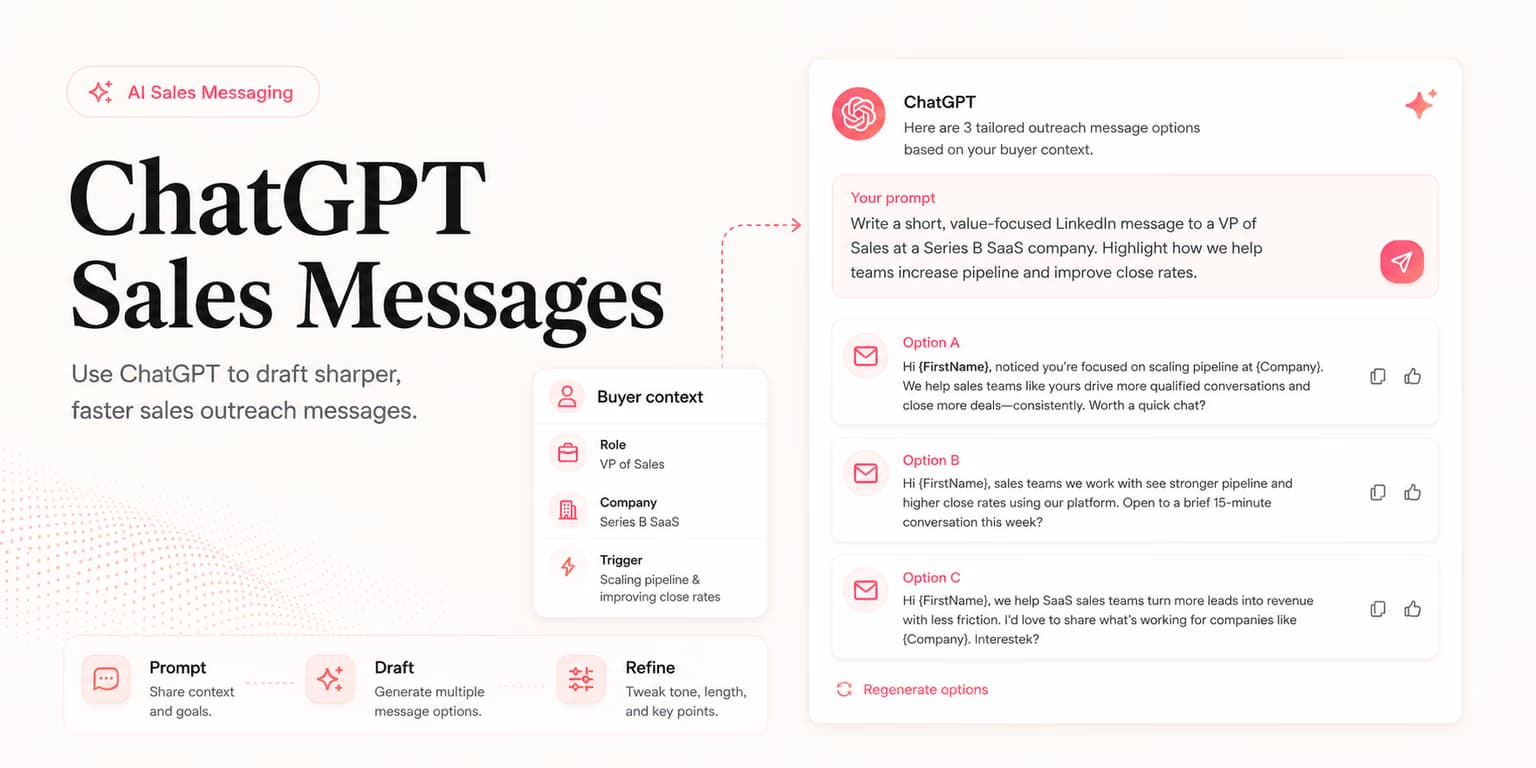
ChatGPT can write a sales message in one second. That is exactly why teams get into trouble. Speed makes it easy to send polished messages before the lead, signal, and claim have been checked.
The best use of ChatGPT for sales messages is not "write something persuasive." It is "turn this approved buyer context into a short first touch that a real person would be comfortable sending from their own LinkedIn profile."
This article is about first-touch sales messages: connection follow-ups, cold DMs, and short email-style notes. Lead finding belongs in the ChatGPT LinkedIn leads workflow. Broader pitch strategy belongs in the AI sales pitch guide. Reply drafting comes later after the buyer answers.
ChatGPT is the drafting room
Treat ChatGPT as the drafting room, not the sales strategy. It should not decide your ICP, invent the pain, guess which prospects matter, or push messages live. It should transform already-approved context into usable copy.
That distinction keeps the workflow clean. Prospecting decides who deserves outreach. Qualification decides why they deserve it. Messaging turns that reason into a small, respectful note.
If you skip the first two steps, ChatGPT will fill the gap with generic benefits: faster workflows, more productivity, more revenue, and other phrases buyers have learned to ignore.
Message rule
ChatGPT should write from evidence, not imagination. If the lead context does not include a real signal, ask for research before asking for copy.
Inputs before output
The quality of a ChatGPT sales message depends mostly on what you give it. The model needs buyer context, product context, channel constraints, and risk boundaries.
Use a compact message brief before every draft. It should fit in a few lines so the model focuses on the right material.
- Buyer: role, company type, and why this person owns the problem.
- Signal: the public evidence that makes the message timely.
- Problem hypothesis: the friction that may appear because of the signal.
- Product outcome: what your product helps improve in buyer language.
- Proof: a safe example, workflow, customer story, or resource.
- Forbidden claims: anything the message must not imply.
The forbidden-claims field is the one most teams forget. It stops ChatGPT from saying the prospect has budget, churn, broken process, poor conversion, or urgent pain when you only have a public clue.
The message prompt
A useful prompt tells ChatGPT the job, the context, the constraints, and the review criteria. It should ask for options, but not too many. Three drafts are enough: one direct, one softer, and one founder-style.
"Write three first-touch sales messages for this buyer. Context: [buyer role/company], signal: [public signal], problem hypothesis: [friction], product outcome: [outcome], proof: [safe proof], forbidden claims: [claims to avoid]. Constraints: under 75 words, plain language, no hype, no calendar link, one easy question. Return direct, soft, and founder-peer versions."
This prompt works because it gives the model a narrow job. It does not ask for a campaign, sequence, value proposition, and follow-up strategy at the same time.
Ask ChatGPT to explain why each draft might work. The explanation helps you catch weak logic. If the model cannot explain the signal-to-message connection clearly, the draft should not be sent.
Worked message build
Imagine your product helps founders review LinkedIn leads before reps send outreach. The buyer is a founder of a 40-person B2B SaaS company. The signal is that they are hiring two account executives. The safe hypothesis is that more reps will create more lead-review work, not that their current process is broken.
A weak ChatGPT prompt would say, "Write a LinkedIn message for a SaaS founder about our AI sales tool." That prompt will likely create a product-centered message about automation, productivity, and pipeline growth.
A stronger prompt says, "Write a first-touch LinkedIn message for a B2B SaaS founder hiring two AEs. The message should mention the hiring signal, raise the problem of keeping lead review consistent before outreach, and ask whether that step is already handled internally. Do not claim they have bad data, low reply rates, or broken process."
The second prompt gives ChatGPT a narrow lane. It knows what to use, what to avoid, and what kind of reply the message should invite.
Draft patterns
ChatGPT should produce messages in patterns, not random clever lines. Patterns make the copy easier to review and improve.
Direct version
"Saw you are hiring two AEs right now. Teams at that stage often start reviewing more leads than they can properly qualify before outreach. We help founders keep that review step consistent. Is that already handled internally?"
Soft version
"Noticed the AE hiring push. That usually brings a lot more lead-review work with it. If useful, I can send a short checklist we use for deciding which LinkedIn prospects deserve follow-up."
Founder-peer version
"Founder-to-founder note: we are building around the lead-review problem that shows up when outbound starts scaling. Your AE hiring caught my eye. Is that workflow already mature for you, or still changing?"
None of these drafts claims the buyer has a broken process. Each one uses the hiring signal to raise a reasonable problem hypothesis. That is the line ChatGPT must learn to respect.
If you want more pattern options for LinkedIn specifically, pair this workflow with the LinkedIn pitch templates.
Edit the draft
The first ChatGPT draft is rarely the final message. Your editing job is to remove anything that makes the note sound automated, inflated, or too eager.
Run four editing passes:
- Specificity pass: remove sentences that could apply to every prospect.
- Claim pass: delete any private assumption or unsupported metric.
- Compression pass: cut filler until the message feels easy to answer on mobile.
- Voice pass: make it sound like a person, not a brochure.
A good edit often makes the message less impressive and more effective. Buyers do not need a perfect paragraph. They need a clear reason to reply.
You can ask ChatGPT to help with the edit, but make the instruction conservative. Do not ask it to "make this more persuasive." Ask it to remove unsupported claims, shorten the message, and preserve only the strongest signal.
"Audit this message. Flag any sentence that sounds generic, assumes private pain, asks for too much, or could apply to any company. Then rewrite it in under 60 words while keeping the original buyer signal."
This review prompt is intentionally strict. It turns ChatGPT into a quality-control partner rather than a hype machine. The best drafts often become shorter, plainer, and more specific after this pass.
For a team workflow, review drafts in batches instead of one by one. Pick ten messages, hide the prospect names, and ask whether each message still explains why the buyer should care. If the answer is no, the draft is relying too much on vague personalization or job-title assumptions.
Then review the same ten messages with names and signals visible. The message should become more convincing when the context is visible. If it does not, the signal is probably weak or the draft failed to use it clearly.
This batch review catches a problem individual editing misses: every message can look acceptable alone while the whole campaign sounds repetitive. When ten drafts use the same sentence rhythm, the buyer can feel the automation even if each message contains a custom detail. Rotate structure as well as wording. A varied batch feels researched; a uniform batch feels processed. That difference shows up in replies.
Bad ChatGPT habits
ChatGPT has a few habits that hurt sales messages. It over-explains, adds cheerful filler, uses abstract value words, and tries to sound helpful by claiming more than the evidence supports.
| Bad habit | Fix |
|---|---|
| "Hope you are doing well" openings. | Start with the signal instead. |
| Hype verbs and empty benefit language. | Use the buyer's workflow words. |
| Early demo asks. | Ask a small relevance question first. |
| Implied private pain. | Frame it as a hypothesis, not a diagnosis. |
You can catch most of these problems by asking, "Would I say this exact sentence to someone I respected at an industry event?" If the answer is no, rewrite.
Handoff to the campaign
A message is only one piece of the campaign. Store the approved draft with the lead reason, source signal, forbidden claims, and follow-up angle. That way the next touch does not lose context.
Omentir is built around this kind of handoff. It finds ICP-fit buyers, scores them against your criteria, drafts personalized outreach, follows up at human-paced limits, and collects replies in one inbox sorted by intent. ChatGPT can help shape the copy, but the campaign needs a system that remembers why the message was sent.
If the prospect replies, do not ask ChatGPT to answer from the original prompt alone. Use the actual reply, the memory card, and the guidance in the AI follow-up playbook. First-touch writing and reply handling are different jobs.
The practical test is simple: if a buyer asked, "Why did you send me this?" could you point to a real signal and a truthful reason? If yes, ChatGPT helped. If not, it only made a weak message sound polished.
FAQs
Yes, if you give it verified buyer context, forbidden claims, channel constraints, and a human review step. A blank prompt will usually produce generic copy.
No. One real signal and one relevant problem hypothesis are usually stronger than a message stuffed with profile details.
Run a fit check, claim check, length check, and voice check. Remove anything that sounds like a landing page or assumes private pain.
Yes. This guide covers first-touch messages. Reply drafting needs the prospect's actual response and belongs later in the conversation.