
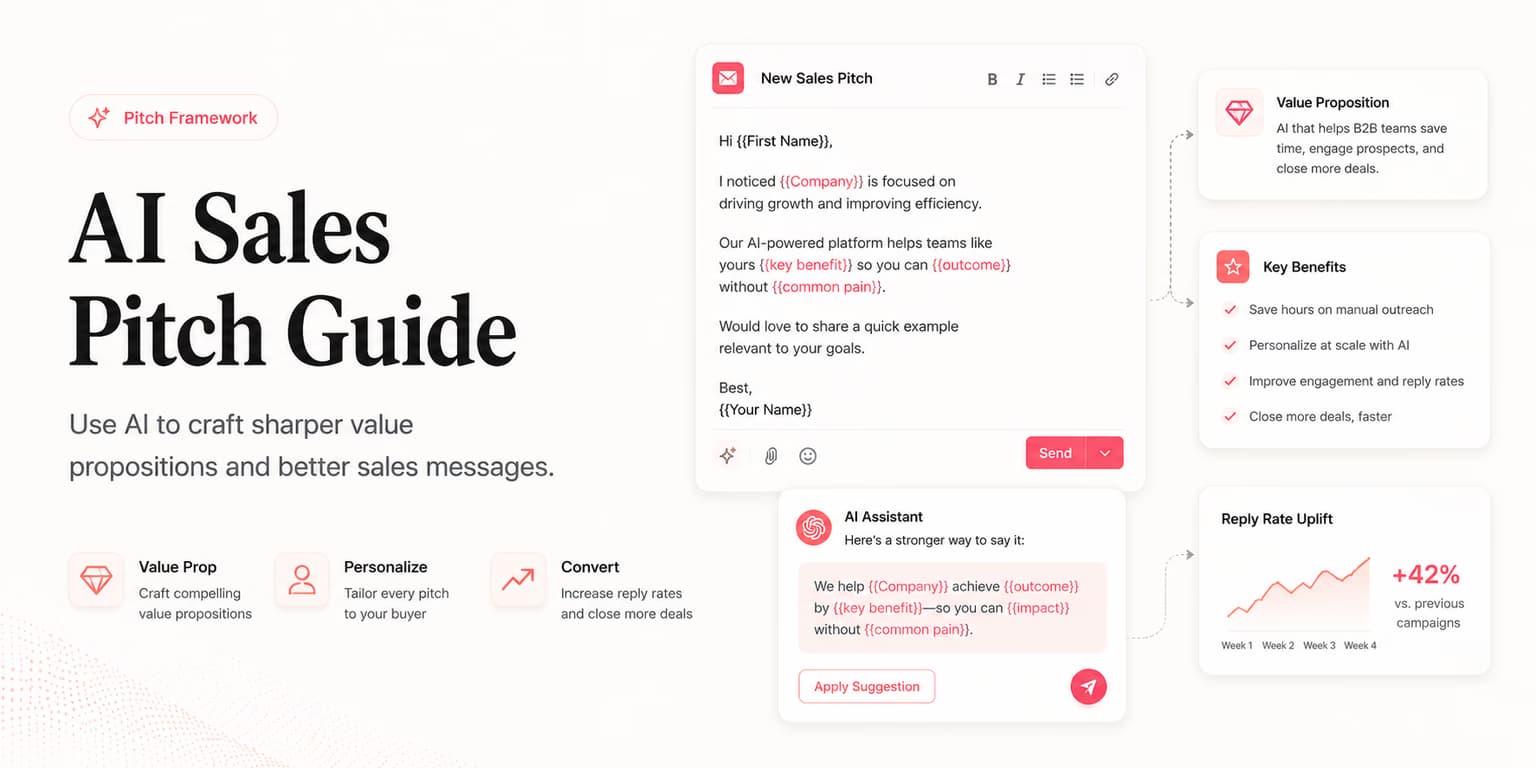
AI can write a sales pitch in seconds. That is not the hard part. The hard part is getting a pitch that sounds true, specific, and relevant to one buyer instead of a polished paragraph that could be sent to everyone.
A strong AI sales pitch starts before the prompt. You need a buyer map, a clear problem, real proof, and a rule for what the pitch is allowed to claim.
This guide is for B2B founders and operators who want AI to help with pitch strategy, not just wordsmithing. The goal is to turn product facts into buyer language without inventing proof or flattening every message into the same cheerful pitch.
Pitch before prompt
Most AI pitch prompts are too lazy. "Write me a sales pitch for my SaaS" gives the model permission to summarize your product and decorate it with generic benefits. You might get something readable, but it will not create urgency.
A pitch is not a product description. A pitch is a bridge between what a buyer is already trying to do and the easier path your product creates. AI needs both sides of that bridge.
Before writing, define the pitch job. Are you trying to get a reply, book a demo, revive a stale conversation, introduce a new use case, or explain why a buyer should switch from a manual process?
Pitch Job Test
If you cannot finish this sentence, do not ask AI for copy yet: "This pitch should make [buyer] want to talk because [current friction] is costing them [business consequence]."
Build the buyer map
One product can require five different pitches because five buyers care about different outcomes. A founder may care about pipeline. A VP of Sales may care about rep efficiency. A RevOps lead may care about process cleanup. A CFO may care about headcount cost.
AI becomes useful when you make those differences explicit. Ask it to map each buyer to their likely goal, current friction, feared risk, success metric, and preferred proof.
- Goal: what the buyer is trying to improve this quarter.
- Friction: what makes the goal harder right now.
- Risk: what they are afraid will break if they change process.
- Metric: how they know the problem is getting better.
- Proof: what evidence would make the pitch credible.
This buyer map is what separates an AI pitch guide from a generic template. The same product fact may become a time-saving pitch for one buyer and a risk-reduction pitch for another.
Build this map as a simple angle matrix. Put buyer roles in the rows and pitch angles in the columns: time saved, risk reduced, revenue created, cost avoided, quality improved, and control preserved. Then ask AI to fill each cell with one plain-language hypothesis.
The matrix will reveal which angles are weak. If every cell says "save time," you do not yet understand the buyer well enough. A CFO, founder, operator, and sales leader may all care about time, but they describe the cost of wasted time differently.
Once the matrix is written, choose one angle per campaign. Do not combine all six in one message. A cold pitch that tries to save time, reduce risk, increase revenue, and improve quality usually reads like a brochure.
For a broader operating system around targeting and messaging, pair this with the AI outreach playbook. This article zooms into the pitch itself.
Features into friction
Buyers do not wake up wanting dashboards, integrations, AI agents, enrichment, or automation. They want less manual work, fewer missed opportunities, faster decisions, cleaner handoffs, or more qualified meetings.
Give AI a list of features and force it to translate each one into the friction it removes. Then review the output and delete anything that sounds abstract.
| Product Fact | Weak Pitch | Buyer-Relevant Pitch |
|---|---|---|
| AI lead scoring | We use AI to score leads. | Your team stops wasting first touches on accounts that never matched the ICP. |
| Unified inbox | All replies are in one place. | Warm replies stop getting buried across tabs while cold replies stay out of your focus. |
| Draft approval | You can approve messages. | You keep control of your profile while the repetitive research and drafting work happens for you. |
The buyer-relevant version is still simple, but it names the operational pain. That is what makes a pitch feel less like a feature list and more like a useful observation.
Proof without fake numbers
AI loves confident numbers. Do not let it invent them. A fake "37 percent lift" may sound persuasive for one second, but it creates a credibility problem you cannot recover from if the buyer asks for detail.
Use proof you actually have. That can be a customer result, a workflow screenshot, a before/after process, a time estimate from your own use, a known manual bottleneck, or a clear product behavior.
- Strong proof: "We helped a two-person founding team replace daily lead scraping with a reviewed shortlist."
- Acceptable proof: "The workflow removes the manual step of copying LinkedIn replies into a spreadsheet."
- Weak proof: "Teams like yours typically see huge improvements."
- Unsafe proof: any metric, customer name, or benchmark you cannot defend.
If you do not have a case study yet, use process proof. Show the buyer the before and after of the workflow. Early-stage pitches often win because the process is obviously cleaner, not because the company has a giant logo slide.
Keep a proof library next to your AI prompts. It can be a short document with approved customer language, real outcomes, screenshots you are allowed to reference, workflows you can describe, and phrases that are off-limits. The point is to make truthful proof easy to reuse.
When AI drafts a pitch, compare every claim against that library. If the claim is not in the library, either add evidence or remove the sentence. This one habit prevents most sales copy from drifting into exaggeration.
You can also ask AI to label every sentence as "fact," "interpretation," or "ask." A healthy cold pitch has a small number of facts, one reasonable interpretation, and one easy ask. If the draft contains three interpretations and no facts, it is too speculative.
A better pitch prompt
Once the buyer map and proof are ready, give AI a constrained prompt. The goal is not to get one magic paragraph. The goal is to generate several honest angles you can choose from.
Act as a B2B sales editor. Buyer: [role]. Current friction: [specific problem]. Product facts: [facts]. Proof I can safely claim: [proof]. Claims to avoid: [forbidden claims]. Channel: LinkedIn first message. Write 5 pitch angles under 70 words each. Each angle must include one friction, one concrete outcome, and one low-pressure question. Do not invent metrics or customer names.
Ask for angles before asking for final copy. Angles let you choose the right sales logic before you polish the sentence.
Edit the AI draft
Treat the AI draft like a junior teammate's first pass. Your job is to remove excess confidence, vague adjectives, unsupported claims, and anything that sounds too polished for a direct message.
Read the draft on a phone-sized screen if the pitch is for LinkedIn. What looks concise on desktop can feel heavy in a mobile inbox.
- Cut the opener if it starts with "hope you are well" or a generic introduction.
- Cut the hype if the sentence uses brochure adjectives or product-hype language.
- Cut the pitch stack if it tries to explain three use cases at once.
- Cut the hard CTA if the buyer has not shown interest yet.
The best edit often makes the message shorter and more specific at the same time. Specific does not mean long; it means the buyer can tell why you chose them.
After the first edit, run a subtraction pass. Remove your company name, one adjective, and one product noun. If the message still makes sense, it will probably feel more natural. If it no longer makes sense, the pitch depended too much on branding instead of buyer relevance.
Then run a buyer-language pass. Replace internal phrases with words the buyer would use in a meeting. "Autonomous outbound orchestration" may be accurate inside your product roadmap; "keeping follow-ups from slipping through the cracks" is easier for a founder to answer.
Use it in outreach
A pitch is only one piece of the outreach system. It belongs after lead qualification and before follow-up logic. If the lead list is weak, even a strong pitch will feel random.
For the channel-specific version, read how to pitch a B2B SaaS on LinkedIn without being spammy. For executive tone, use the guide on conversational pitches for high-value buyers.
In Omentir, the workflow is designed around that order: find ICP-fit buyers, draft personalized outreach from real context, follow up automatically, and collect replies in one inbox sorted by intent. AI helps, but the system stays grounded in the buyer and the evidence.
Use the final pitch as a controlled ingredient, not the whole campaign. The connection request may only need a light context line. The first message can carry the pitch. The follow-up should add one useful detail, not repeat the pitch with different wording.
If the pitch gets replies but not meetings, the issue may be the next step rather than the pitch itself. Try offering a short workflow, a one-page teardown, or a simple diagnostic question before pushing a calendar link.
FAQs
It can produce a rough draft, but it usually needs buyer context, proof, disqualification rules, and channel constraints before the pitch is good enough to send.
Give it the buyer role, the buyer's current problem, your product facts, real proof, forbidden claims, and the desired next step. Those inputs matter more than the model's creativity.
Force the draft to name a specific business friction, use plain buyer language, avoid buzzwords, and ask one low-pressure question. Then manually remove any sentence that could apply to every company in your market.
No. Use metrics only when they are true and relevant. When you do not have numbers, use concrete workflow proof, before/after examples, or a narrow process observation.