
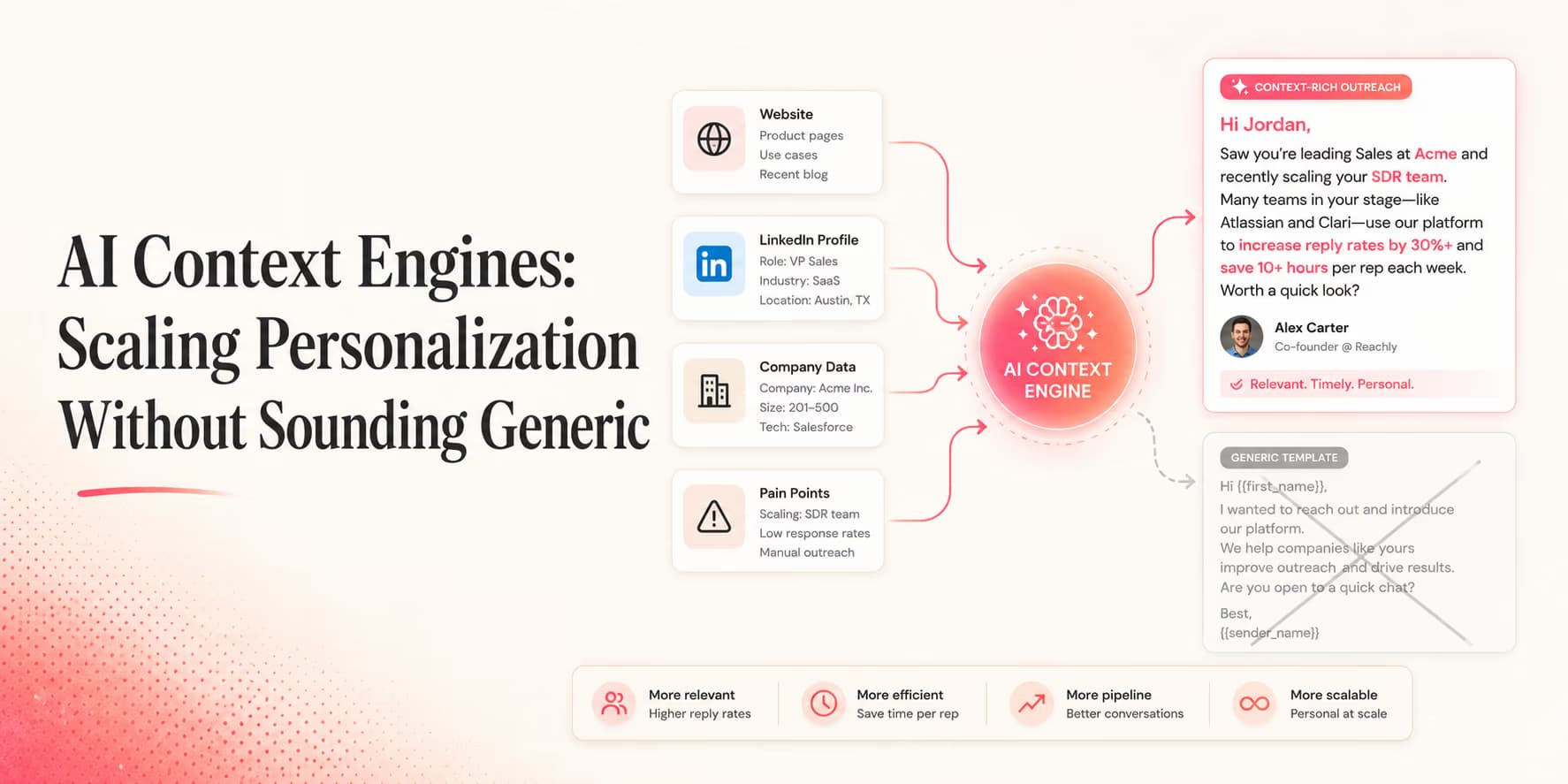
Language models have made B2B sales writing easier. Senders can ask the system to write an email pitching their software to a target prospect. The copy is readable, but it often contains errors. The model might invent features, misrepresent pricing, or exaggerate client results.
Those errors happen because the prompt lacks context. Language models rely on general training data. If you do not provide specific product facts and prospect details, the engine writes generic copy that gets few replies.
To scale outreach without inventing claims, build an AI context engine. That is an active data pipeline that gathers, cleans, and structures product specs and buyer details into a single prompt payload.
Omentir is the execution layer for these campaigns, using live profile signals to personalize outreach. Here is how to construct a context engine.
Context is not the same as personalization
Personalization is what the buyer sees in the message. Context is the evidence the system uses before writing that message. If you skip the evidence layer, the output may sound personalized while still being wrong.
A context engine should answer three questions before any draft is generated: what do we know about our product, what do we know about this prospect, and what are we allowed to claim? The third question is the one most teams miss. It is the difference between helpful AI assistance and a message that invents a customer result you cannot defend.
The goal is not to stuff every possible signal into the prompt. The goal is to provide enough verified evidence for the model to write one specific, honest opener.
Architecture of an AI context engine
An AI context engine is a data processing system that structures prospect and product information before calling copywriting APIs.
A working context engine manages three main steps:
- Sourcing: Retrieving your product profiles, pricing structures, and case studies.
- Crawling: Extracting live metadata from prospect websites and LinkedIn profiles.
- Aggregation: Compiling this information into a structured JSON payload.
For details on web crawling infrastructure, see our analysis of modern outbound data stacks.
The architecture should include a fourth step: rejection. If the engine cannot find a strong reason to contact the prospect, it should mark the lead as "research more" or "skip" instead of forcing a weak message. The best context engines improve quality by refusing to write when the evidence is thin.
Source product specs, pricing, and case studies
To keep outreach accurate, ground copywriting prompts in verified product data.
Configure a product profile containing the following details:
- Capabilities: What your platform does and does not do.
- Pricing Plans: Specific plan names and costs, matching the details in your product settings.
- Case Studies: Verified results from active clients in specific sectors.
Keep this product profile short and maintained. A context engine that uses old pricing or stale feature descriptions will create trust problems quickly. Assign one owner to update product facts whenever pricing, plan limits, integrations, or positioning changes.
For Omentir, the verified product context should come from live product pages and plan configuration, not memory. The current core facts are straightforward: Omentir helps find qualified buyers, personalize outreach, book more demos, and manage replies from one workflow. The Pro plan is $49/month, with a minimum of three bookings per week or you pay nothing.
Define a claim policy
A claim policy tells the AI what it may say. This is different from a product description. The product description explains the product. The claim policy defines proof requirements.
- Allowed: factual capabilities visible in the product or documentation.
- Allowed with caution: customer outcomes only when tied to a named, approved case study.
- Blocked: fabricated benchmarks, fake social proof, competitor claims you cannot verify, or promises of guaranteed revenue.
This policy keeps sales copy honest. It also makes review easier because the human editor can check the draft against a clear standard instead of relying on taste.
Crawl prospect ecosystems and website metadata
In addition to product data, the context engine crawls the prospect's website to identify active operational parameters.
The crawler extracts homepage value propositions and active career board postings, identifying specific challenges. For details on crawling signals, see our guide to how AI crawlers analyze B2B websites.
Raw crawls are noisy. A homepage might contain product copy, cookie banners, navigation labels, customer logos, and hiring pages all mixed together. Your engine should extract clean evidence, label where it came from, and discard anything that cannot be tied to a source.
Useful prospect context usually falls into a few buckets: what the company sells, who they sell to, what team they appear to be building, what tools or workflows they mention publicly, and what recent signal suggests timing. If you cannot identify at least one timing signal, write a softer opener or hold the lead for nurture.
Score context confidence
Every extracted field should carry confidence. A role listed on a current careers page is high-confidence. A vague phrase from a homepage hero is medium-confidence. A guess inferred from industry category is low-confidence.
Confidence should shape the message. High-confidence signals can be referenced directly. Medium-confidence signals should be phrased carefully. Low-confidence signals should not appear in the message at all; they can guide research, but they should not become buyer-facing copy.
High confidence: "Saw you are hiring SDRs in Austin." Medium confidence: "Looks like outbound may be a focus." Low confidence: do not mention it.
Context Rule: Restrict the Token Size 💡
Do not pass entire raw HTML payloads to the LLM. Extract the main text components first to keep API latency low and costs manageable.
Construct the unified context JSON payload
Once variables are extracted, the engine compiles them into a unified JSON payload:
{
  "product_context": {
    "name": "Omentir",
    "pricing": "Pro $49/month, minimum three bookings per week or you pay nothing; Enterprise includes unlimited users, unlimited LinkedIn accounts, SSO, dedicated onboarding, and priority support; guarantee policy: https://omentir.com/minimum-booking-guarantee",
    "case_study": "Helped SDRs reduce manual tracking by 80%"
  },
  "prospect_context": {
    "name": "John Doe",
    "company": "Example Inc",
    "hiring_roles": ["SDR Lead"],
    "tech_stack": ["HubSpot"]
  }
}
This unified payload is passed to your prompt templates so the generated copy stays accurate.
In a real system, add source and confidence fields. The model does not need long raw evidence, but the reviewer does need to know where the evidence came from.
{
  "signal": {
    "type": "hiring",
    "summary": "Company is hiring two SDR roles",
    "source_url": "https://example.com/careers",
    "confidence": "high"
  },
  "allowed_claims": [
    "Omentir finds ICP-fit LinkedIn buyers",
    "Omentir drafts personalized outreach for review",
    "Omentir collects replies in one inbox"
  ],
  "blocked_claims": [
    "guaranteed meetings",
    "specific customer ROI without approved proof"
  ]
}
Write the prompt contract
The prompt should behave like a contract, not a creative writing request. Tell the model what evidence it may use, what it must avoid, and what to do when evidence is missing.
A strong rule is: if no high-confidence prospect signal exists, return "needs research" instead of writing a message. This prevents the system from filling gaps with generic praise.
Also require the draft to include an evidence note for the reviewer. The buyer should not see the note, but the operator should. That note might say, "Used hiring signal from careers page; did not use pricing claim." This makes approval fast and accountable.
Review gates before delivery
Context engines are powerful because they scale decisions. That also means a bad rule can scale mistakes. Put gates before delivery: reject drafts with unsupported claims, reject messages over the length limit, reject first-touch calendar asks, and reject any opener that references sensitive or creepy personal details.
The review queue should show the final draft, the signal used, the product claim used, and the reason the lead passed ICP. With that view, a human can approve or edit quickly without redoing the entire research process.
Enforce human pacing and deliverability safety
Even with highly relevant copy, you must manage outreach volume to protect account safety. Spacing out requests protects your profile health.
Omentir manages this pacing automatically. For safety metrics, see our guide to pacing LinkedIn outreach campaigns.
Delivery safety should be part of the context engine because context affects volume. If the engine finds strong signals for only 12 prospects today, send to 12. Do not ask the model to stretch weak evidence into 100 messages just because the campaign quota allows it.
SOP: the 15-minute context assembler checklist
Build your context engine using these steps:
- Step 1: Paste your verified product specifications and case studies in the settings.
- Step 2: Configure crawlers to scrape target prospect websites during discovery.
- Step 3: Compile the data into a unified JSON variables schema.
- Step 4: Route the variables to Omentir's prompt builder to generate drafts.
- Step 5: Reject leads without high-confidence evidence instead of forcing generic copy.
- Step 6: Review evidence notes before approving any message from a real LinkedIn account.
Omentir updates these variables automatically, keeping your campaigns personalized and safe. The operator's job is to define the claim policy and keep the product facts current.
Ground outbound copy in real data
B2B outreach works when it is timely and relevant. An AI context engine keeps invented claims out of the sales copy.
Treat context as evidence, not decoration. A product claim that is not on the site, the pricing page, or a customer quote should not appear in a first message, no matter how well the model phrases it.
Frequently Asked Questions
It is a system that aggregates disparate data streams (product docs, case studies, prospect profiles) into a single structured payload to ground LLM generation.
By setting strict prompt boundaries that instruct the LLM to only write details present in the payload, returning an error flag if details are missing.
Omentir automatically retrieves prospect website metadata, checks active integrations, and uses this context to draft custom connection notes.
Yes. Senders can paste product facts in settings, while developers can connect custom vector databases via REST endpoints or the hosted MCP server.