
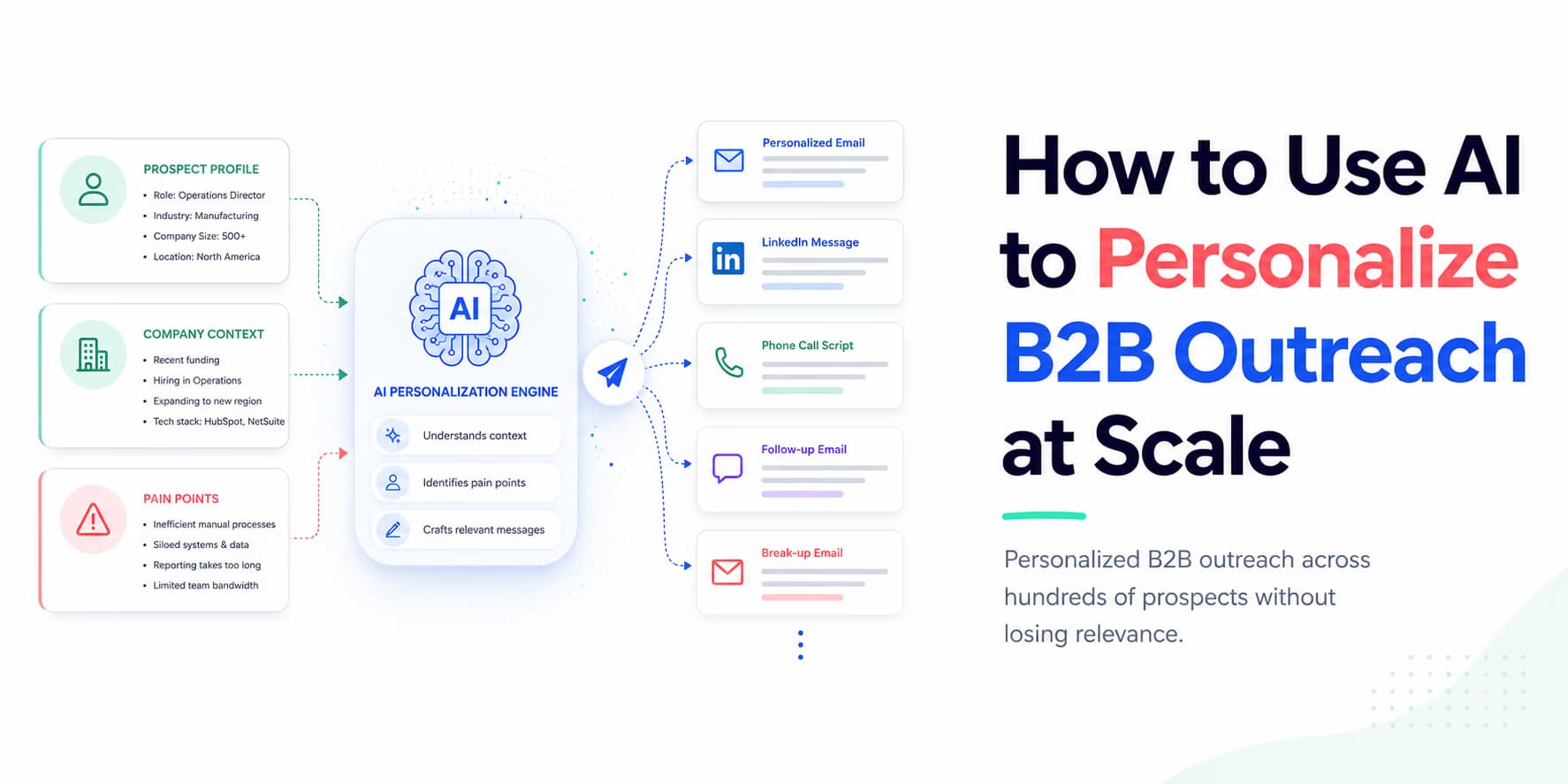
Personalization at scale fails when teams confuse "different words" with "better outreach." A message can be unique and still be useless. If the AI rewrites the same generic pitch one hundred ways, the campaign may look varied in a spreadsheet, but buyers still feel the same hollow sales motion.
The real problem is judgment. A human researching ten strategic accounts can decide which signal matters, what to ignore, and how to ask a natural question. At larger volume, that judgment has to be turned into a system: which accounts qualify, which evidence is strong enough, which claims are allowed, and which drafts must be rejected.
AI helps when it is used as part of that system. It can summarize public context, suggest angles, draft concise messages, and adapt follow-ups. It becomes dangerous when it is asked to invent relevance for leads that should not have entered the campaign in the first place.
Omentir supports this workflow by combining lead discovery, product-grounded drafting, paced LinkedIn campaigns, and reply organization. The goal is not to make outreach sound automated at scale. The goal is to make good research and thoughtful first messages repeatable.
Architecture of an AI personalization engine
An automated personalization pipeline should not feed a prospect's name into a language model and ask for a sales pitch. That approach produces polite nonsense: "I noticed your impressive work at Company" followed by a generic value proposition. It is technically personalized and practically invisible.
A useful personalization engine operates as a structured decision pipeline:
- Data sourcing layer: Pulls dynamic variables (job changes, company updates, technology stacks) from live prospect profiles.
- Context grounding layer: Combines prospect variables with your product facts and case studies, and sets boundaries so the model cannot invent claims.
- Execution layer: Processes variables through structured copywriting rules and outputs a concise, clear message.
- Quality gate: Rejects weak evidence, unsupported claims, awkward tone, and poor-fit accounts before sending.
- Learning loop: Feeds replies, objections, and rejected drafts back into sourcing and prompt rules.
The quality gate is what separates useful AI personalization from automated flattery. If the only available signal is "prospect has a VP title," the system should write a role-based message or reject the lead. It should not pretend to have discovered a deep insight.
Treat personalization as a chain. If sourcing is weak, the prompt cannot save it. If product context is vague, the model will fill gaps. If review is skipped, small errors become public messages. Every layer has to do its job.
To learn more about setting up these data feeds, check out our guide on modern outbound data stacks.
Grounding the copywriter in company facts
AI models require strict reference boundaries. If you ask a model to pitch your product without constraints, it may invent features, exaggerate proof, imply integrations you do not support, or make promises your team cannot keep. The copy may sound confident while being wrong.
Grounding starts with a verified product profile. This profile should contain:
- Product scope: What your platform does and does not do.
- Target audience: The challenges your software resolves for specific roles.
- Proof boundaries: Approved customer examples, claims, and outcomes the model is allowed to mention.
- Disallowed claims: Features, guarantees, pricing, integrations, or compliance statements the model must not invent.
Instruct the engine to only write claims present in this profile or in sourceable prospect evidence. If the product profile does not mention a CRM integration, the message cannot mention one. If the prospect evidence does not prove a pain point, the message should ask a question rather than declare the pain.
This is especially important at scale because one bad claim can be repeated across many drafts. A human might catch an invented feature in one message. A system needs explicit guardrails so the error does not multiply.
A copyable copywriting prompt blueprint
A structured prompt is essential, but the prompt should not try to do everything. It should receive already-clean evidence, a clear product profile, and rules for what good copy looks like. The prompt below is a safer starting point:
You are an expert sales writer. Write a B2B outreach message based on the input:
- Prospect Name: {prospect_name}
- Company Name: {company_name}
- Buyer Signal: {buyer_signal}
- Signal Source: {signal_source}
- Signal Confidence: {signal_confidence}
- Product Profile: {product_profile}

Rules:
1. Limit the message to under 80 words.
2. Avoid generic introductions like "Hope this finds you well" or "Congrats on the success."
3. Open directly by referencing the Buyer Signal.
4. Transition into a single problem solved by the Product Profile.
5. Do not claim private knowledge or unsupported pain.
6. If signal confidence is low, use a role-based opener instead.
7. Conclude with a low-friction question rather than a direct meeting request.
This prompt makes the model account for evidence quality. It also gives the model permission to be less specific when the signal is weak. That is important. Forced personalization is worse than honest role-based relevance.
Keep prompt versions. When a campaign performs poorly, you need to know which prompt created the drafts. Otherwise, you cannot tell whether the issue was sourcing, evidence extraction, product positioning, or the writing instruction itself.
Copywriter Rule: Avoid Buzzwords
Instruct your AI copywriter to avoid words like "revolutionize," "seamless," "supercharge," and "next-generation." Human writers avoid these phrases; using them highlights that the message was automated.
Gathering web inputs and personalization signals
Dynamic variables are only useful when they are verified and relevant. A recent post can be a great opener if it relates to your offer. It is a distraction if the post is personal, old, or unrelated. A hiring signal can be strong if it points to a workflow your product improves. It is weak if the job post has nothing to do with your buyer.
Useful inputs often come from public sources such as:
- Hiring posts: Identify roles they are recruiting for (e.g. "building out your SDR team in London").
- Competitor tech stacks: Note if they use tools your software replaces or integrates with.
- Profile updates: Reference specific milestones, such as a recent executive transition.
- Website positioning: Understand the buyer's market, product category, and stated value proposition.
- Product or changelog pages: Detect new initiatives that may change operational priorities.
- Role context: Use the prospect's responsibilities to ask a relevant question without needing a flashy trigger.
Store the source beside the signal. "Careers page says the role owns outbound reporting" is usable. "They need outbound automation" is an interpretation. The message should be written from the sourceable fact, while the interpretation can guide the angle.
For details on how to write hooks based on these signals, see our guide on writing LinkedIn message hooks.
Managing the draft review and approval process
Even with strong prompts, you should not treat every draft as send-ready. AI models can misread context, overstate a signal, choose an awkward tone, or write a message that is technically accurate but commercially weak. Review is not a formality; it is part of the system.
A review queue should make decisions fast. The reviewer should see the prospect, source evidence, draft, product angle, and reason the lead was selected. Without that context, the human is just proofreading sentences instead of judging whether the message should exist.
Omentir supports reviewable campaign workflows: agents can stage drafts or activate campaigns depending on the user's preference, and replies are collected in one place. For higher-risk campaigns, keep the first batch in review until you trust the sourcing and message quality.
Use a simple reject list. Reject drafts that mention unsupported features, reference stale signals, sound overfamiliar, diagnose private pain, ask for too much too soon, or fail to explain why this buyer was chosen. Rejections are not wasted work. They teach the system what to avoid.
Outbound success benchmarks and reply rates
Do not judge personalization by whether the message includes a custom sentence. Judge it by whether the custom sentence improves the conversation. The right metrics are quality metrics, not vanity metrics.
- Qualified reply rate: How many replies come from buyers who match the ICP and show real interest?
- Objection quality: Are prospects raising useful objections, or are they confused about why you contacted them?
- Draft rejection rate: How many AI drafts fail review, and why?
- Signal accuracy: How often does the referenced signal hold up when reviewed by a human?
- Meeting fit: Do booked calls involve the right role, account type, and problem?
Compare campaigns with similar ICPs and pacing. If one campaign produces more replies but most are poor-fit, it is not better. If another produces fewer replies but more qualified conversations, it may be the healthier campaign.
The best personalization systems reduce waste. They send fewer irrelevant messages, create clearer replies, and help the team learn which signals actually matter.
Combining systems with quality outreach
Outbound outreach does not have to be a choice between quality and scale, but quality has to lead. If the system starts with weak targeting and asks AI to make the message feel personal, it will create polished spam. If the system starts with evidence, product truth, and review, it can scale thoughtful outreach.
Start with one segment and one offer. Define strong signals, write the disallowed claims, review the first drafts, and track reply quality. Once the workflow consistently creates useful conversations, scale the volume carefully.
The standard remains human: would this message make sense if a careful founder wrote it by hand? If the answer is no, the merge fields are not personalization. They are a mail merge with extra steps.
Frequently Asked Questions
You must ground the prompt in specific personal data fields (such as their recent blog posts, job listings, or company updates) and restrict the engine from using standard introductory transitions.
The most useful variables are sourceable and relevant: role changes, hiring patterns, public company initiatives, website positioning, product pages, and technology context that connects directly to your offer.
Omentir uses product and prospect context to help discover leads, draft LinkedIn outreach, pace campaigns, and organize replies. Teams can stage drafts for review or launch campaigns depending on their workflow.
No. While developers can use Omentir's REST endpoints or hosted Model Context Protocol (MCP) server, sales operators can manage prompt variables and approve campaign drafts directly from the user interface.