
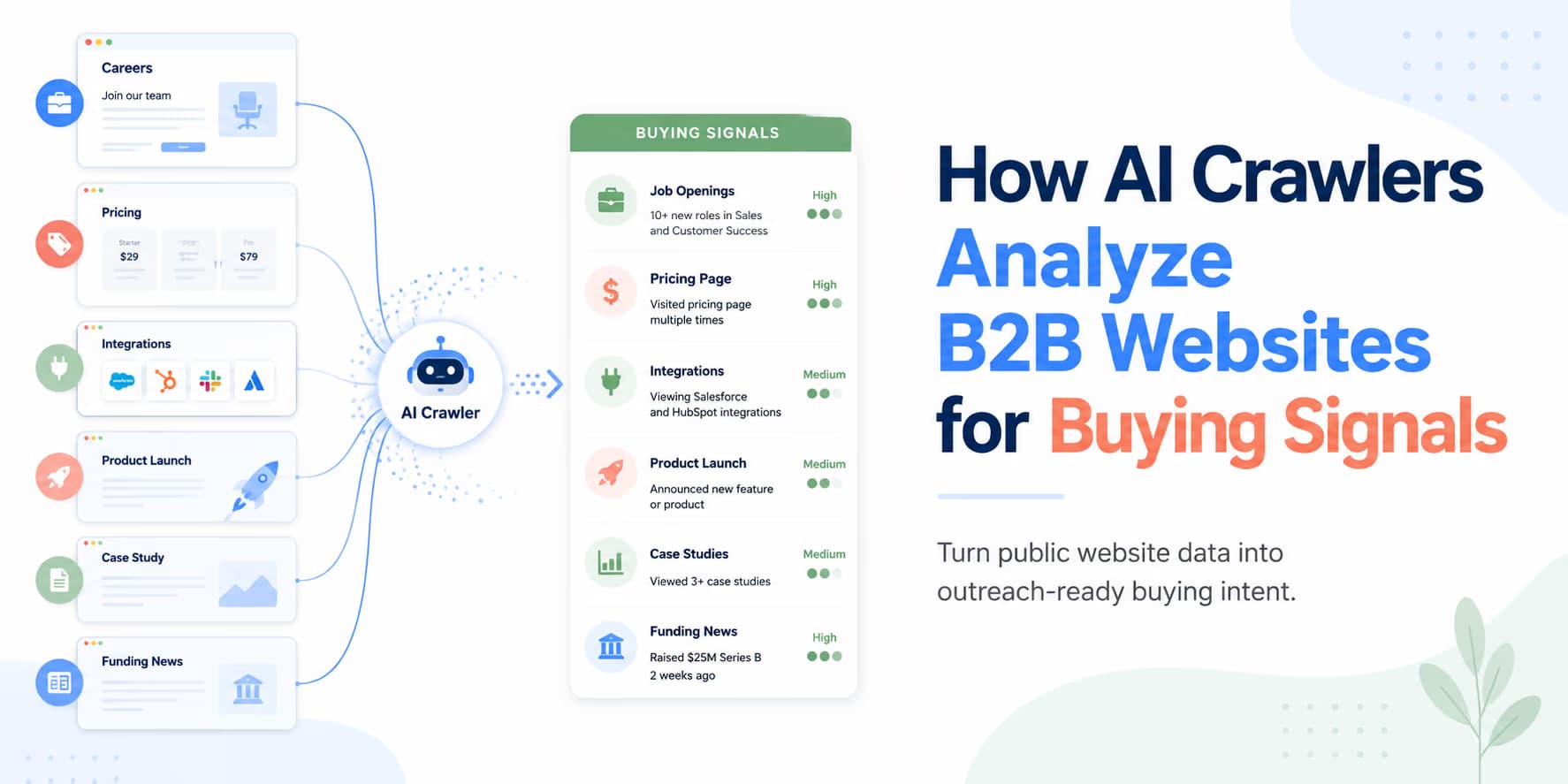
Most outbound lists are built from facts that age slowly: industry, region, head count, funding stage, seniority, job title. Those filters are useful, but they only answer one question: could this company theoretically buy from us? They do not answer the question that matters when you send the message: why would they care this week?
Buying signals fill that gap. A company that just added a RevOps role, published a new integration page, opened a new region, changed pricing, or rewrote its homepage around a new buyer may be easier to approach than a company that merely matches your database filters. The signal is not proof that they are ready to buy. It is a clue that your message can be anchored in something real.
Manual website review works when you are researching ten accounts. It breaks when you need to sort hundreds of accounts every week. AI crawlers help by reading public company pages, extracting the parts that matter, and turning messy text into a structured view of what changed, who might care, and whether the account deserves outreach.
The important word is "help." A crawler should not invent intent from thin evidence or write creepy messages that make prospects feel watched. Used well, it gives your sales system better context before a human-paced message is drafted. Used poorly, it becomes a faster way to send irrelevant personalization.
How AI crawlers scan B2B corporate domains
AI crawling is more than downloading HTML. A basic scraper can return a blob of navigation links, cookie notices, footer text, and repeated marketing copy. A useful sales crawler needs to separate the page furniture from the page meaning.
A good crawler usually performs five jobs. First, it discovers pages worth reading. Second, it cleans the text. Third, it classifies the page type. Fourth, it extracts evidence. Fifth, it decides whether the evidence is strong enough to affect routing, scoring, or messaging.
- Page discovery: Map likely signal pages such as homepage, pricing, careers, integrations, docs, customers, changelog, security, and partner pages.
- Text cleaning: Remove repeated navigation, footer copy, cookie banners, scripts, style blocks, and duplicated boilerplate.
- Page classification: Label each page by purpose so a hiring signal is not mixed with a product claim or a customer story.
- Evidence extraction: Pull out exact public snippets, source URLs, dates where available, mentioned tools, buyer roles, and stated initiatives.
- Confidence scoring: Decide whether the signal is fresh, specific, relevant to your ICP, and safe to reference in outreach.
The crawler should store the source URL beside every extracted signal. Without the source, your team cannot review the evidence, debug bad scores, or understand why a message was drafted a certain way. This is especially important when a model summarizes a page. Summaries are helpful, but outreach should be based on traceable public evidence.
For details on this evaluation logic, see our analysis of active lead qualification methods.
Detecting software integrations and tech stack changes
Software stack signals can be useful because they connect your offer to an existing workflow. If your product improves HubSpot operations, the account is more interesting when the company publicly mentions HubSpot in docs, job posts, integration pages, or customer-facing setup instructions.
The crawler should not treat every mention as equal. A blog post from five years ago that says "we compared HubSpot" is weak evidence. A current integration page that says "connect your HubSpot workspace" is stronger. A RevOps job posting that asks for HubSpot automation experience is different again: it may signal operational complexity rather than product usage alone.
The safest extraction format is specific: tool mentioned, page type, snippet, source, and interpretation. For example, "HubSpot appears in the implementation docs; likely relevant to CRM workflow" is a better signal than "uses HubSpot." The first statement is grounded. The second may be true, but it is too confident unless the page clearly proves it.
This distinction matters in the message. A strong outreach line says, "Saw your team has public docs around HubSpot setup." A weaker and riskier line says, "I know you use HubSpot." The first references public context. The second sounds like surveillance unless the prospect already made that fact obvious.
Extracting pain points from active career boards
Career pages are one of the richest public sources for operational pain because companies describe the work they need done. They list tools, processes, reporting lines, territories, and projects. That does not mean every job post is a buying signal, but it often tells you what the team is trying to build.
A crawler should read job posts like a careful sales rep, not like a keyword counter. The useful question is not "does this post contain the word outbound?" The useful question is "what job is this company hiring a person to do, and does our product reduce the burden of that work?"
- Raw evidence: "Own list building, LinkedIn prospecting, and weekly pipeline reporting for founder-led sales."
- Likely workflow: The team is building an outbound motion and still expects manual prospect research.
- Possible buyer: Founder, Head of Sales, or first GTM hire.
- Safe message angle: Ask whether they are trying to make LinkedIn sourcing more repeatable while they hire.
Notice the wording: "possible" and "likely." The crawler should not pretend it knows the company's internal priorities. It should create a hypothesis that a human or an automated QA layer can approve before the account enters a campaign.
Discovery rule: filter outdated signals
Record posting dates, crawl dates, and source pages. A signal from an old job post or stale changelog can still be useful for research, but it should not drive urgent copy. When freshness is unclear, lower the confidence score instead of forcing a timely angle.
Structuring crawled text into actionable prompts
Website context becomes valuable when it is structured enough for scoring and restrained enough for messaging. Raw text extracts are noisy. A model needs a schema that separates evidence from interpretation.
{
  "prospect_domain": "example.com",
  "signals": {
    "source_url": "https://example.com/careers/sales-operations",
    "page_type": "careers",
    "public_snippet": "Own LinkedIn prospecting and weekly pipeline reporting",
    "signal_type": "outbound_workflow_buildout",
    "freshness": "posted_recently",
    "confidence": "medium",
    "buyer_role": ["Founder", "Head of Sales"],
    "safe_outreach_angle": "Ask whether LinkedIn sourcing is becoming a repeatable process."
  }
}
This kind of schema protects quality. It prevents the message writer from jumping directly from "job post mentions LinkedIn" to "you need our product." It also gives your review layer something to inspect. If the snippet is weak, the score should drop. If the buyer role is unclear, the account can stay in research instead of entering a sequence.
The prompt that drafts the message should receive both the signal and the safety rule. A simple rule works well: reference only public evidence, do not claim private knowledge, and ask a relevant question before pitching. That keeps personalization helpful instead of invasive.
For example, the output should sound like: "Saw you are hiring for someone to own LinkedIn prospecting and pipeline reporting. Are you trying to make that workflow repeatable before the new hire ramps?" That is very different from: "Your outbound process is broken and you need automation." The same signal can produce either a useful opener or an obnoxious one.
Excluding competitors and outdated websites
A crawler that reads everything will eventually score the wrong accounts. Some domains are irrelevant, some are stale, and some should never enter outreach. Data quality is not a cleanup step at the end; it is part of the crawl design.
Start with exclusion lists. Remove competitors, current customers, current partners, investors, vendors, agencies you do not sell to, personal blogs, directories, and parked domains. If your company serves B2B SaaS teams, a community page that merely mentions a SaaS company should not be treated as the company domain.
Then add evidence checks. Does the page belong to the target company? Is the page accessible without login? Is the text unique enough to learn from, or is it mostly template copy? Does the page include a date? Is the signal specific to a business problem, or is it a generic marketing claim that every company makes?
You also need conflict handling. Suppose a company has an old careers page asking for Salesforce skills but a newer integration page focused on HubSpot. The crawler should not blend those into a confident "uses Salesforce and HubSpot" claim unless both sources are current. More recent, more specific evidence should win, and the older signal should be marked as low confidence.
Triggering paced outreach when buying signals match
A buying signal should not immediately mean "send a message." It should move the account to the next decision point. The strongest workflow is crawl, score, draft, review, then send at a human pace.
Scoring should combine fit and timing. Fit asks whether the account matches your ICP: segment, size, geography, buyer role, and problem. Timing asks whether the public evidence suggests a current reason to talk. A great signal on a poor-fit account should not pass. A great-fit account with no timing signal may belong in a nurture list, not an immediate outbound campaign.
Once an account passes, route it to a paced queue. LinkedIn outreach should look like a thoughtful rep working a small list, not a machine dumping every detected signal into the outbox. Omentir is built around that human-paced philosophy: discovery, scoring, message drafting, and controlled sending from the user's own account. For pacing details, see our guide on pacing LinkedIn outreach campaigns.
The draft should also pass a QA check. Ask: does the message cite a public signal? Is the signal relevant to the recipient's role? Does the opener sound natural if the prospect reads it on a phone? Is there a clear reason to reply? If any answer is no, the lead can stay qualified while the message is rewritten.
SOP: the automated buyer intent checklist
Use this operating checklist before trusting website signals in a live outbound workflow:
- Define the ICP first: Document who you sell to, what pain you solve, and which signals should increase or decrease priority.
- Choose signal pages: Crawl pages that can reveal change: careers, pricing, integrations, docs, security, customers, product updates, and partner pages.
- Store source evidence: Save the URL, snippet, page type, crawl date, and any visible publication date.
- Score conservatively: Separate strong signals from weak mentions. Do not let one keyword overpower poor fit.
- Write from evidence: Draft messages that reference public context and ask useful questions instead of making private-sounding claims.
- Review edge cases: Manually inspect competitor domains, ambiguous signals, stale pages, and high-value accounts before sending.
- Throttle delivery: Send through a paced queue with daily limits, reply handling, and stop conditions when the prospect engages.
The checklist is intentionally boring. That is the point. AI crawling becomes powerful when the system is disciplined about evidence. If the crawler cannot explain why an account is relevant, the message should not be sent.
Omentir uses this kind of discovery and scoring approach to help teams move from broad lead lists to accounts with clearer context. The goal is not to make outreach feel automated. The goal is to make every approved message feel like it came from someone who did their homework.
Building a live intent outbound funnel
Website crawling gives outbound teams a better sense of timing. It helps identify public changes that a normal database misses: new roles, new integrations, new positioning, new product pages, and new operational priorities. Those signals can improve targeting, but only when they are interpreted carefully.
The winning pattern is not "crawl more pages and send more messages." It is collect better evidence, score it honestly, and write outreach that respects the buyer. That is how AI crawlers become part of a sustainable outbound funnel instead of another source of noisy personalization.
If your current prospecting process starts with static filters, add a small signal layer before scaling. Pick one ICP, crawl the pages most likely to show change, review the first batch manually, and only automate what consistently produces useful evidence. That is the path from basic scraping to a live intent system your sales team can trust.
Frequently Asked Questions
It is an automated script that scans prospect homepages, technical docs, and career listings, extracting text to identify active business changes and software setups.
By scanning public pages for specific integration badges, reviewing technical documentation headers, or analyzing career posts requesting experience in specific tools.
Omentir uses website context as part of lead discovery and scoring, then drafts outreach that references public signals only when they are relevant to the buyer and the offer.
A responsible crawler should respect robots.txt, avoid aggressive request rates, cache results, and focus on public pages that a human sales rep would reasonably review.