
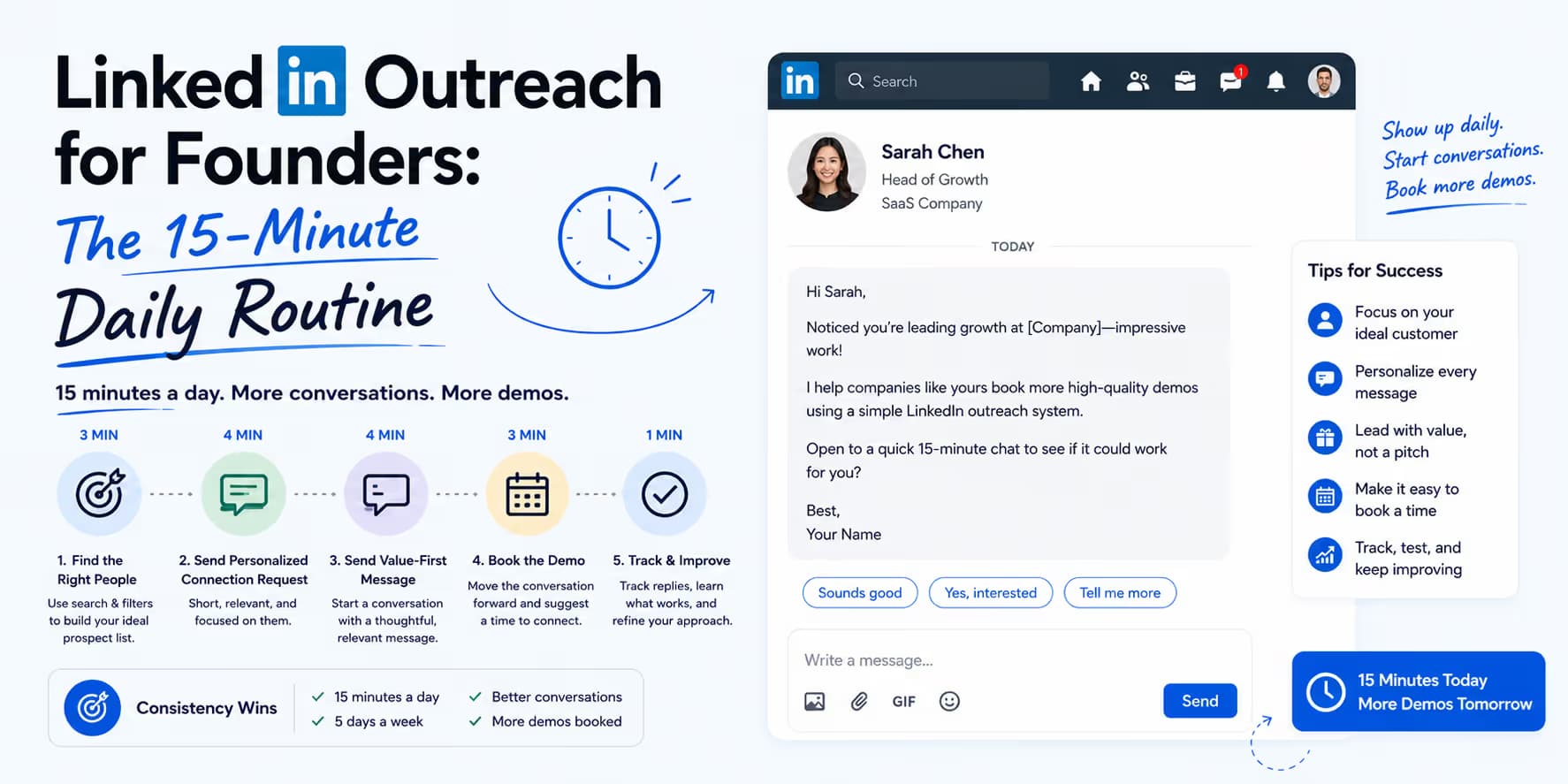
As an early-stage B2B founder, time is the scarce asset. Product work, bugs, early users, and fundraising all crowd the calendar. Outbound is usually the first thing that slips.
Ignore customer acquisition and the pipeline dries up. You do not need a four-hour sales block. You need a small daily habit. Fifteen minutes each morning, with a fixed checklist, is enough to keep demos on the calendar without stalling development.
The early-stage founder's pipeline paradox
Most early-stage technical founders fall into feast or famine. They spend two months building, notice there is no pipeline, panic-outreach on LinkedIn for a week, book three demos, close one customer, then stop outreach to handle onboarding and write more code.
That pattern stalls growth. Product validation and fundraising both need a steady line of qualified conversations. You do not need four hours a day scraping directories. You need a small, consistent lead generation habit that keeps the calendar from going empty.
Why founders make the best outbound sales reps
Many founders try to outsource early-stage sales too early, hiring expensive agencies or junior SDRs. That is almost always a mistake.
In the early days of a B2B startup, outreach is also market research. As the founder, you know the product, the vision, and the pain better than an outsourced rep. When an executive replies with a technical objection, you can turn it into a product conversation on the spot. Peer-to-peer founder outreach converts at up to three times the rate of junior sales representative outreach.
The consistency multiplier
Sending 10 targeted, personalized connection requests daily outperforms sending 150 generic messages once a week. Daily consistency is also safer for the account and keeps your name in the feeds that matter.
The 15-minute daily outreach routine
To maintain a healthy sales pipeline without burning out, allocate exactly 15 minutes in your calendar every morning to address active sales tasks. Turn off all Slack and email notifications and execute this checklist:
| Time Slot | Activity Name | Action Items |
|---|---|---|
| Minutes 0-5 | Inbox triage and bookings | Log into your LinkedIn inbox. Reply to any active leads, answer technical questions, and drop your booking link. Pause campaigns for leads who replied. |
| Minutes 5-10 | Signal evaluation | Review the leads identified by your intent crawlers. Check fit scores, evaluate profile views, and approve queued sequences. |
| Minutes 10-15 | Social warm-up | Find 3 high-value target accounts. Leave thoughtful, specific comments on their recent posts. This primes them for your connection. |
The predictable outbound funnel
B2B customer acquisition is a numbers game once the daily volume is fixed. Keep the same inputs and the pipeline stops being a surprise.
Here is the outbound math for this 15-minute daily routine over a standard 20-business-day month:
- Daily output: 15 connection requests = 300 prospects targeted per month.
- Acceptance rate (45%): 135 new connections added to your LinkedIn network.
- Conversation rate (15%): 20 newly engaged, high-context conversations.
- Demo booking rate (25%): 5 qualified product demos booked per month.
- Close rate (20%): 1 new B2B customer closed every single month.
If your customer lifetime value (LTV) is $10,000, this simple 15-minute daily investment yields a predictable $10,000 in monthly recurring revenue (MRR) growth.
The social warm-up play
The biggest conversion lift in this daily routine is the social warm-up play. Cold connection requests have a standard acceptance rate of 20-25%. If the prospect recognizes your name or face before they see your invite, that rate spikes to over 50%.
Implement the 3-day social warmup method:
- Day 1 (The Footprint): Visit their profile, scroll their recent posts, and leave a simple "like" on their latest update.
- Day 2 (The Insight): Return to their profile. Write a two-sentence comment on their post that adds something useful to the thread.
- Day 3 (The Connect): Send your connection request. Keep it simple: "Hi [Name], loved your insights on [Topic] yesterday. Let's connect peer-to-peer."
Keep the founder routine practical
Use the daily routine above to protect founder time. A small, consistent workflow usually beats occasional bursts of rushed, low-context outreach.
The 15-minute routine, minute by minute
The title promises a 15-minute daily routine, so the routine must be precise. A founder does not need a complicated SDR process. They need a small block that creates new conversations every day without stealing product, hiring, or customer time.
- Minutes 0 to 3: Review yesterday's replies and sort them into interested, objection, referral, not now, and not a fit. Only interested and objection replies deserve same-day founder attention.
- Minutes 3 to 6: Find five new prospects from one narrow segment. Do not switch industries during the block. Consistency makes your learning faster.
- Minutes 6 to 9: Capture one context signal for each prospect. Use a recent post, hiring page, product page, founder interview, or funding announcement.
- Minutes 9 to 12: Send three to five connection requests. Each note should reference the context signal and avoid a product pitch.
- Minutes 12 to 15: Write one follow-up to an accepted connection and record the best-performing hook in a simple note. The goal is learning, not just sending.
Over 20 workdays, this routine produces 60 to 100 targeted invitations and a useful set of reply data. That is enough to validate a segment, improve positioning, and book early demos without pretending the founder has time for full-time prospecting.
What founders should track weekly
A founder's LinkedIn routine should produce learning, not only activity. Track a small set of numbers every Friday so you know whether the routine is improving the business or just filling the calendar with busywork.
- Qualified prospects sourced: Count only people who match the ICP and have a plausible reason to care.
- Connection acceptance rate: This shows whether your profile and invite copy create enough trust.
- First-message reply rate: This shows whether your opener is tied to a real buyer problem.
- Positive conversation rate: This separates polite replies from actual business interest.
- Demos booked: This is the output metric, but it should be interpreted after the earlier metrics.
If acceptance is weak, fix the profile and request note. If replies are weak, fix the context and problem statement. If conversations are positive but demos are weak, fix the ask. This keeps the founder focused on the real bottleneck instead of simply sending more messages.
How to keep the routine sustainable
The routine fails when founders make it too ambitious. Do not try to research 50 accounts, write custom essays, publish content, and handle every reply in the same daily block. The point of 15 minutes is consistency. Small, high-quality batches beat occasional bursts of 200 rushed messages.
Protect the block by using one segment per week. On Monday, decide the exact buyer type and trigger you will pursue. For the rest of the week, do not switch audiences unless the data proves the segment is wrong. This keeps your learning clean because every reply belongs to the same campaign hypothesis.
Also separate creation from response. Use the daily block for sourcing and sending. Handle interested replies in a different sales block later in the day, when you can think carefully. That prevents the founder from rushing warm conversations just to finish the routine.
A simple weekly founder schedule
Here is the simplest weekly version of the routine. Monday is for choosing the segment. Tuesday and Wednesday are for sourcing and sending. Thursday is for follow-ups to accepted connections. Friday is for reviewing replies and improving the next week's hook. This rhythm keeps the founder from reinventing the process every day.
Keep one document with three lists: best-performing openers, common objections, and prospects who said not right now. Over time, this becomes founder-led sales intelligence. You will learn which buyer language appears repeatedly, which problem creates urgency, and which segments are polite but not ready to buy.
The routine is small by design. Its value comes from repetition, clear targeting, and fast learning, not from pretending a founder can run a full SDR desk between product calls.
Founder sales FAQs
Almost never in the early stages. Agencies charge high retainers and typically run high-volume, generic campaigns that damage your personal brand reputation. Doing it yourself for 15 minutes a day builds real relationship equity.
If you don't have 15 minutes to spend securing clients, you don't have a business-you have a hobby. Reframe sales not as an interruption to building, but as the fuel that funds it.
Frame the link entirely as a convenience option: "Completely fine if you're too busy, but if you'd like to chat, here is my direct calendar link to save us the back-and-forth: [Link]. Otherwise, happy to keep mapping out ideas here!"