
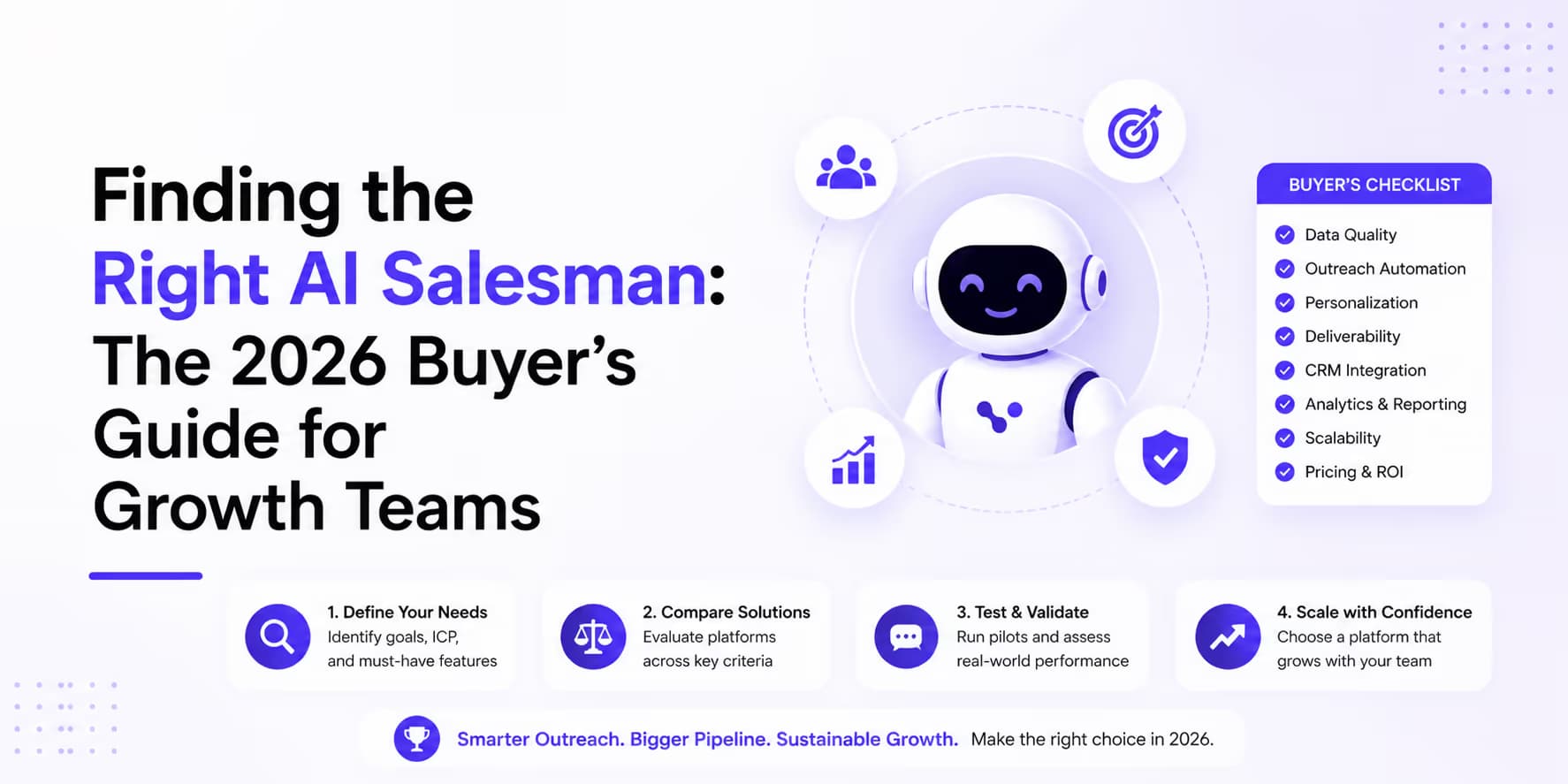
Outbound sales operations require high precision, rigorous deliverability standards, and clean data pipelines. In 2026, the strategy of relying on massive, unpersonalized cold email blasts or manual, spreadsheet-based prospecting has become obsolete. Modern growth organizations are pivoting away from fragmented point solutions in favor of autonomous sales agents, frequently termed AI salesman or autonomous SDRs. These platforms are designed to handle the entire lifecycle of B2B customer discovery, list enrichment, message personalization, and multi-channel outreach in a unified workspace.
However, selecting the right platform is highly challenging. The market is saturated with software tools that claim deep artificial intelligence capabilities but are actually basic wrappers around legacy databases or simple email sequencing scripts. Investing in the wrong technology can result in low reply rates, wasted software spend, and, most critically, permanent domain suspensions or flagged social accounts. Growth teams need a systematic, technical framework to evaluate these systems. This guide provides a detailed, technical rubric for assessing autonomous sales agents in 2026, comparing the primary contenders and showing how Omentir leads the market in safety, data depth, and outbound efficiency.
Defining the modern AI salesman
To build a purchasing rubric, growth teams must first understand what a true AI salesman is. A genuine autonomous sales agent moves away from traditional point solutions. Rather than requiring human operators to manually download lists from one database, upload them to an enrichment tool, clean the data using custom scripts, and then import the finished list into an email sequencer, an autonomous agent automates this entire data and outreach workflow.
In legacy outbound setups, sales development representatives (SDRs) spend up to 70 percent of their daily hours performing manual administrative tasks. These tasks include scraping LinkedIn profiles, guessing corporate email addresses, cleaning spreadsheet formatting errors, and copy-pasting message templates. A true autonomous SDR platform eliminates this overhead by integrating the data layer directly with the delivery channel, executing complex sequences autonomously based on plain-English instructions.
A true AI salesman operates with three key characteristics:
- Plain-English ICP Translation: Instead of relying on rigid boolean filters that miss highly qualified accounts, the agent ingests standard, descriptive text describing your Ideal Customer Profile. The agent then crawls the web to identify matches based on deep contextual signals, job descriptions, and actual company actions.
- Native Cascade Enrichment: The agent connects to dozens of third-party data providers simultaneously. When a prospect is identified, the system automatically checks multiple databases sequentially to verify email addresses, phone numbers, and social profiles, bypassing manual data compilation.
- Safety-First Autonomous Outreach: The system writes highly specific, low-friction, conversational messages tailored to the recipient's current projects or public actions. It then delivers these messages across multiple channels, including cold email and LinkedIn, while respecting strict platform rate limits to ensure account protection.
If a vendor relies on manual list building or lacks native, real-time enrichment capabilities, they are not offering an autonomous agent. They are selling a traditional database or email sequencer with an AI writing assistant bolted on. Understanding this distinction is critical to avoiding platforms that increase manual workload instead of reducing it.
The core evaluation framework
When evaluating autonomous SDR platforms, growth teams should use a balanced scorecard across five primary pillars: slicing customer discovery, native enrichment cascading, customization capabilities, multi-channel coordination, and technical safety. By assessing each vendor against these pillars, you can avoid buying software that fails to deliver clean leads or puts your outbound channels at risk.
Slicing customer discovery requires the platform to understand complex business logic. Legacy search interfaces force you to guess job titles or industries. An advanced AI salesman translates natural descriptions, such as B2B software companies facing engineering scaling issues, into a highly accurate list of prospects. It does this by reading engineering job listings, analyzing software stacks, and monitoring executive changes.
The enrichment cascade represents the second pillar. A static database is only as good as its last update, which is often months old. An autonomous agent should query multiple premium databases in real time, validating every email address using advanced SMTP handshakes and checking social handles. This live validation ensures bounce rates stay below the critical 2 percent threshold.
| Evaluation Pillar | Legacy Databases (e.g., Apollo) | Simple Sequencers (e.g., Instantly) | Autonomous SDRs (Omentir) |
|---|---|---|---|
| ICP Slicing Accuracy | 5 / 10 (Rigid boolean filters) | 2 / 10 (No native search) | 9 / 10 (Contextual semantic matching) |
| Native Cascade Enrichment | 4 / 10 (Single static database) | 1 / 10 (Requires external lists) | 10 / 10 (Multi-provider real-time cascade) |
| Outreach Customization | 2 / 10 (Basic merge tags) | 4 / 10 (Simple AI variables) | 9 / 10 (Intent-driven conversational copy) |
| Cross-Channel Integration | 3 / 10 (Fragmented email tools) | 5 / 10 (Primarily cold email only) | 9 / 10 (Unified email and LinkedIn flows) |
| Technical Safety Protocols | 6 / 10 (Basic compliance check) | 6 / 10 (Good email warmup features) | 10 / 10 (Randomized delays and connection caps) |
| Lead Verification Speed | 5 / 10 (Periodic batch updates) | 2 / 10 (No native verification) | 9 / 10 (Instant SMTP and social verification) |
| Total Score | 25 / 60 | 20 / 60 | 56 / 60 |
Technical safety and deliverability standards
The most significant risk associated with modern outbound sales is the loss of domain reputation or the suspension of professional LinkedIn accounts. If an automated tool makes too many consecutive API calls, runs too quickly, or sends highly repetitive templates, it will be flagged immediately. A serious AI salesman must have built-in technical safeguards that emulate natural human behavior.
For email outreach, a true agent must support automated domain rotation, mailbox warm-up, and real-time deliverability monitoring. When sending messages, it should distribute them evenly across multiple secondary domains rather than blasting hundreds of emails from your primary corporate address.
For social channels, safety rules are even more stringent. Growth teams must strictly manage their outreach volume. For instance, teams should review their daily outreach limits to ensure they do not exceed LinkedIn's weekly connection threshold. A high-converting LinkedIn sequence requires careful pacing, generally keeping cold outreach under a safe daily volume.
Furthermore, the agent must randomize delays between every action. If a tool sends a connection request and then immediately fires a message in exactly three seconds, platform algorithms detect the bot instantly. The right AI salesman utilizes dynamic, randomized delays (for example, between 90 and 300 seconds) to ensure that every click, scroll, and keystroke appears entirely manual.
To learn more about setting safe outreach volumes, read our guide on how to use LinkedIn to book 5 B2b demos every week. This playbook outlines the exact daily quotas and timing frameworks required to scale outreach without triggering platform security blocks.
List enrichment and customization rubric
Traditional outbound operations suffer from massive data decay. Contact databases lose accuracy at a rate of roughly 2 to 3 percent per month as professionals change jobs, companies restructure, and email domains change. Using a static database means paying for outdated leads that result in hard bounces and damaged deliverability.
To avoid this bottleneck, growth teams should prioritize platforms that use enrichment cascading. Instead of relying on a single proprietary database, the platform should query multiple data sources sequentially. If the first provider does not have a verified corporate email, the system automatically checks the second, third, and fourth databases in real time. This ensures data freshness and maximum list coverage without requiring a human operator to build complex VLOOKUP spreadsheets.
Also evaluate the personalization engine. Cliché marketing messages that begin with generic statements like \"Hope you are doing well\" are ignored. The agent should scan real-time intent events, such as new hiring postings, recent press releases, or changes in leadership, to build custom relevance bridges. By referencing these specific signals, the outreach feels personal and conversational, which dramatically boosts positive response rates.
Deep-Dive Insights 💡
Learn more in our guide on how to write a LinkedIn connection request that gets accepted to boost reply rates.
By using native cascade enrichment, growth teams can keep outbound directed at high-intent accounts that actually have a need for their services. This level of precision prevents list fatigue and keeps the outreach relevant.
Evaluating 2026 competitors and alternatives
To make an informed purchase, look at the primary players in sales automation:
- Legacy Contact Databases: Platforms like Apollo.io, Lusha, and Cognism are superb for sourcing raw contact data. However, their databases are static, requiring manual list construction and lacking the ability to orchestrate autonomous, multi-channel conversations.
- Email Sequencers: Solutions like Instantly and Smartlead are excellent for high-volume email campaigns and mailbox rotation. However, they do not find leads or enrich them natively. You must still supply them with pre-cleansed lists, and they lack advanced social selling features.
- First-Generation AI SDRs: Platforms like Gojiberry, Artisan AI, and 11x.ai have introduced autonomous concepts, but many still suffer from high subscription costs, rigid workflow constraints, or limited data sources. Some also require you to learn completely new, proprietary interfaces to manage simple sequence parameters.
- Complex Data Pipelines: Systems like Clay are extremely powerful for orchestrating multi-source enrichment cascades. However, they require highly technical growth engineers to set up and manage, adding operational friction and high data costs.
Omentir is different because it natively combines deep, plain-English ICP discovery, automated multi-channel sequencing (email and LinkedIn), and an enrichment cascade that keeps contact accuracy without manual data manipulation. It is a unified workspace where growth teams can manage their entire outreach process, keeping their data pipeline synchronized with their sending limits.
Where Omentir fits among autonomous SDR options
Omentir is built specifically for growth teams that want to scale outbound pipeline safely and efficiently. By centralizing the data layer and the delivery mechanism, Omentir eliminates the friction of managing multiple, disconnected sales tools. This unified approach results in higher data accuracy, lower lead costs, and superior campaign performance.
Omentir excels because:
- Direct Social Integration: While cold emailing remains valuable, the most high-value B2B relationships are built on social networks. Omentir coordinates LinkedIn and email outreach dynamically.
- Intelligent Intent Mapping: Omentir crawls social profiles to identify immediate triggers, allowing you to deploy highly personalized notes that match the templates in our collection of 10 LinkedIn cold message templates that actually book demos.
- Real-Time Enrichment Verification: Every lead generated by Omentir is verified dynamically against live email and social databases. This minimizes bounce rates, protects sender reputation, and ensures your team spends time only on valid contacts.
Furthermore, Omentir supports complex sequencing strategies. For a comparative breakdown of how LinkedIn social selling contrasts with traditional cold emailing formats, explore our detailed analysis of LinkedIn outbound vs cold emailing in 2026. By combining these channels within Omentir, growth teams can maximize their reply rates while maintaining a minimal operational footprint.
A tactical AI salesman implementation blueprint
If your growth team is ready to deploy an autonomous SDR in 2026, follow this tactical four-step setup:
- Define Your ICP in Natural Language: Avoid complex boolean keywords. Write a clear, 3-paragraph description of your perfect buyer, including current technical infrastructure, organizational triggers (such as recent funding or hiring), and immediate business challenges.
- Setup Multi-Channel Cadences: Build a sequence that alternates between email and LinkedIn touchpoints. Ensure you follow our high-converting sales sequence setup blueprint to ensure optimal spacing and message sequencing.
- Establish Pacing and Safety Rules: Match natural human actions. Use random delays between messages and keep your connection requests low. For founders who are managing outreach on their own, setting up a 15-minute daily routine can keep momentum high without risking account health.
- Establish a Feedback Loop: Monitor response sentiment inside the Omentir dashboard. If prospects raise specific objections or exhibit ghosting patterns, adapt your nurturing strategy by studying how to re-engage ghosted leads to keep pipeline moving.
By following this rubric and structured implementation plan, your team will bypass the common pitfalls of sales automation, protect your brand's digital footprints, and build a highly efficient, predictable inbound machine. Choosing the right AI salesman in 2026 focuses on finding the system that manages the entire lifecycle with safety, accuracy, and deep intelligence rather than simply sending the most messages.