
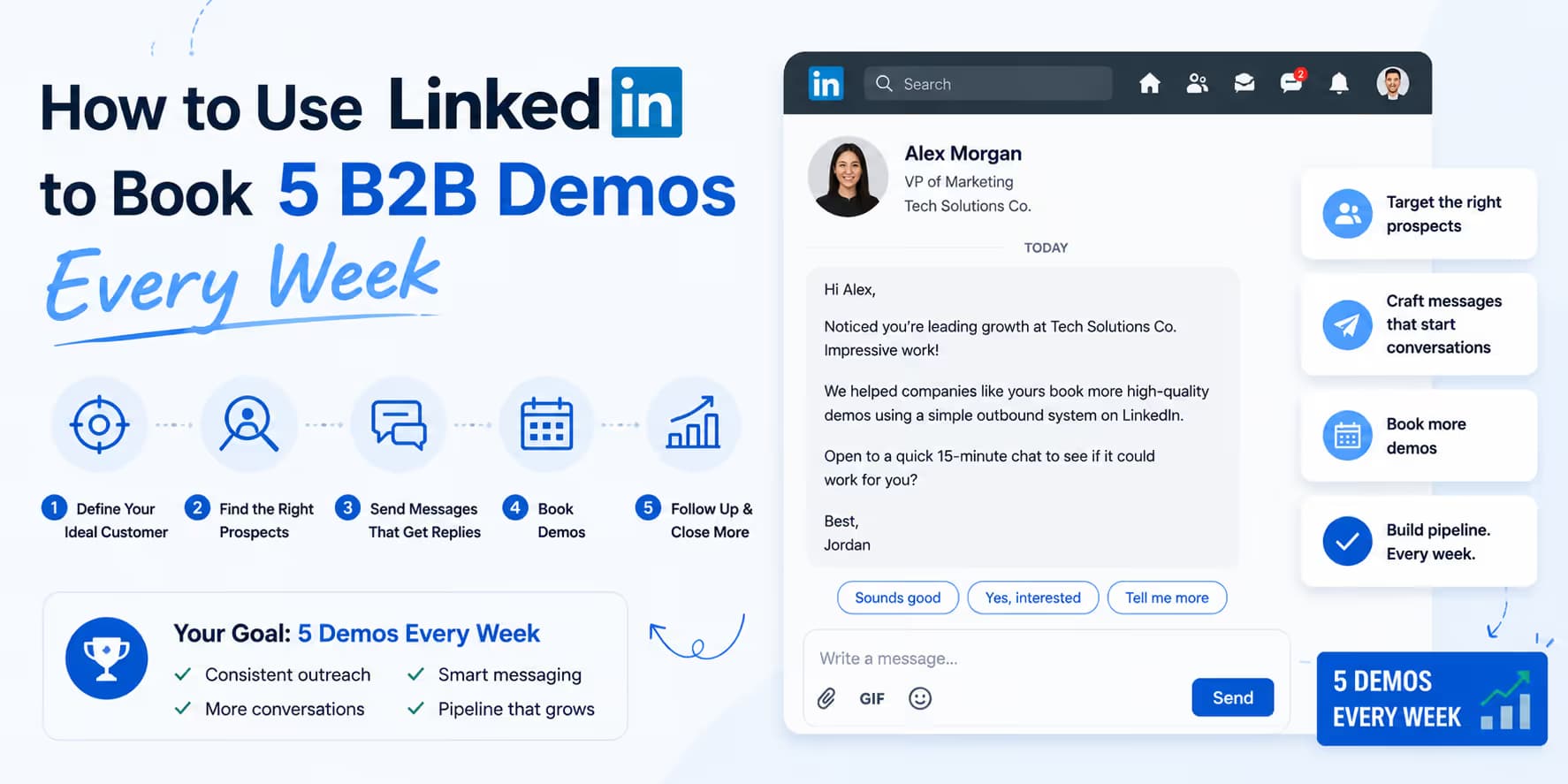
Booking five B2B demos every week is hard if you only wait on referrals or organic LinkedIn posts. Those channels work, but the pipeline swings with them. One quiet week and the calendar is empty.
A more stable approach is a LinkedIn outreach system you can run on a schedule: find people who already look like buyers, start conversations about the work they are doing, and ask for a demo only after the thread has a reason to continue. The math later in this post is how that can add up to 5 product demos every week without turning outreach into a second full-time job.
The repeatable demo-booking architecture
Booking meetings on a schedule means dropping spray-and-pray. Buyers ignore a cold ask for a 30-minute Zoom when they have no idea who you are.
Treat the thread as a conversation that builds. Reach people who already look like a fit, start with a question about the work they are doing, and only introduce the product once they have said something that makes a demo useful.
The peer-to-peer advantage
When B2B founders or executives reach out directly to target buyers peer-to-peer, they see acceptance rates up to 3 times higher than junior SDRs. The buyer values discussing solutions with an equal partner who has actual engineering or business authority.
The predictable outreach math for 5 demos
Outbound is arithmetic once you pick a weekly volume and watch the conversion steps.
Here is one weekly model that can produce 5 product demos:
| Campaign Stage | Weekly Volume / Target | Conversion Benchmark | Outcome Metric |
|---|---|---|---|
| 1. Connection Invites | 100 Invites sent (20 daily) | 45% Acceptance Rate | 45 New Connections |
| 2. Conversational Hook | 45 Messages delivered | 33% Active Response Rate | 15 Engaged Dialogues |
| 3. Pitch Pivot | 15 Conversations nurtured | 33% Demo Conversion Rate | 5 Booked Demos |
Lowering conversational friction in DMs
The fastest way to lose a warm thread is to drop a booking link too early. A Calendly link in the second message tells the prospect you did not read their situation. You just want them on a call.
Use DMs to open a conversation, not to force a meeting. Instead of asking: "Can we book a 15-minute Zoom call on Thursday at 2:00 PM?" ask: "Is reducing technical debt on legacy clusters a focus for your engineering team this quarter, or are you fully sorted there?"
A question like that is easy to answer. Once they say yes or describe the current setup, moving to a calendar link is a smaller ask.
The 3-step conversation-to-booking script
Once a prospect has responded positively to your conversational hook, use this step-by-step playbook to transition the chat into a booked demo cleanly.
Step 1: Validate their pain point
Acknowledge their response and show that you understand their operational world.
Step 2: Present the frictionless solution angle
Highlight how you solved this specific problem for a peer, without pitching product features.
Step 3: The soft scheduling request
Frame the calendar invite as a convenience option, preserving their right to say no.
Otherwise, happy to drop a brief 1-page summary here instead?"
Why this works: By providing an alternative ("otherwise, I can drop a PDF here"), you remove all pressure. Because you respected their time, prospects frequently select the booking link organically.
Scaling outbound safely without restrictions
Sending 20 connection requests every day by hand is tedious. You log in, search, clean names, and track threads. Most founders drop the routine and fall back into feast or famine.
Automating lead generation and the messaging sequence keeps the pipeline moving. Safety still comes first. Stay inside these platform constraints to reduce restriction risk:
- Staggered delay intervals: Use random delays between actions (for example, 60 to 180 seconds) rather than a fixed schedule.
- Clean lead sources: Do not scrape low-quality directories. Use Sales Navigator lists scored against your exact ICP.
- Keep volume low: Stay under 20 requests daily. Volume well under the maximum is safer for the profile.
Check the meeting workflow first
Use the weekly math above to set a realistic activity target. The priority is not maximum volume; it is a repeatable routine that creates enough relevant conversations to learn.
Common hurdles that stop leads from booking
If conversations are happening but calendar slots are not, check these bottlenecks:
- Using messy scheduling links: Tools that require long forms, timezone picking, or five questions before booking. Keep it to a single-click widget if you can.
- Lack of immediate context: If you wait 48 hours to reply to an engaged response, the prospect will forget the conversation. Reply within 2 hours of a notification to keep conversions high.
- Aggressive sales pitches: Switching to a hard sales tone the second a lead shows interest. Keep the dialogue collaborative and peer-to-peer all the way onto the call.
The weekly activity plan for five demos
Booking five B2B demos every week requires a fixed input model. The exact numbers will vary by offer, market, and profile authority, but the operating plan should be concrete enough to execute without guessing every morning.
- Monday: Source 75 qualified prospects and remove anyone without a clear trigger. Do not message broad lists just to hit volume.
- Tuesday: Send 20 to 25 personalized connection requests using one clear context line. Track accepted requests separately from pending invites.
- Wednesday: Send first messages to new accepts from the previous week. Keep the message under 90 words and ask a diagnostic question.
- Thursday: Follow up with prospects who replied but did not book. Share one proof point or workflow, not a generic calendar link.
- Friday: Review replies, objections, acceptance rates, and booked meetings. Cut the worst-performing hook and write a replacement for the next week.
The target is not simply more activity. It is enough qualified activity to create ten to fifteen real conversations, from which five demos can be booked. When the conversation count drops, fix targeting and copy before increasing outreach volume.
Troubleshooting if you miss the five-demo target
If you do not book five demos, diagnose the funnel in order. Do not assume the answer is always more volume. Low accepts point to profile positioning or request copy. Low replies point to weak first-message relevance. Low bookings from replies point to a poor call-to-action or an offer that does not feel urgent.
- Acceptance rate below 35 percent: Improve profile clarity and make the request more specific.
- Reply rate below 10 percent: Rewrite the opener around a sharper trigger and ask a simpler question.
- Replies but no demos: Add proof, reduce the meeting length, or offer to send a short workflow before asking for time.
Weekly review is what turns the system into a repeatable engine. Every Friday, update the segment, trigger, hook, and ask based on the weakest metric in the chain.
What a good demo-booking reply looks like
A good reply does not always say, "book me for a demo." Many strong opportunities begin with softer signals: "send it over," "how does that work," "we are looking at this next quarter," or "talk to my ops lead." Treat these as active buying conversations, not casual replies.
When a prospect shows interest, do not jump into a long explanation. Confirm the pain, share one relevant proof point, and offer a specific next step. For example: "Makes sense. The workflow is usually useful when reps are spending too much time researching accounts before sending. I can show the exact setup in 15 minutes. Is Tuesday or Wednesday better?"
This keeps the booking motion clean. The prospect has already shown intent, so your job is to reduce uncertainty and make the meeting feel like the easiest next step, not to restart the sales pitch from the beginning.
Frequently asked questions
Yes. By sending 100 connection requests weekly, achieving a 45% acceptance rate, and converting 1 in 3 active responses, booking 5 demos weekly is a standard outcome of this system.
In the early stages, almost never. Agencies typically run high-volume, generic outreach that damages your brand. Running a more personal, lower-volume system yourself usually produces better pipeline.
Any tool that allows single-click bookings with integrated calendar sync (like Calendly or Cal.com). Ensure timezone detection is automatic and booking forms are kept to a bare minimum (just Name and Email).
Validate their schedule instantly and ask for a simple future window: "Completely understand, [First_Name]. I'll drop a note in 3 weeks to see if things have settled down. Have a stellar sprint!" This keeps you top of mind without looking pushy.