
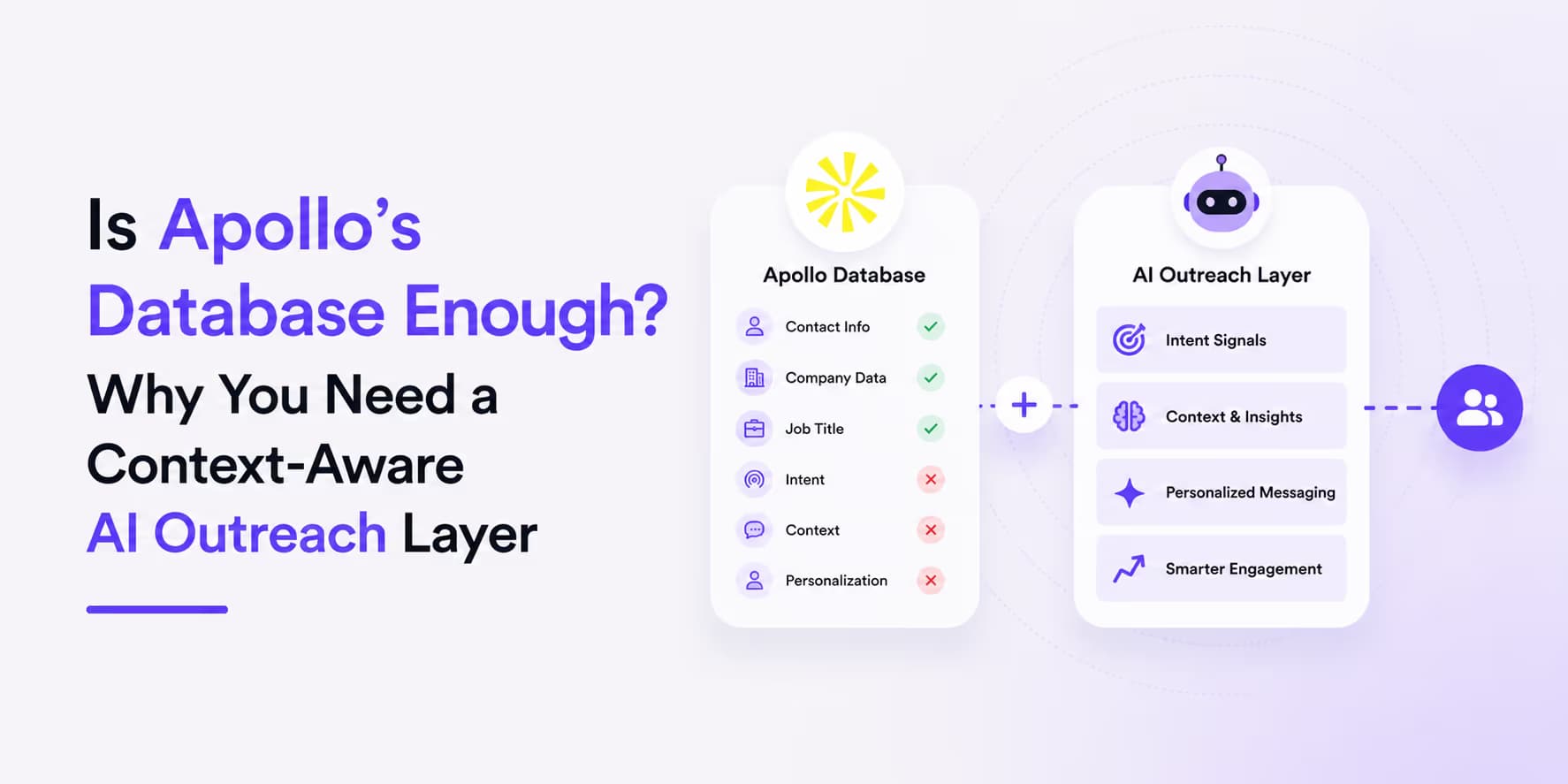
B2B outbound used to be a volume problem. Now it is a precision problem. For years, the foundation of every cold campaign has been the centralized business directory. Platforms like Apollo.io gained massive adoption by compiling millions of professional profiles and offering a simple interface to search, filter, and export contacts.
As cold outreach volume has scaled globally, database searches alone have hit a wall. Access to direct dial numbers and email addresses is no longer a competitive advantage. Because every sales team has access to the same lists, buyers are overwhelmed by generic templates.
That is why sales teams are looking past static contact directories. Outbound campaigns need a context-aware AI outreach layer. Instead of sending generic template sequences, growth teams are adopting systems that crawl company websites, analyze active buying signals, and draft personalized, multi-channel pitches.
The limits of centralized B2B databases
To understand why raw lists are no longer enough, look at how database providers operate. Centralized directories crawl the web, compile public registries, and buy bulk datasets to maintain an index of professionals.
That is useful for quickly building broad lists, but static databases have three operational problems:
- Stale data decay: Professional records decay rapidly as people change companies, roles shift, and corporate domains are retired. Outdated records lead to high bounce rates, which can damage your domain's sending health.
- Absence of custom company context: Centralized databases offer standardized firmographic filters such as industry and headcount. They do not capture custom business details, such as specific products offered, compliance certifications, or technical integrations.
- Lack of multi-channel delivery: Databases are designed for simple list exports. To run campaigns, you must export CSV files and sync them across separate email sequencers and social automation tools, which creates sync errors and extra data maintenance.
Related reading
Before launching your campaigns, optimize your landing pages. Read our step-by-step operational guide on Crafting a LinkedIn Profile That Doubles Your Outbound Acceptances to raise your social conversion rates.
The outbound context bottleneck
Sourcing contact records is only the beginning of a campaign. Broad, template-driven drip emails produce diminishing reply rates. Buyers can spot a generic sequence instantly.
The real bottleneck in sales development is context. If you want to capture attention, your outreach must reference target-specific objectives, challenges, or goals. Sourcing this intelligence manually takes hours, which makes campaigns hard to scale.
Static database sourcing vs. context-aware AI outreach
Compare a list-building directory with a unified, autonomous context-aware salesman workspace:
| Feature / Dimension | Apollo.io Database | Omentir (AI Salesman) |
|---|---|---|
| Core Capability | Centralized contact directory lookup | Autonomous multi-channel sourcing and active outreach |
| Lead Enrichment | Statically mapped firmographics | Real-time website crawls and customized AI research |
| Outreach Channels | Cold email sequences | Unified LinkedIn actions and cold email |
| Personalization Depth | Static dynamic tags and merge fields | Custom AI drafts based on company-specific triggers |
| Stack Consolidation | Requires separate scraper and LinkedIn tools | All-in-one workspace (no external tools required) |
How context-aware AI personalization works
An autonomous layer like Omentir unifies lead sourcing, research, and outreach in a single workspace.
Instead of manually building list exports, define your target profile using plain English prompts. Omentir discovers matching companies, crawls their sites using AI to identify specific business signals, and drafts personalized pitches. It then coordinates outreach across LinkedIn and cold email, managing replies and bookings automatically.
Rebuilding your B2B outbound funnel
To scale sales development without the administrative burden of traditional CRM stacks, use this three-step blueprint:
- Map sourcing intent signals: Look for target triggers such as job listings, fundraisings, technology stack changes, and product launches to guide your campaigns.
- Consolidate sourcing and execution: Choose a unified, autonomous workspace that keeps lead generation, data verification, and outreach tightly integrated to protect sender health.
- Design conversational, low-friction sequences: Keep messages concise and focus on building relationships rather than pitching features immediately.
The direct answer: when Apollo is enough and when it is not
Apollo's database can be enough when your sales motion is simple: you know the exact titles to target, the market is broad, your offer is already proven, and your team has people who can manually qualify accounts before messaging. In that case, Apollo gives you a fast way to build lists and start testing outbound.
Apollo is usually not enough when the buying trigger matters more than the job title. For example, "VP of Sales at a SaaS company" is a searchable contact. "VP of Sales at a SaaS company that just hired three SDRs, is expanding into the United States, and is likely struggling with lead quality" is a context-aware prospect. The second version requires live signal analysis, not just a static database field.
- Apollo is enough for: broad market mapping, initial list building, title-based prospecting, and basic email campaigns.
- Apollo is not enough for: signal-based qualification, deep account research, dynamic LinkedIn personalization, and automated reply classification.
- A context-aware layer is needed when: your product solves a specific operational pain and the message only works if it references why the prospect is likely feeling that pain right now.
The best workflow is not always Apollo versus AI. Many teams can use a database as one input while letting an AI outreach layer verify fit, enrich missing context, reject poor accounts, and write a message that feels tied to the prospect's real business situation.
Context signals that change the message
The strongest argument for a context-aware outreach layer is that different signals should produce different messages, even when the contact title is identical. A static database might show two prospects as the same persona. Real outreach should treat them differently.
- Hiring signal: If the company is hiring SDRs, lead with ramp time, list quality, and message consistency.
- Funding signal: If the company recently raised money, lead with growth pressure, new pipeline targets, and the cost of building a large sales team too early.
- Product launch signal: If the company launched a new product, lead with market education, target-account discovery, and outreach to likely early adopters.
- Competitor-content signal: If the prospect is publishing about a category problem, lead with their stated point of view and ask whether they are exploring the operational side of that problem.
- No signal: If there is no current trigger, either delay outreach or send a very low-pressure note. Do not pretend the account has urgency.
This is where database-only sourcing breaks down. A database can tell you who the person is. Context-aware AI helps determine why the conversation should happen now and what the first sentence should say.
Apollo plus AI: the practical hybrid workflow
For many teams, the best answer is a hybrid workflow. Use Apollo to identify broad market coverage and then use a context-aware AI layer to decide which contacts deserve outreach. This avoids throwing away useful database access while still solving the problem that databases alone cannot solve: relevance.
A practical workflow looks like this. First, build a broad Apollo search using title, industry, company size, and geography. Second, pass the accounts through an AI qualification layer that checks websites, hiring pages, LinkedIn activity, funding news, and product positioning. Third, reject accounts with no current trigger. Fourth, generate different messages based on the trigger that qualified each account. Fifth, route replies by intent so interested buyers are handled quickly.
This approach gives you the reach of a database and the judgment of a research assistant. It also protects your sender reputation because weak-fit accounts never enter the campaign. Apollo can tell you who might be reachable. Context-aware AI helps decide who is worth reaching and what the first sentence should say.
The bottom line on Apollo and AI outreach
The bottom line is that Apollo is a strong starting point, but it is not the full answer when outbound depends on timing, context, and message quality. A database helps you find possible buyers. A context-aware outreach layer helps you decide which possible buyers are worth contacting today.
If your team already has skilled reps who research every account manually, Apollo may be enough. If your team is trying to scale without adding hours of manual research, the AI layer becomes important. It keeps the message tied to real account evidence, reduces irrelevant outreach, and gives salespeople a better starting point when replies arrive.
That is the exact distinction the title asks for. Apollo's database can answer "who exists in this market?" Context-aware AI answers "who should we contact, why now, and what should we say first?"
Outbound data sourcing FAQs
Apollo.io maintains one of the largest contact databases in the industry. However, like all static indices, it naturally decays at roughly 2 to 3 percent per month. To protect your domain's reputation, lists should be validated before executing outbound email campaigns.
Context-aware outreach moves beyond simple merge tags like first name and company. It references specific target-specific business signals, such as recent hiring trends, company challenges, compliance goals, or products, to show genuine business interest.
Yes. While Omentir features native prompt-driven lead sourcing, you can easily upload your existing database lists. Omentir's AI layer will crawl those profiles, verify emails, gather custom company signals, and execute coordinated multi-channel campaigns automatically.