
B2B pipeline generation has shifted from a volume game to a precision exercise. Your outbound campaigns are only as healthy as the data feeding them. If you are using outdated or inaccurate prospect records, even persuasive messaging will land in the spam folder. Sales operations teams have gravitated toward two primary platforms: Apollo.io and Clay.
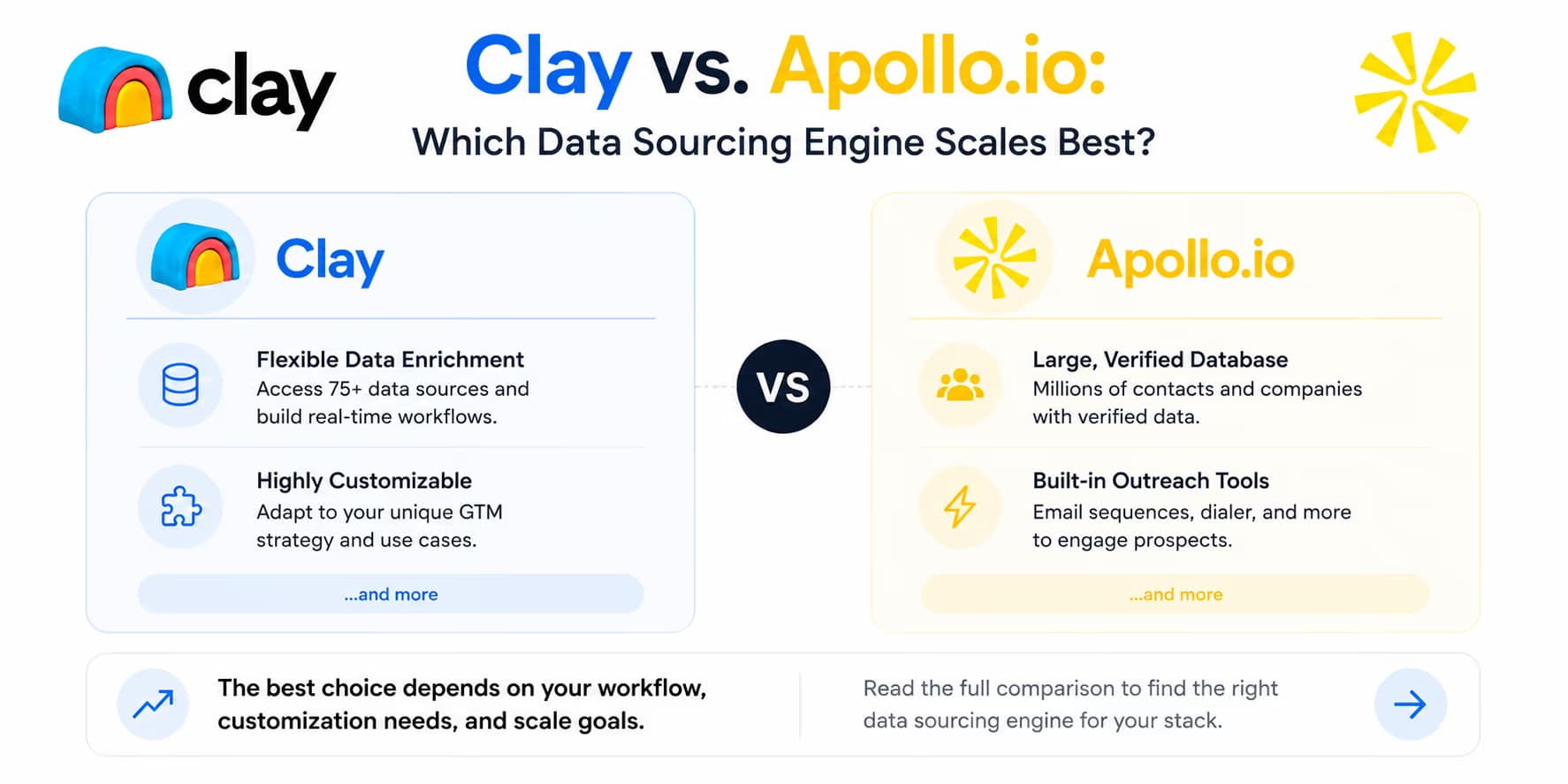
Both tools have earned massive popularity, but they approach the challenge of lead generation from opposite directions. Apollo.io operates as a massive, centralized proprietary database of over 275 million contacts, providing a standard, all-in-one platform for filtering and exporting prospects. Clay, on the other hand, acts as a flexible data orchestrator, allowing you to build programmatic waterfall enrichment cascades by combining more than 50 distinct third-party data providers.
Which engine scales best depends on architecture, operating cost, and how each tool handles enrichment. This comparison covers Clay and Apollo.io: strengths, limits, and why some sales teams are moving toward autonomous systems like Omentir to connect data sourcing with multi-channel outreach.
Core philosophies: legacy DB vs waterfall cascade
To make an informed decision, it is essential to look at the underlying architecture of each platform. Apollo.io is a legacy database provider. They crawl web pages, scrape public directories, buy bulk data, and match signals to maintain a massive internal index of professionals. When you search on Apollo.io, you are querying their proprietary index.
The primary advantage of the legacy database approach is speed and convenience. Within seconds, you can input filters such as location, industry, headcount, and job title, and receive thousands of results. The disadvantage is decay. People change jobs, companies change domains, and databases naturally degrade at a rate of roughly 2 to 3 percent per month.
Clay is a different design. Clay does not maintain its own proprietary contact database. It is an engine that connects to external data providers. You start with a basic seed list, such as a list of company names or LinkedIn URLs, and build a waterfall workflow. The platform queries provider A, and if a verified email is not found, it automatically queries provider B, then provider C, and so on.
This waterfall enrichment method ensures maximum coverage and accuracy. Because you are querying multiple specialized tools in real time, you are not dependent on the health of a single proprietary database.
Cross-Linking Insights 💡
If you want to understand how to write high-converting copy that utilizes this enriched data, read our complete guide on Writing LinkedIn Connection Requests That Get Accepted to maximize your reply rates.
Data quality and coverage comparison
When comparing data quality, coverage varies significantly based on target geographies, industries, and job titles.
- Apollo.io Strengths: Apollo.io is exceptional for standard searches within North America and Europe, especially for common B2B tech roles. Its massive scale means you can quickly spin up broad campaigns without having to configure complex workflows. It also offers solid firmographic filtering, helping you filter by revenue, technology stack, and funding rounds.
- Apollo.io Weaknesses: The database can suffer from stale records. Old titles and inactive email addresses are common. If you rely solely on Apollo.io, you will experience higher bounce rates unless you run the list through an external verification service before executing outbound campaigns.
- Clay Strengths: Clay achieves near-perfect coverage because it aggregates many data sources. You can waterfall check premium databases such as People Data Labs, Hunter, Dropcontact, Lusha, and Findymail in a single table. Clay also integrates with OpenAI, allowing you to crawl target websites and extract highly specific information, such as whether a company offers a mobile application or has a SOC2 compliance badge.
- Clay Weaknesses: Because it relies on external API calls, Clay requires a higher level of technical setup. You must configure the waterfall logic, handle field mapping, and pay close attention to credit consumption across different runs.
| Feature / Dimension | Apollo.io | Clay.com |
|---|---|---|
| Data Source Type | Proprietary centralized database | Aggregated multi-provider API calls (real-time) |
| Email Enrichment Coverage | Moderate (dependent on internal database accuracy) | Extremely high (uses waterfall logic across tools) |
| Custom Site Scraping | Limited to standardized firmographics | Advanced (crawls sites using AI to find specific markers) |
| Sequence Capabilities | Built-in email sequences and basic task manager | None (requires syncing with external sending tools) |
| Learning Curve | Low (simple UI designed for sales reps) | High (requires data operations and logic skills) |
Total cost of ownership and operational complexity
Pricing models for these platforms are structured differently, and what seems like a simple monthly subscription can grow complex as your campaign volume increases.
Apollo.io uses a seat-based subscription model. You pay a predictable monthly rate per user, which grants a set number of export credits. While this makes budgeting simple, it can become expensive if you need custom data attributes or advanced buyer intent signals.
Clay operates on a credit-based consumption model. Every enrichment action, whether it is finding a LinkedIn URL, running an email waterfall, or using AI to scrape a site, costs a fraction of a credit. While this model is cost-effective because you only pay for what you enrich, it requires active monitoring. A poorly configured table can consume thousands of credits in minutes, leading to unexpected overages.
Furthermore, Clay is not an outbound execution platform. Once you finish enriching your lead list, you must export it via webhook or CSV and import it into an external sequencer like Smartlead, Instantly, or a CRM. This multi-step process introduces data pipeline fragility, sync delays, and ongoing tool management costs.
The missing link: sourcing without outreach execution
This fragmentation reveals the main limitation of the Clay and Apollo.io debate. Both tools treat lead sourcing and outreach as separate, disconnected systems.
If you choose Apollo.io, you get a simple database and a basic email sequence engine, but you miss out on deep enrichment, dynamic site crawling, and advanced multi-channel personalization. If you choose Clay, you build incredibly detailed, high-quality lists, but you are forced to manage a complex system of external sequencers, webhooks, and separate LinkedIn outreach software.
Modern sales operations require a unified solution. High-performing outbound teams are replacing disjointed, fragile data stacks with autonomous sales agents.
How Omentir bridges sourcing and outreach natively
Omentir was built to solve this exact fragmentation. Instead of forcing you to choose between static databases and complex waterfall orchestrators, Omentir is an autonomous, all-in-one B2B salesman.
Omentir connects lead discovery, advanced multi-source enrichment, and multi-channel execution in a single, cohesive workspace. It acts as an active, context-aware SDR that manages the entire lifecycle of a sales campaign:
- Autonomous AI Sourcing: Instead of manually building data tables or applying database filters, you define your ideal customer profile in plain English and let the sourcing workflow look for companies and contacts that match the criteria.
- Built-In Dynamic Enrichment: The platform crawls company websites, scans social profiles, and queries verified data networks in real time to assemble a deep profile of every prospect.
- Multi-Channel Execution: Omentir handles outreach directly across LinkedIn and cold email, managing the conversational cadence dynamically. If a prospect replies on LinkedIn, it pauses the email follow-up sequence immediately, ensuring a professional buying experience.
Your unified outbound playbook
If you are looking to scale your B2B sales development program, consider this three-step blueprint to transition away from fragmented outbound systems:
- Define Real-Time Sourcing Triggers: Look for active signals rather than static lists. Focus on job postings, recent funding rounds, technology stack changes, and product launches to time your campaigns.
- Consolidate to Protect Deliverability: Managing multiple third-party API connections increases the risk of data mismatch. Keeping your sourcing and sending layers tightly integrated ensures high list hygiene and low bounce rates.
- Embrace Dynamic Personalization: Avoid generic templates. Ensure every outbound message references specific corporate challenges, products, or achievements to earn trust. If you are structuring a multi-step sequence, reference our blueprint on Building High-Converting B2B Sales Sequences on LinkedIn to maximize conversions.
Decision summary: when Clay wins and when Apollo wins
Clay wins when your team needs a flexible data workspace. If you want to combine multiple providers, add custom scoring, enrich only certain records, and build repeatable research workflows, Clay is the stronger sourcing engine. It rewards technical operators who want control.
Apollo wins when speed and simplicity matter more than custom logic. If a rep needs to search titles, save contacts, and launch a basic outbound test quickly, Apollo is easier to operate. It is not as programmable, but it has a lower operational barrier for sales teams that do not have dedicated growth engineering support.
The hidden question is what happens after sourcing. If the next step still requires exports, manual cleanup, and a separate sequencer, neither tool fully solves pipeline creation on its own. That is where teams evaluate an autonomous workspace that connects sourcing to outreach execution.
Data sourcing FAQs
It depends on your list building volume. For basic, high-volume exports, Apollo.io can be more cost-effective due to its seat-based pricing. However, for campaigns that require high deliverability, Clay saves budget in the long run by verifying emails via waterfall logic, reducing expensive bounces, and enriching lists with custom AI scrapers.
Single databases often have outdated records. A waterfall system queries multiple specialized verification services sequentially. If the first tool finds a contact email but cannot verify it, subsequent tools verify the record or find an active alternative, ensuring that only deliverable addresses enter your outbound sequence.
Yes. Utilizing a unified, autonomous sales agent like Omentir eliminates the need to pay for, integrate, and maintain separate database, scraping, and sequencing tools. This cohesive approach keeps your data accurate, protects your sender reputation, and saves hours of manual work every week.