
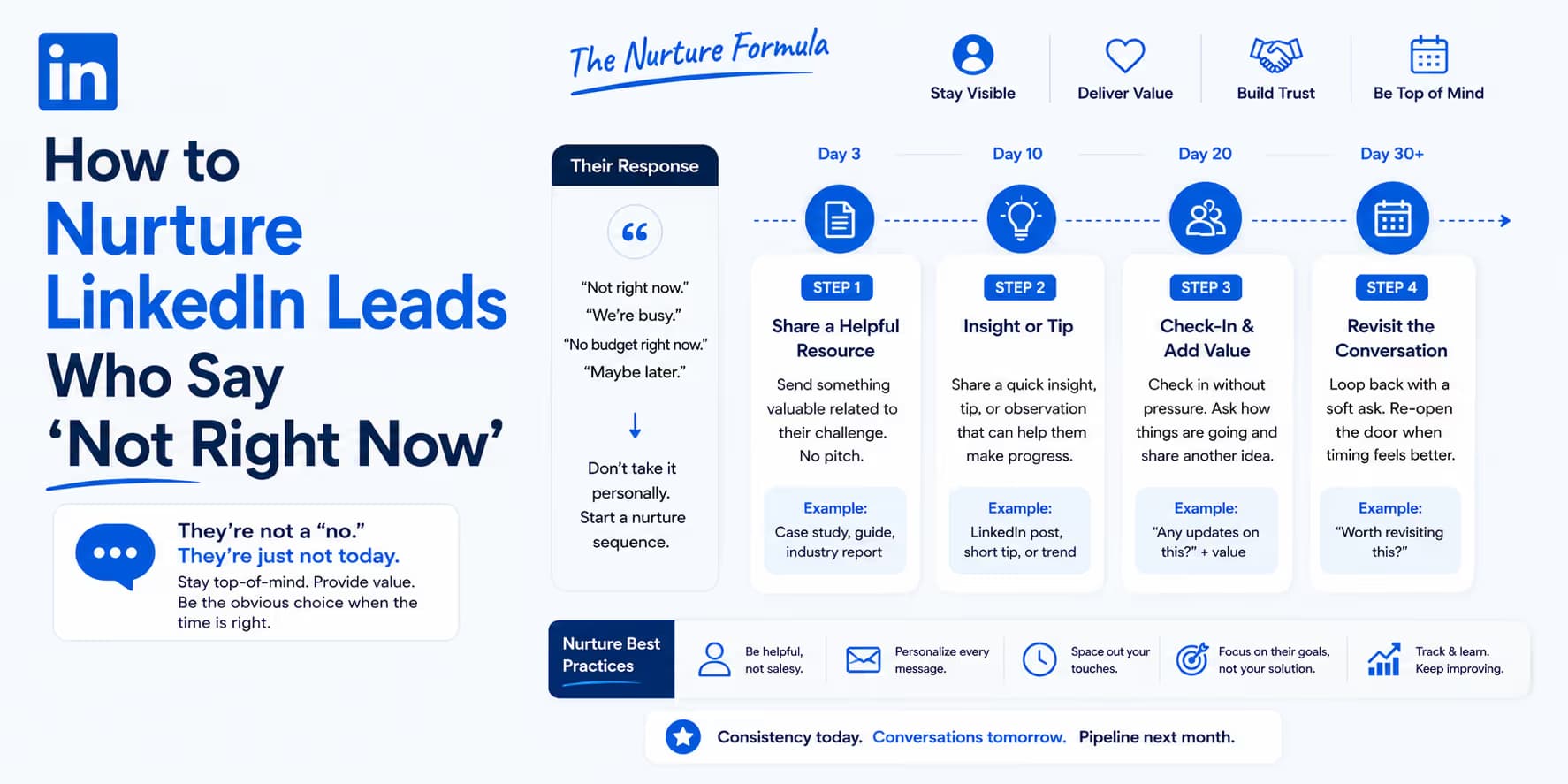
A soft rejection like "Not right now, try again next quarter" or "We don't have the budget for this until Q3" is one of the most underused signals in B2B sales. In cold outbound, a flat "No" or a deletion usually means mismatch. "Not right now" is different. It is a timing signal, not a rejection. You found the right buyer at the right company with a real problem, but you are stuck on an internal timing bottleneck.
Most B2B sales reps and founders treat "Not right now" as a closed door. They either abandon the lead, which lets months of pipeline go cold, or they set a single calendar reminder that produces a robotic "just checking in" months later. If you want a scalable revenue engine, you need a value-first LinkedIn nurturing routine that stays visible without feeling like a chase.
The psychology and real value of the 'not right now' lead
When a prospect takes the time to reply to your cold message with a timing constraint, they are giving you highly valuable intent data. In B2B sales, buyers are constantly juggling multiple high-priority initiatives. A delay is rarely a reflection of your product's utility; instead, it is usually a result of structural hurdles such as:
- Fiscal budget allocations: The department's discretionary budget has been fully committed for the current quarter, and new capital will not be available until the next fiscal cycle.
- Active Implementation Projects: The engineering or operations team is currently migrating to a new software suite or database infrastructure, leaving zero bandwidth for new tools.
- Strategic Reorganization: The company is undergoing leadership changes, acquisitions, or team restructuring, meaning all non-essential vendor decisions are temporarily frozen.
- Contractual Lock-ins: They are currently bound to an existing vendor contract that does not expire for another four to six months.
Stay visible on LinkedIn during the wait, in a light and professional way, and you build peer-to-peer trust. When the timing constraint lifts, you will not be a random vendor in their inbox. You will be the person who has been adding useful context for months.
The golden rule of B2B nurturing
Never pitch, sell, or push for calendar bookings during the nurture phase. Your goal is to decrease the prospect's defensive guard. Focus 100 percent of your efforts on providing educational resources, celebrating their business milestones, and engaging with their public content.
The 90-day value-first nurturing framework
Nurturing a warm lead is about maintaining visibility without causing inbox fatigue. If you message a prospect every week, you will quickly find your account blocked. Instead, you should implement a structured, multi-touch framework spread out over a 90-day cycle. This approach balances low-friction direct messaging with organic social selling.
| Timeline | Touchpoint Type | Operational Goal | Friction Level |
|---|---|---|---|
| Week 1 (Immediate) | The "Acknowledge & Tag" Note | Confirm timing constraints, pause active sales campaigns, and tag in CRM. | Zero Friction |
| Week 4 | Passive Social Engagement | thoughtfully like and leave a professional comment on one of their feed posts. | Zero Friction |
| Week 8 | The High-Value Resource Drop | Share a highly relevant, un-gated industry PDF, guide, or case study via DM. | Very Low Friction |
| Week 12 (Re-engage) | The Conversational Timing Check | Open a direct dialog evaluating if their previous timing bottleneck has resolved. | Low Friction |
Execution for each phase of this 90-day pipeline protection sequence:
- Step 1: Immediate Acknowledgment. As soon as a lead gives you a timing rejection, reply within 24 hours. Validate their constraint. Do not try to push back or overcome the objection. Say: "Totally understand, [FirstName]. Timing is everything. I will keep an eye out on your updates here and check back in around [Stated Month]. Good luck with [Current Project]!"
- Step 2: Passive Authority Warmup. Before you ever send another direct message, you must re-engage passively. Follow their profile on LinkedIn. Set a notification alert for their account. When they write a post, publish a company milestone, or comment on an industry thread, leave a thoughtful, 2-sentence perspective. This ensures that when you finally slide back into their DMs, your name is already familiar.
- Step 3: The Un-Gated Asset Drop. Roughly halfway through their waiting window, send them a hyper-targeted industry resource. This asset must be completely free of sales pitches, calendar links, or product placements. It should be a high-quality PDF checklist, a case study from a similar peer organization, or a major industry news report.
- Step 4: The Strategic Check-in. When their stated timing window officially opens, initiate a fresh, conversational check-in. The biggest mistake here is saying "Just following up to see if you have budget now." Instead, frame your check-in around the strategic projects they were focused on during your last conversation.
4 non-intrusive, high-value nurturing templates
Use these exact copy-paste templates to maintain professional relationships in your LinkedIn outbox. Be sure to customize every bracketed variable with precise, hyper-personalized context.
"Hi [FirstName], came across this new research report outlining how B2B companies are adjusting their [Specific Process] to meet the 2026 data compliance guidelines. I know your team is highly focused on [Department Goal] right now, so I thought this might be useful. No pitch at all, just thought of you: [Link]"
Strategic rationale: Positions you as an industry curator. By offering highly relevant education with zero selling pressure, you lower their cognitive barriers.
"Hi [FirstName], saw the announcement that [CompanyName] just finalized your [Specific Milestone, e.g., Series A funding / new product launch / geographic expansion]. A massive congratulations to you and the team! It looks like a huge step forward for your Q3 roadmap."
Strategic rationale: Celebrates their professional success. People love receiving praise, especially from outside observers who are paying close attention to their career milestones.
"Hi [FirstName], we recently mapped out the exact operational steps we used to help [Similar Company] resolve their [Shared Bottleneck] issues, driving a [Metric Outcome] within 45 days. I recorded a brief 90-second loom showing the exact custom workflow. Thought it might spark some ideas for your [Target Department] plan. Open to taking a quick look?"
Strategic rationale: Introduces highly relevant social proof. The phrase "90-second loom" signals an extremely low time commitment, making it easy for them to reply with a simple "Sure."
"Hi [FirstName], hope your Q1 ended strong. You mentioned checking back in around this time regarding [Target Pain Point/Project]. Are you guys ready to review some outlines this month, or is it better to push this back a bit longer?"
Strategic rationale: Offers an easy out. By giving the prospect permission to say "let's push this back longer," you completely eliminate the pressure, which paradoxically increases positive response rates.
Technical CRM tagging and lead routing safeties
Systematic nurturing is impossible to manage manually once you have more than 20 prospects in your pipeline. Without technical automation and CRM workflows, high-value leads slip through, or they receive overlapping sales pitches that ruin the relationship.
To coordinate your nurturing pipeline safely:
- Implement strict CRM Stage Routing: As soon as a prospect responds with a timing objection, route their lead status to a dedicated stage called "Nurture - Waiting Window." This status must automatically trigger a webhook that pauses all active outbound email and LinkedIn sequences.
- Tag with Precision Custom Variables: Create two specific metadata tags inside your CRM: `[Nurture_Date]` (the targeted re-engagement month) and `[Nurture_Context]` (the specific project or bottleneck they mentioned).
- Set Up Dynamic Slack & Workspace Notifications: Configure automated notifications that ping your account executive on the 1st of each month with a list of historical "Not Right Now" leads whose stated windows are opening up. This allows for highly personalized, manually checked outreach.
Technical automation safeguards
To scale your nurturing sequence without risking account suspensions or spam flags on LinkedIn, you must enforce strict platform safety throttles:
- Maximum Daily DMs: Limit manual nurturing follow-up DMs to no more than 15 per day per profile.
- Connection Limits: Keep your weekly connection requests below 80 to maintain account health.
- Active Profile Monitors: Use safety-first workspaces like Omentir to automatically detect active prospect updates and coordinate touchpoints without triggering security alarms.
Nurturing pitfalls to avoid
Outbound lead nurturing is a delicate process. A single misstep can shatter months of built-up trust and push your prospect straight into the arms of a competitor. Be sure to audit your campaigns against these common pitfalls:
- The "Just Checking In" Trap: Never send a message that contains no value. Sentences like "just checking in to see if anything has changed" are lazy, self-serving, and tell the prospect that you care only about their money.
- Ignoring Feed Engagement: Sending direct messages while completely ignoring the prospect's public feed looks transactional. Always comment on their recent posts before sending a direct message.
- Over-automating the Nurture: While tools can organize your reminders, the actual messages must be drafted by a human. Automated templates that fail to reference previous conversation details will be instantly marked as spam.
- Failing to Track Stated Dates: If a prospect says "Check back in October," and you message them in June, you prove that you do not listen. Respect their boundaries strictly.
Frequently asked questions
If a prospect has a silent feed, you cannot engage with their posts. Instead, focus on company-level updates. Comment on their company's official page posts, or reference their company's recent hiring changes, product updates, or PR statements in your direct messages.
If you have executed four consecutive high-value touchpoints over a 12-month period and received zero replies, route the lead to a "Passive/Cold" bucket. Keep them connected, but stop sending direct follow-ups unless a significant company trigger event occurs.
Absolutely not. Offering an unprompted discount in your follow-up cheapens your product and signals desperation. Focus entirely on value, operational outcomes, and solving their specific business challenges.
Use sales execution workspaces like Omentir. By setting up smart reminders, tracking real-time prospect activity, and keeping a structured campaign schedule, you can scale nurturing outreach without violating LinkedIn's technical safety boundaries.