
Sourcing B2B sales data in North America is relatively straightforward. Growth teams can search databases, export lists of corporate emails, and launch cold outbound campaigns with less legal friction. If you target prospects in Europe, the rules change completely.
The General Data Protection Regulation (GDPR) enforces strict requirements on how personal information is collected, stored, and utilized. Sending cold sales messages to European buyers without verifying compliance trails can result in significant legal penalties and domain blocks.
For growth teams entering the European market, choosing the right data provider is the most important decision. Two of the most popular platforms for sourcing B2B leads are Cognism and Apollo.io.
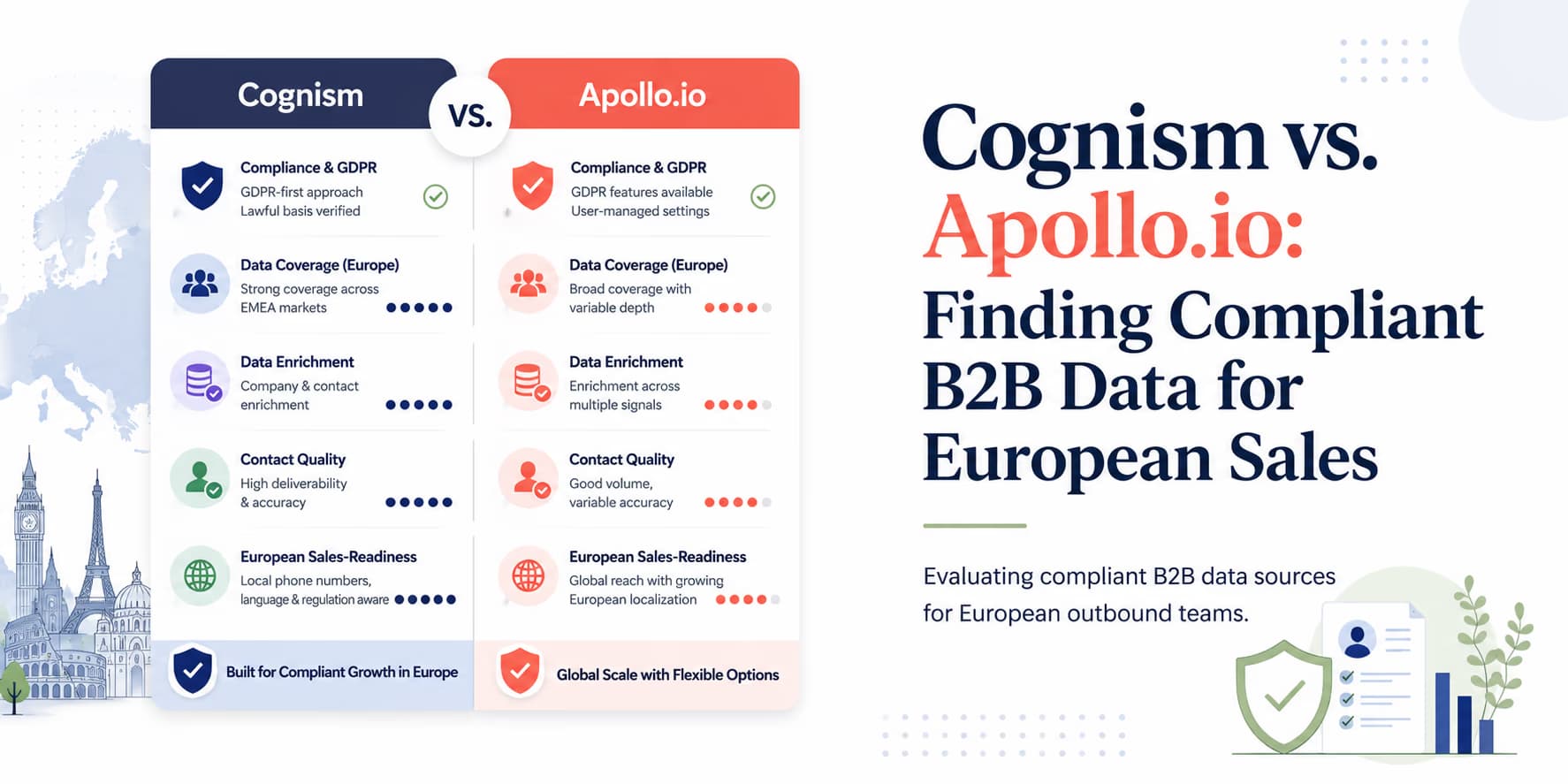
This piece compares Cognism and Apollo.io head-to-head on GDPR handling, mobile phone number accuracy, EMEA database coverage, and pricing. Use it to pick a data engine for European campaigns.
This is not legal advice. The practical lesson is that a sales database can reduce operational risk, but it cannot remove your responsibility as the sender. Your team still needs a lawful basis, clean opt-out handling, accurate records, and country-specific rules for email, phone, and LinkedIn outreach.
Cognism: the compliance-first EMEA database
Cognism has built its brand reputation on compliant, premium European contact data. The UK-headquartered platform focuses specifically on quality over quantity for EMEA sales teams.
Cognism's standout feature is its manual mobile verification workflow. The platform employs a team to call and verify mobile phone numbers (referred to as Diamond Data), ensuring that you reach the correct buyer directly.
Cognism also markets Do Not Call list cross-referencing across multiple territories through its Diamond Data offering. That is useful for teams where phone outreach is a serious motion, because the operational burden of checking local registers can become heavy fast.
The trade-off is procurement. Cognism is usually a sales-led, higher-commitment purchase rather than a lightweight self-serve tool. That can be exactly right for a team selling into the UK and Europe with account executives who need reliable direct dials. It can be excessive for a founder who only needs a small experimental list.
Apollo.io: the global sourcing engine
Apollo.io is one of the most widely used B2B databases in the world. The platform combines company and contact search with outbound workflows, enrichment, and sales engagement features.
Apollo's value proposition is scale and affordability. The platform uses a credit-based model that lets growth teams export large lead lists at a low cost. For startups targeting global markets, Apollo provides a quick way to build initial outbound volume.
The trade-off is that Apollo is a broad system. It is not only an EMEA compliance product, and buyers should evaluate European phone quality, opt-out workflows, and data rights handling against their own use case. Apollo publishes GDPR, security, privacy, and data processing resources, but the sender still owns campaign-level compliance.
Apollo tends to make the most sense when the primary motion is email-led prospecting across multiple markets and the team wants a fast, flexible database with built-in outreach tooling. It is less obviously the default choice when verified European direct dials are the main reason you are buying data.
Compliance Rule: Do Not Call Registers
Before phone outreach, check the relevant local calling rules and suppression registers for the prospect's country. Europe is not one uniform calling market.
EMEA mobile phone accuracy and manual verification
Mobile phone accuracy has become the deciding factor for sales velocity. With many professionals working remotely, dialing office switchboards is no longer effective.
Cognism addresses this with its Diamond Data product, which centers on phone-verified mobile numbers. The practical value is not just "more numbers." It is fewer wasted dials, fewer awkward wrong-person calls, and a cleaner path to the buyer when phone is part of your sales motion.
Apollo can still be useful for contact discovery, email workflows, account research, and broad list building. But if your campaign depends on high-confidence mobile calls into Europe, test a sample before buying at scale. Export a small list, verify numbers, log connect rates, and measure how often reps reach the intended person.
A simple test is enough. Pull fifty target accounts from your exact ICP, verify the contacts manually or through your normal calling workflow, and count usable numbers. Then compare the result with the total cost of the platform, the rep time saved, and the value of the opportunities you are chasing. Data quality should be measured in selling time recovered, not just rows exported.
GDPR compliance, consent records, and opt-out registers
GDPR regulations distinguish between different kinds of processing, and B2B outreach often relies on legitimate interest when the sender can justify relevance and respect data rights. That is not a free pass. You must maintain strict data protocols:
- Right to Object: You must provide an easy, friction-free way for prospects to opt out of your database.
- Data Protection: You must store and process contact details securely, verifying that data has not been leaked or compromised.
- Audit Trail: You must document how you sourced the contact's details and why you have a legitimate interest in messaging them.
Cognism's public compliance positioning emphasizes GDPR and CCPA-aligned data practices, security certifications, and compliance-first prospecting. Apollo's public security materials also describe GDPR compliance, ISO 27001, SOC 2, encryption, and data rights processes. The buyer question is not "which company says GDPR?" Both do. The buyer question is which workflow gives your team the controls it needs for the specific countries and channels you use.
Omentir supports this compliance layer by coordinating your campaigns to respect user opt-outs and pacing outreach safely. Learn more about safety limits in our guide to human-paced social selling pacing.
For European campaigns, build a compliance checklist before importing any list into an outreach system. Confirm source, lawful basis, opt-out path, country-specific calling rules, message relevance, and retention policy. If you cannot explain why a person is on the list, they should not be contacted.
Pricing comparison: subscription retainers vs. credit systems
The financial commitment for each tool matches their data philosophy.
Cognism uses quote-based pricing rather than publishing simple self-serve tiers. Its public pricing page frames cost around business needs and package selection. That usually means you should evaluate it like a strategic data investment: seats, regions, mobile verification needs, CRM enrichment, onboarding, and the value of each successful connection.
Apollo.io publishes self-serve pricing. At the time of writing, its public pricing page lists a free plan and paid plans that begin at $49 per seat per month when billed annually, with higher tiers adding more capacity and workflow features. The important detail is not only the seat price; it is how credits, email sends, mobile access, and team usage affect the real monthly cost.
Once you source your data, use Omentir to qualify prospects and run safe LinkedIn outreach from $49/month. Keep the job boundaries clean: the data vendor helps you identify contact records, and Omentir helps turn qualified prospects into human-paced LinkedIn conversations.
The ROI math should include failure cost. A cheaper database is not cheaper if reps waste hours on bad numbers, compliance review takes longer than expected, or low-fit contacts create noisy pipeline. A premium database is not automatically worth it if your average deal size is low or your motion does not use direct dials.
For a founder-led team, the cheapest test is usually Apollo plus a strict manual review step. For a sales team with high annual contract values, European territories, and calling as a core channel, Cognism's higher-touch model may be easier to justify. The price conversation should follow the motion, not the other way around.
Decision matrix: which platform fits your sales team?
Evaluate the following variables before selecting your B2B data provider:
Choose Cognism if: You are targeting EMEA enterprise buyers, need verified mobile numbers, and require built-in compliance filtering against national DNC registers.
Choose Apollo.io if: You are targeting global growth startups, have a limited software budget, and prefer a flexible credit model to export high lead volumes.
Regardless of the database you select, Omentir can act as the execution layer that qualifies leads, scoring fit parameters before scheduling campaigns.
Run a sample before committing: pick one country, one persona, and one channel. Export a small list, verify the data, check opt-out handling, and test whether your reps can actually start relevant conversations. Do not judge either vendor from a generic demo database.
The best European outbound stack is usually boring and disciplined. It has fewer mystery contacts, clearer records, slower but safer pacing, and a documented reason for every touch. That discipline matters more than the logo on the data platform.
If you are unsure, start with the narrowest possible campaign. Choose one country where you understand the rules, one persona with a clear business reason to hear from you, and one message that explains that relevance plainly. Then compare the vendors on the quality of conversations created, not on the size of the exported list.
That keeps the decision grounded in revenue reality.
Frequently Asked Questions
Cognism positions itself around compliance-first European prospecting, phone-verified mobile data, and Do Not Call list checks. Apollo also publishes GDPR and security resources, but buyers should still run their own compliance review for the exact countries, channels, and use cases they plan to use.
Potentially, but do not treat any database export as automatically safe. Verify lawful basis, opt-out handling, local calling rules, data minimization, and whether the contact data is appropriate for your outreach channel.
Use Omentir as the LinkedIn execution and qualification layer around your data workflow: define the ICP, review fit, draft personalized outreach, and pace LinkedIn actions safely.
Cognism is usually the stronger fit when verified European mobile numbers are the buying priority. Apollo is usually the broader, lower-friction option when your team wants global prospecting and email-led workflows.