
Cold email delivery has changed dramatically. Senders could previously upload a list of contacts, connect a single Google Workspace account, and send hundreds of emails a day. Today, major email providers like Google and Yahoo block domains that send high volumes of outreach from a single address.
To scale your outreach pipeline in this environment, you must build a multi-inbox infrastructure. This involves purchasing multiple domains, setting up sending profiles, and rotating them to distribute sending volume. Two of the leading platforms for managing this workflow are Instantly.ai and Smartlead.io.
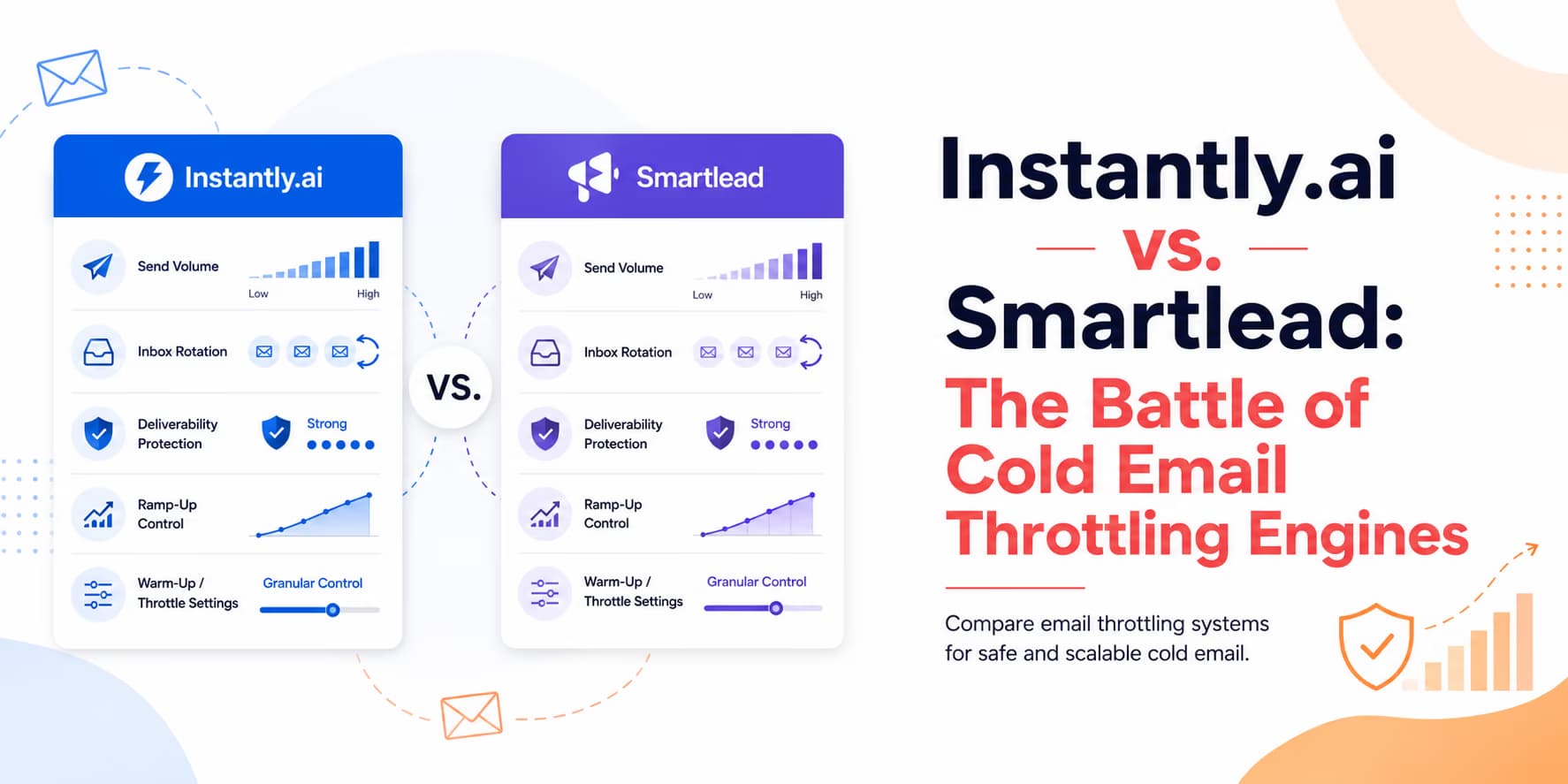
Both tools provide the core features needed for multi-inbox campaigns: email warm-up pools, address rotation, and consolidated inboxes. They differ in throttling logic, API reliability, and workflow layouts.
This article compares Instantly and Smartlead head-to-head: how their throttling engines work, how they manage domain safety, and how to choose a delivery engine for your sales stack.
One caveat before the comparison: cold email platforms change packaging often. Use this article as a buying framework, then check the live pricing and feature pages before committing. The right question is not "which tool is objectively better?" It is "which tool matches the way our team will actually operate outbound every week?"
Instantly.ai: the volume scale engine
Instantly.ai is designed to simplify cold email setup. The platform is highly popular among growth agencies and startups because of its user-friendly interface and flat-rate pricing.
Instantly's primary advantage is its unlimited sending accounts policy. You can connect as many sending addresses as you want without paying additional per-user fees. This makes it affordable to scale campaigns across fifty or one hundred secondary domains.
The platform also puts warm-up, campaign creation, inbox handling, and lead workflows close together. That matters for small teams because the biggest deliverability mistakes often come from operational friction: someone forgets to pause a weak domain, sends too much from a new inbox, or launches a campaign before the list has been cleaned.
Instantly is strongest when your team wants a simple path from "we have sending domains" to "we can launch and monitor campaigns." It is less appealing if you want every client, region, inbox pool, and routing rule modeled in a highly customized way. The trade-off is ease of operation versus deeper infrastructure control.
Smartlead.io: the infrastructure-first router
Smartlead.io is built for agencies and enterprises that require precise control over their delivery infrastructure. The platform focuses on backend customization and API performance.
Smartlead's standout feature is its Master Inbox architecture. This interface helps consolidate replies from many sending addresses into a single view, which is useful when an agency or outbound team is managing several campaigns at once.
Smartlead also offers a REST API. This lets development teams build custom white-label setups, sync outreach data with CRM databases, and manage sending profiles programmatically.
Smartlead is strongest when the outbound operation already has process maturity. If you have a deliverability owner, client-level reporting needs, custom routing rules, and a clear handoff from reply to sales rep, Smartlead gives you more room to shape the machine. If your team is still figuring out basic list quality and messaging, that flexibility can become extra setup burden.
Safety warning: daily sent limits
Treat daily send caps as a risk-control setting, not a growth lever. New domains, cold mailboxes, weak lists, and poor authentication all require more conservative pacing.
Multi-inbox rotation and warm-up pool architecture
To run high-volume campaigns, both platforms use sender rotation. When you import a lead list, the platform selects random active addresses to send the messages, preventing single addresses from hitting daily volume limits.
Rotation does not magically make a bad campaign safe. It spreads volume, but the underlying signals still matter: SPF, DKIM, DMARC, domain age, bounce rate, reply quality, unsubscribe behavior, and the relevance of the email itself. A platform can help manage sending behavior, but it cannot turn a scraped, unqualified list into a healthy outbound channel.
Instantly's rotation logic is easy to configure. You group your sending profiles into a sending pool and assign that pool to your campaign. Instantly balances the volume across all active profiles automatically.
Smartlead provides more advanced rotation controls. You can set specific rotation weights, assign sending profiles to particular regions, and customize send-delay intervals. This level of control is helpful when targeting international markets that require localized sending domains.
For warm-up, focus less on the marketing claim and more on the operating habit. Are weak inboxes easy to spot? Can you slow down a domain without breaking the whole campaign? Can you separate new mailboxes from proven ones? Can the team see where replies, bounces, and failures are happening? Those questions matter more than a single warm-up checkbox.
A practical setup is to group inboxes by maturity. Keep brand-new inboxes in a cautious pool, move stable inboxes into a normal production pool, and isolate any domain that starts showing poor engagement. Whether you use Instantly or Smartlead, the discipline is the same: do not let one unhealthy sender drag down the whole campaign.
Throttling algorithms and spam filter prevention
Throttling is the practice of spacing out message delivery to mimic manual activity. If your delivery engine sends ten emails in a single second, spam filters will identify the pattern and block the sender.
Instantly emphasizes simple pacing controls that keep sending speeds natural without forcing every operator to tune each delay manually. That is useful when the person running outbound is also handling list building, copy, replies, and sales calls.
Smartlead offers a customizable throttling engine. You can define exact sending windows, set maximum hourly caps, and configure custom delay spreads. This level of optimization is valuable when managing campaigns across multiple client workspaces.
The strategic choice is how much control you want to own. If you want the platform to make most delivery choices easy, Instantly may feel cleaner. If you want to tune behavior by workspace, client, region, or sender group, Smartlead may fit better. Neither approach saves you from the fundamentals: clean lists, relevant copy, authenticated domains, and a sane ramp.
By combining cold email with LinkedIn outreach, you can build a diversified sales funnel. Omentir provides safe LinkedIn campaign pacing that complements your email delivery. Read more in our faceoff of Instantly, Smartlead, and Omentir.
Pricing comparison: inbox capacity vs pro campaigns
The pricing structures reflect the focus areas of each platform:
Instantly.ai Pricing: Instantly's public pricing page positions its outreach plans around email volume, uploaded contacts, and access to outreach features. At the time of writing, its monthly Growth tier is listed at $47/month, with higher tiers adding more email volume and contacts. Annual billing may change the effective monthly price.
Smartlead.io Pricing: Smartlead's public pricing page starts its Base plan at $39/month and scales by contacts, email sends, verified emails, and higher-tier workflow needs. The practical bill can also include add-ons, verification, mailbox infrastructure, and any operational tooling around the platform.
Do not compare only the headline subscription. Add the cost of domains, inboxes, verification, enrichment, deliverability monitoring, and the person responsible for keeping the system healthy. A cheap sending platform becomes expensive if it produces low-fit replies, burns domains, or creates inbox chaos.
To manage LinkedIn discovery and social outreach alongside email, the Omentir plan starts at $49/month. The cleanest stack is usually not "one tool does everything." It is a clear separation of jobs: Omentir finds and engages high-fit LinkedIn prospects, while your cold email platform handles the email-specific delivery layer.
Decision matrix: which platform fits your delivery stack?
Evaluate the following variables before selecting your cold email delivery platform:
Choose Instantly.ai if: You want a user-friendly setup, need to warm up a large number of domains quickly, and prefer a flat-rate plan with unlimited sending profiles.
Choose Smartlead.io if: You are a growth agency managing multiple client workspaces, require advanced API access for custom integrations, and need a unified inbox to coordinate thousands of sending addresses.
Choose neither yet if: your list quality is weak, your offer is unclear, or your reply handling process is not ready. Cold email infrastructure amplifies whatever is already there. If the targeting is sloppy, a better throttling engine simply sends sloppy outreach more efficiently.
Before buying, run a small test plan. Pick one narrow ICP, write one sequence, connect a limited number of healthy inboxes, and measure replies by quality rather than raw opens. Track how many replies are from the right type of buyer, how many ask a real buying question, and how quickly your team can respond. That test will reveal more than a feature checklist.
By pairing email delivery with LinkedIn campaigns, you can increase touchpoints with target accounts. That only works if the LinkedIn note and the email do not repeat the same paragraph. Two channels with one script is still one script.
The best stack is the one your team can operate safely every week. If you need speed and simplicity, lean toward the tool with the cleanest day-to-day workflow. If you need deeper infrastructure control, choose the tool that lets you tune the system without messy workarounds. Either way, keep the channel strategy grounded in fit, timing, and a message worth receiving.
Frequently Asked Questions
Instantly is generally easier for teams that want a fast multi-inbox outreach setup. Smartlead tends to appeal to operators who want more control over client workspaces, routing rules, inbox management, and API-led workflows.
Both platforms help teams distribute sending across multiple inboxes, warm up accounts, and pace delivery. The exact safe sending volume depends on domain age, mailbox history, list quality, authentication setup, and spam complaint rates.
Growth teams can use Omentir to find high-intent prospects and run safe LinkedIn outreach alongside email campaigns. For email tooling, keep the workflow explicit: qualify the account first, then decide which channel should carry the next touch.
Do not choose only on warm-up. Look at mailbox management, campaign controls, inbox workflow, reporting, API needs, and how much deliverability ownership your team actually wants.