
B2B outbound has always carried a lot of admin. Sales development reps spend up to 70% of their hours building lists, verifying emails, writing copy, and updating CRM records. That leaves little time for actual conversations.
To cut that overhead, companies are buying autonomous AI agents. These digital workers handle more of the outbound process so humans can keep judgment, relationships, and closing. Two visible platforms in this category are 11x.ai (Alice, its AI SDR) and Gojiberry.
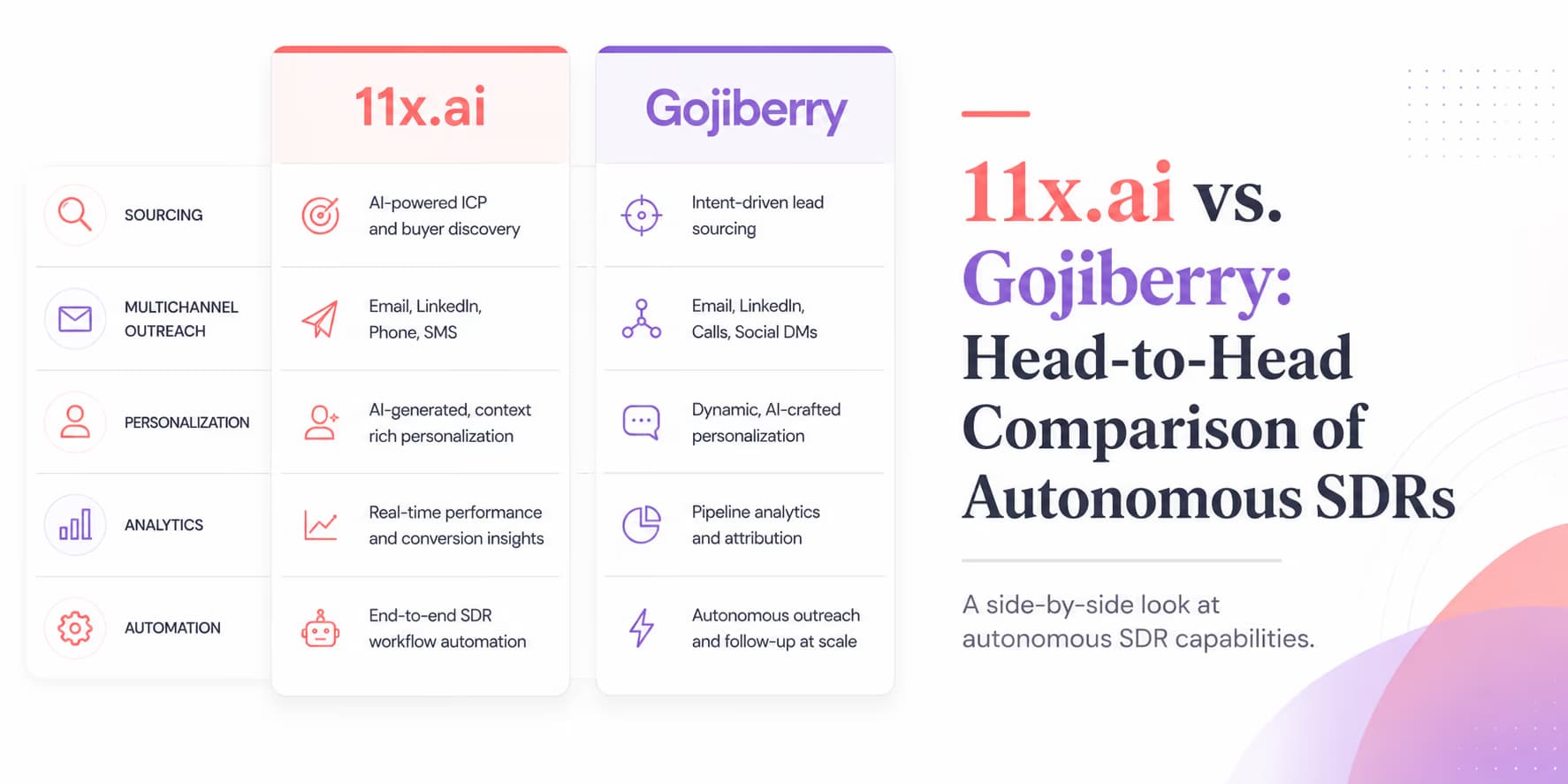
Both automate B2B prospecting. They do not do it the same way. 11x.ai builds a fully autonomous multi-channel agent. Gojiberry focuses on live intent signals and automated qualification.
This comparison covers sourcing logic, workflow transparency, account safety, and pricing so you can pick the platform that matches how your team actually works.
The comparison is really about operating model. Do you want to buy an enterprise digital worker and delegate a large part of outbound? Or do you want a lighter AI agent focused on finding high-intent prospects and running a more founder-friendly workflow? The answer depends less on the logo and more on your team size, deal value, and tolerance for handing execution to software.
11x.ai Alice: the multi-channel outbound agent
11x.ai positions Alice as a digital employee that handles campaigns autonomously. Alice manages lead search, writes sequences, and handles outreach across both email and LinkedIn.
Alice's main advantage is multi-channel execution. Once you set campaign rules, Alice researches prospects, drafts connection notes, and runs follow-up schedules. That cuts daily management for the sales team.
However, Alice is best evaluated as a serious GTM implementation, not a casual subscription. 11x's public positioning is enterprise-heavy: digital workers, live demos, custom deployment, and pipeline outcomes. That can be attractive if you have a mature sales motion and enough volume to justify the setup.
The risk is control. Any autonomous SDR platform can become uncomfortable if your team cannot see why a prospect was selected, what claim the model used, or which messages will go out next. If your brand requires strict compliance, founder-level tone, or approval before every message, inspect the review workflow carefully before committing.
Gojiberry: the autonomous sourcing platform
Gojiberry focuses on the founder and small-team version of the problem: teach the agent your business, identify high-intent buyers, and contact them without forcing the team to assemble a large outbound stack.
Its public positioning emphasizes warm leads, intent signals, personalized outreach, and quick launch. That makes it more approachable for teams that care less about enterprise orchestration and more about starting conversations with buyers who appear to be in market.
The risk is ceiling. A lightweight, intent-led agent may be easier to start with, but larger sales teams should verify account management, reporting, CRM handoff, sender controls, and team workflows before relying on it as the core outbound system.
Workforce Strategy
11x.ai is usually evaluated like an enterprise digital worker. Gojiberry is usually evaluated like a faster path to intent-led outbound. Keep that distinction clear when comparing demos.
Intent signals and live lead discovery
A B2B outbound campaign is only successful if it targets the right buyers at the right time. Senders using static list exports will see low conversion rates because of outdated data.
Gojiberry is stronger at live discovery. Its crawlers pull details from company websites, including hiring trends and software stack updates, so outreach can hit active projects.
11x.ai Alice is positioned around autonomous prospecting and pipeline creation. Rather than judging it only on raw sourcing, ask how it combines account research, contact discovery, personalization, and campaign execution into one workflow.
Gojiberry should be judged on signal quality. Does the agent explain why a lead is high intent? Can you see the trigger that caused the contact to enter a campaign? Does the signal map to your actual buyer pain, or is it just a generic event like hiring or posting on LinkedIn? Intent only matters when it gives you a truthful reason to reach out.
Omentir combines these approaches by running discovery agents that analyze profiles for live buyer signals. Read more in our guide on B2B LinkedIn buyer signals.
Transparency, control loops, and review queues
Delegating outreach to an AI agent requires trust. If the agent drafts messages without review, it can write generic or inaccurate copy that hurts your brand reputation.
11x.ai Alice runs with high autonomy, often in the background with little human intervention. Convenient for volume-focused teams. Risky for brands that need exact copy control.
Gojiberry provides a structured qualification interface, allowing sales operations to review lead scores and check fit details before pushing contacts to external campaigns.
Omentir includes a human-in-the-loop review queue. It drafts connection notes and replies, then holds them for your approval so you still control every send.
This is the category buyers often underweight. A slick demo can make full autonomy look effortless, but the real question is what happens when the agent is wrong. Can you pause it quickly? Can you inspect drafts? Can you see why a lead qualified? Can you edit messaging before it hits LinkedIn? Can you separate draft campaigns from active ones? Those controls matter more than the phrase "AI SDR."
If you sell into regulated industries, enterprise accounts, or founder-led networks, pick the platform with the clearest review path. If the motion is high-volume and the offer is already proven, you may trade some control for speed.
Pacing quotas, account health, and delivery safety
Outbound campaigns must respect platform security limits. Sending connection requests at mechanical speeds will trigger LinkedIn's safety filters, resulting in account limits or bans.
11x.ai Alice manages send pacing internally, but its high-volume approach requires careful monitoring to ensure sending profiles stay safe.
Gojiberry focuses on lead discovery and delegates delivery safety to your external sending platforms, requiring your team to configure safety limits independently.
Omentir protects your accounts with conservative daily quotas and human-paced sending queues. The goal is to make LinkedIn activity look like careful human outreach, not bulk automation.
For 11x and Gojiberry, ask the same practical questions during a demo: how are LinkedIn accounts connected, how are daily actions capped, what happens after a rejection, how are opt-outs stored, and can a human approve copy before delivery? The vendor's answer should be operationally specific, not just "we handle safety."
Pricing: enterprise licenses vs scaling tiers
The financial commitment for these platforms differs significantly:
11x.ai Pricing: 11x's public Alice pricing page lists the Growth plan at $36,000 per year, with Pro and Enterprise plans custom-priced based on volume, end users, and channels. That puts Alice in the serious budget category for teams that already know outbound can support the investment.
Gojiberry Pricing: Gojiberry's public site emphasizes launching an agent quickly, but pricing details are less visible in the materials reviewed here. Treat it as a demo question: ask what is included, how many senders or channels are supported, and where costs increase as volume grows.
Omentir Pricing: Pro is $49/month, with a minimum of three bookings per week or you pay nothing. Enterprise includes unlimited users, unlimited LinkedIn accounts, SSO, dedicated onboarding, and priority support.
ROI depends on motion maturity. Enterprise digital workers make sense when the company already understands its ICP, has strong proof, and can assign someone to manage the system. A smaller AI prospecting tool makes sense when you are still testing buyer signals and messaging. A low-cost LinkedIn-first tool like Omentir makes sense when the constraint is daily qualified conversations, not a fully outsourced SDR department.
Which platform fits your growth goals
Check these before you pick an autonomous sales tool:
Choose 11x.ai (Alice) if: You want an enterprise digital SDR, have the budget for annual commitments, and can support a serious implementation with clear oversight.
Choose Gojiberry if: You want a faster way to find high-intent buyers and run AI-assisted outreach without adopting a larger enterprise digital-worker program.
If you already have a CRM and a sequencer, the missing piece is usually not another dashboard. It is a LinkedIn motion that can find buyers and keep replies in the same place you started the conversation.
Choose Omentir if: you want LinkedIn-first outreach, human-paced sending, visible draft review, and an open MCP/REST surface that lets external agents help without taking over the whole sales motion.
The smartest buying process is to test the same ICP in each tool. Give each platform one buyer segment, one offer, and one success definition. Compare the quality of leads, the usefulness of drafts, the clarity of controls, and the number of real conversations created. That will tell you more than a feature grid.
Also compare how each platform behaves when the answer is no. Good outbound software should make it easy to respect rejections, pause weak campaigns, and learn from low-quality replies without pushing more volume into the same broken path.
Frequently Asked Questions
11x.ai Alice is positioned as an enterprise digital SDR for autonomous prospecting and pipeline work. Gojiberry is positioned as an AI agent that learns your business, finds high-intent leads, and runs outreach for smaller GTM teams.
Both vendors market themselves as GTM workflow tools, but integration depth can change by plan and implementation. Confirm the exact CRM, webhook, and data-sync requirements during evaluation rather than assuming every workflow is supported.
Omentir provides builder-friendly infrastructure starting at $49/month, with a hosted Model Context Protocol (MCP) server that lets external AI agents such as Claude configure lead discovery, retrieve scored prospects, and work with existing replies.
Ask each vendor how it handles sender pacing, account connection methods, review queues, and opt-outs. Omentir uses human-paced queues and conservative daily quotas so LinkedIn activity does not behave like bulk spam.