
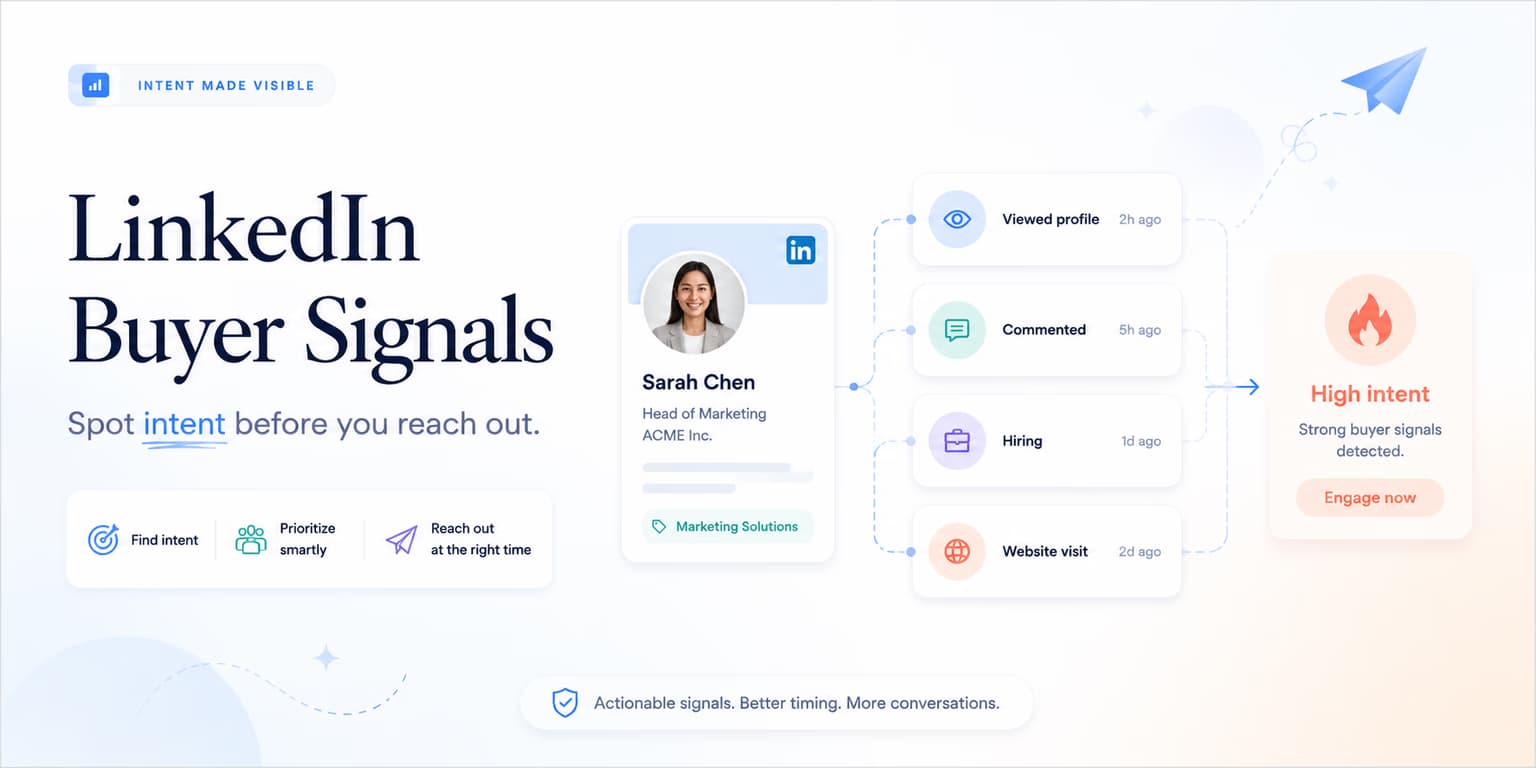
A high-fit LinkedIn lead is not automatically a high-timing lead. The prospect may have the right title, work at the right company, and still have no reason to care today. They may have solved the problem last quarter, frozen budget, changed priorities, or delegated the workflow to someone else.
Buyer signals help with the timing problem. Instead of messaging every manager in a market, you look for public events that make a conversation more relevant: a new role, a hiring post, a team expansion, a comment about the problem, or a change in how the company presents itself.
The signal is not proof. It is a reason to investigate. A job post may reveal a workflow, but not budget. A promotion may create a review window, but not buying intent. A comment may show interest in a topic, but not urgency. The best outbound teams use signals to write better questions, not to make private-sounding claims.
Omentir supports this intent-driven layer with discovery agents, ICP-based context, campaign drafting, paced outreach, and reply organization. The rest of this post covers which LinkedIn signals are worth tracking, how to score them, and how to turn them into useful messages without overreaching.
Identifying the 6 core LinkedIn buyer signals
Potential buyers leave signals across LinkedIn and related public pages. To build a targeted pipeline, monitor these six event types and score them by relevance:
- Department hiring: A job listing related to your product may reveal an active workflow or operational gap.
- New executive transition: A leader in a new role may be reviewing priorities, vendors, and team process.
- Industry comment activity: Comments on relevant posts can reveal interest in a topic or pain category.
- Company funding event: Funding may indicate growth pressure, hiring plans, or new operating priorities.
- Organic content posting: Posts about bottlenecks, team goals, or tooling can create a natural opening.
- Profile keyword update: New language in a profile can show a shift in responsibility or focus.
Score each signal by source, freshness, specificity, and connection to your offer. A current job post with exact workflow language is stronger than a vague profile keyword. A comment that explains a problem is stronger than a like. A funding announcement is only useful if your offer connects to what funded companies do next.
For detailed list filters, check out our guide on high-intent LinkedIn leads.
Targeting rule: spot the transition window
A new role can be a good reason to start a conversation, but keep the claim modest. Ask what they are reviewing in the new seat instead of assuming they are shopping for vendors.
Signal 1: the department sourcing expansion trigger
When an organization lists a department vacancy, it often reveals the work the team needs done. A sales role may mention prospecting, pipeline reporting, CRM hygiene, or outbound experimentation. A RevOps role may mention routing, attribution, dashboards, or enrichment. Those responsibilities are more useful than the job title alone.
Use the exact job responsibility to customize your first message. Do not say, "I saw you are hiring, so you need our tool." Say, "Saw the role includes owning LinkedIn prospecting and weekly reporting. Curious if that workflow is still founder-led or already systemized?" That is grounded and easy to answer.
You can find technographic waterfalls in our guide to ICP lead discovery agents.
Signal 2: the new executive transition window
Track promotions and new hires using advanced filters in LinkedIn Sales Navigator. A role transition matters because the buyer may be learning the team, auditing tools, and looking for early wins.
Your outreach copy should congratulate briefly, then ask a role-relevant question. Avoid turning the promotion into a sales demo request. "Congrats on the new role" is polite. "Are you reviewing outbound tooling in the first quarter?" is more useful. "Want a demo?" is too abrupt.
If the new role is not connected to your offer, skip the signal. Not every promotion is your opening.
Signal 3: industry feed and influencer comment activity
Identify credible voices in your niche and track meaningful engagement with their posts. A comment is more useful than a like because it shows the prospect's point of view. But even a comment does not prove active buying intent; it only gives you a topic the prospect has publicly engaged with.
The best content hook reflects the idea. If an executive comments about outbound quality dropping as teams scale, your opener can ask how they are keeping personalization high while increasing volume. Do not write "loved your comment" unless you can name the point.
Use data workflows like Clay or databases like Apollo.io to enrich profile details before launching sequences. This step is detailed in our guide to AI lead qualification playbooks.
Automating intent sourcing with workspace discovery agents
Checking LinkedIn feeds and job listings manually takes too much time once your target market grows. Use discovery agents to find candidate leads and collect context, but keep a scoring layer between the signal and the send.
Define your target buyer signals in settings. Omentir can help discover leads, apply your product and ICP context, and draft campaign messages. The strongest workflows stage new signal-based campaigns for review until the team trusts the sourcing quality.
The review should answer one question: would a reasonable buyer understand why we reached out? If the answer is no, the signal is not ready for outreach.
Managing outbound volume limits and profile security
Signal-based outreach can tempt teams to over-send because every alert feels timely. Resist that. A signal should improve prioritization, not bypass account safety or message quality.
Configure campaigns with conservative daily quotas, natural spacing, reply stop conditions, and draft review for new segments. Omentir coordinates outreach through paced queues and campaign state so signal-based campaigns do not turn into bulk blasts.
SOP: the LinkedIn intent sourcing audit checklist
Follow this SOP to configure intent-based campaigns:
- Verify intent signal: Is the campaign trigger based on a real event (hiring post, promotion, or comment) rather than static data?
- Score evidence: Check source, freshness, specificity, and relevance to your offer.
- Audit copy relevance: Does your message opening hook reference the signal without overclaiming?
- Check pacing limits: Keep connection and message volume conservative for the sender profile.
- Enable draft review: Save new signal campaigns in drafts until the team verifies quality.
- Track outcomes: Record qualified replies, objections, not-now responses, and meetings in your revenue workflow.
Revisit the score after replies come in. If a signal produces confused replies, it may be too weak or too far from your offer. If it produces good objections, it may be worth refining. If it produces qualified meetings, it deserves more sourcing attention.
The best signal programs also look for combinations. One weak signal is rarely enough. A new VP Sales is interesting. A new VP Sales at a company hiring SDRs, rewriting its outbound job descriptions, and posting about pipeline quality is much stronger. The combination creates a more credible reason to reach out.
Build a simple stacking model. Give one point for role fit, one for account fit, one for a fresh public signal, one for a signal that directly connects to your offer, and one for a clear buyer question you can ask. Leads with only one or two points may belong in monitoring. Leads with four or five points may deserve reviewed outreach.
Also define false positives. Funding can mean hiring, but it can also mean product development or runway extension. Hiring can mean growth, but it can also mean backfilling attrition. Content engagement can mean curiosity, not budget. Naming false positives keeps your copy honest and prevents the AI from turning every event into a buying moment.
A good signal note should include the source, the interpretation, and the safe message angle. For example: "Source: careers page mentions owning LinkedIn prospecting. Interpretation: outbound workflow may be under construction. Safe angle: ask whether they are trying to make prospecting repeatable as the team grows." That gives a human or AI writer enough context to stay grounded.
The final message should stay modest: "Saw the new role includes LinkedIn prospecting and weekly pipeline reporting. Are you trying to make that workflow more repeatable as the team grows?" That line references the signal, asks a real question, and avoids claiming that the company has a broken process.
That restraint is what keeps signal-based outreach from feeling like surveillance. It also makes replies easier, because the buyer can answer the question without defending their internal process.
Building a signal-driven outbound motion
LinkedIn buyer signals help you move from broad targeting to better timing. They show where a conversation might be more relevant, but they do not remove the need for judgment. Score the evidence, write from public facts, and ask questions instead of making assumptions.
Omentir can help with discovery, context, campaign drafting, pacing, and reply organization. Your job is to decide which signals actually deserve outreach and which should stay in monitoring. That restraint is what turns intent sourcing into a healthy outbound motion.
Frequently asked questions
A buyer signal is a public event or behavior that gives you a better reason to start a conversation. It does not prove active need by itself, but it can improve timing and message relevance.
Static databases provide firmographics (like company size or city), which do not tell you if a buyer is looking for a solution. Sourcing intent signals targets only prospects showing active demand.
Omentir captures leads, campaign state, and reply conversations in the workspace. Teams should connect qualified conversations and meetings to their CRM or pipeline tracker as part of their revenue workflow.
It can be safe when outreach is paced, reviewed, and grounded in real public evidence. Do not let every signal alert become an immediate message.