
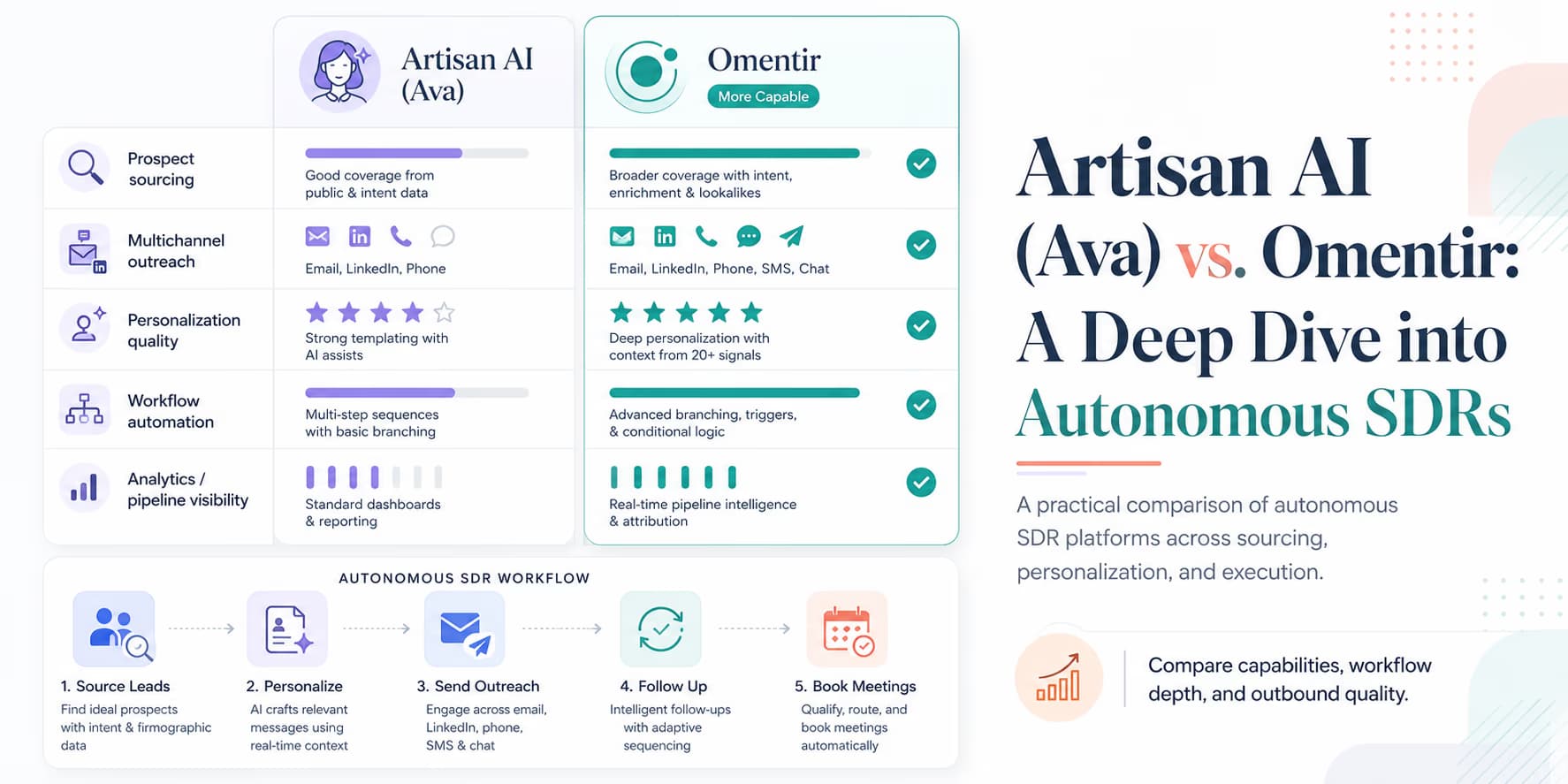
The sales development representative role is changing. For years, B2B companies scaled outbound by hiring SDRs to build lists, write email sequences, and follow up. Growth teams are now replacing those manual workflows with autonomous AI agents.
These digital workers are more than simple automation scripts. They can research prospects, evaluate Ideal Customer Profile (ICP) fit, write personalized copy, and handle replies. Two of the leading solutions in this space are Artisan AI (featuring Ava, their digital SDR) and Omentir.
Both platforms aim to automate B2B outbound, but they rest on different philosophies. Artisan is a closed-garden application for business users who want an all-in-one workspace. Omentir is an open infrastructure engine for developers and sales teams who want control over data, prompts, and agent workflows.
Below we compare capabilities, data waterfall mechanics, account safety engines, and pricing so you can pick the platform that matches how you sell.
The cleanest way to think about the choice is ownership. Artisan gives you a packaged AI BDR experience that tries to replace more of the outbound stack. Omentir gives you a controlled LinkedIn-first execution layer with agent access for teams that want to keep more of the workflow visible and editable.
Artisan AI Ava: the all-in-one closed garden
Artisan AI positions Ava as the first fully autonomous digital employee. The platform provides a complete workspace where Ava runs in the background to handle outbound sales tasks.
Ava's primary advantage is its unified interface. You do not need to configure API routes or connect several separate prospecting tools before getting started. Artisan's public materials position Ava as an AI BDR that finds leads, researches them, sends cold emails, handles replies, and books meetings.
However, this all-in-one approach comes with trade-offs. When a platform packages the entire workflow, you need to ask how much of the underlying logic is visible: why a lead qualified, what data was used, how copy was generated, and what review controls exist before outreach goes live. If Ava's copy or targeting misses your voice, the important question is which dials you can actually adjust.
Artisan is strongest for teams that want an AI BDR operating inside one dedicated workspace. It is less obviously the right fit for teams that want to connect their own agents, inspect every workflow step, or keep LinkedIn outreach separate from email-led automation.
Omentir: the builder-friendly outbound engine
Omentir is built on open integration. Rather than forcing you into a single interface, Omentir is the infrastructure layer for your outbound campaigns.
The platform connects to your personal LinkedIn account using Unipile. This lets Omentir support LinkedIn actions through an integration layer while still enforcing review, pacing, and quota controls inside the product.
For development teams, Omentir's standout feature is its hosted Model Context Protocol (MCP) server. This hosted gateway lets external AI agents such as Claude Code, Cursor, or ChatGPT work with lead discovery and existing reply conversations, as detailed in our guide on MCP client setup.
Architectural Focus
Artisan Ava is a packaged AI BDR workspace. Omentir is an open agent-friendly execution layer designed for teams that want LinkedIn outreach, review queues, and API/MCP access.
Data sourcing and enrichment waterfall mechanics
An autonomous SDR is only as good as the data it uses. If your agent uses outdated database entries, your campaigns will produce low engagement.
Artisan Ava relies on the data and research workflows inside Artisan. That provides a simpler setup because you are not assembling sourcing, enrichment, sequencing, and reply handling yourself.
Omentir adopts a discovery-agent approach. Instead of treating a one-time export as the truth forever, it keeps the lead workflow tied to ICP rules, buyer signals, and reviewable lead groups. That is useful when you care about why a lead qualified, not only whether a database row exists.
Teams can still use enrichment tools like Clay around the workflow when they need extra company data or custom variables. The important part is keeping the outbound message grounded in verified context rather than treating enrichment output as automatically true. Read more about data setups in our analysis of modern outbound stacks.
Copywriting, context grounding, and template systems
Most buyers can spot AI-generated sales messages immediately. Generic openings, exaggerated benefits, and robotic phrasing drive low reply rates.
Artisan Ava uses proprietary algorithms to generate sequences. While these algorithms write readable text, they operate as a black box. You cannot adjust the prompt structure or instruct the agent to use specific B2B copywriting frameworks.
Omentir is built on prompt transparency. The system grounds its copywriting engine in your verified product profile and targets specific company pain points. You can customize the prompt instructions, define variable fallbacks, and audit test runs in a review workspace.
This control keeps outreach closer to how an in-house sales leader would write. For a detailed copywriting blueprint, check out our guide to the B2B outreach copywriting framework.
This difference matters most for founder-led or brand-sensitive outbound. If the message is going out from your personal LinkedIn profile, you need to be comfortable defending every line. A black-box system may still write usable copy, but a reviewable prompt-and-draft workflow makes it easier to catch overclaims before they reach prospects.
Omentir's advantage is not that every draft is automatically perfect. It is that drafts can be inspected, edited, and approved in context. The buyer signal, product profile, and message can be reviewed together before the campaign moves forward.
Account health, invite throttling, and Unipile API
LinkedIn safety is a major concern for growth teams. High message volumes and rapid invite pacing will trigger security filters, resulting in account limits or restrictions.
Artisan Ava manages outbound volume internally, but its focus is primarily on email channels.
Omentir was built with a safety-first approach to social channels. A dedicated throttling engine spaces connection requests and follow-ups with random, organic delays.
The platform enforces daily quotas and human-paced queues so connection requests and follow-ups are spread out conservatively. This pacing helps protect your account while keeping the focus on qualified conversations instead of raw volume. For more safety guidance, check out our guide on safe human-paced outbound campaigns.
Pricing comparison: enterprise seats vs flexible plans
The financial commitment for these platforms differs significantly.
Artisan publishes a credit-based pricing page with a free trial, a free plan, and paid tiers. Its public site currently describes a 10,000-credit trial for new accounts and a Free plan after the trial if no card is added. Because credits are consumed by actions, buyers should model expected usage rather than comparing only the plan name.
Omentir offers straightforward self-serve Pro pricing, plus Enterprise support for teams with more advanced needs:
- Pro ($49/month): Includes one user, one LinkedIn account, unlimited AI agents, leads, campaigns, AI automated campaigns, API access, email customer support, and a minimum of three bookings per week or you pay nothing.
- Enterprise: Includes unlimited users, unlimited LinkedIn accounts, all Pro features, plus SSO, dedicated onboarding, and priority support. Book a call to discuss your setup.
This self-serve model lets you start with a low monthly budget and scale your outbound spending as you book more demos.
The practical pricing question is predictability. Credit systems can be flexible, but you need to understand which actions consume credits: lead research, enrichment, sending, replies, or other workflow steps. Flat self-serve plans are easier to reason about at small scale, but may offer fewer bundled actions than a larger managed outbound platform.
Decision rubric: choosing the right agent for your team
To choose the right tool for your outbound campaigns, evaluate your team's technical capabilities and workflow requirements:
Choose Artisan AI if: You have a large budget, prefer an all-in-one workspace, do not need to customize prompt instructions, and focus primarily on email outbound campaigns.
Choose Omentir if: You want control over your copywriting prompts, need deep LinkedIn integrations, want to connect external agents like Claude via a hosted MCP server, and want a flexible monthly plan.
Artisan is built as a packaged AI SDR. Omentir is built as a workspace you can read, self-host, and operate from chat. Pick the one whose operating model matches how you actually want to sell, not the one with the louder agent name.
If you are choosing between the two, run the same test in both systems. Pick one ICP, one offer, one buyer signal, and one success metric. Compare lead quality, message quality, safety controls, reply handling, and how much manual correction was required. That will reveal whether you need a packaged digital BDR or a more controllable LinkedIn-first engine.
The best tool is the one your team will operate responsibly. Autonomy is valuable only when the workflow stays visible enough to improve. If you cannot see why a lead was chosen or what message will be sent, you are not scaling sales judgment. You are outsourcing it.
That distinction should guide the buying decision. Visibility is what turns automation into a system you can trust.
Frequently Asked Questions
Artisan Ava operates as an all-in-one platform with its own built-in email and chat interfaces. Omentir connects to existing LinkedIn profiles via Unipile and offers a hosted MCP server so external agents such as Claude can configure lead finders, retrieve scored prospects, and work with existing replies.
Artisan markets Ava as an autonomous outbound agent, with safety handled inside its platform. Omentir uses conservative daily quotas, reviewable drafts, and human-paced LinkedIn queues so activity does not behave like bulk spam.
Artisan packages Ava as a managed AI BDR experience. Omentir is more builder-oriented, exposing hosted MCP and REST surfaces so external agents can inspect context, configure lead finders, retrieve scored prospects, monitor activity, and work with existing replies.
Artisan now offers a public credit-based pricing page with a free trial and paid tiers. Omentir offers Pro at $49/month, with a minimum of three bookings per week or you pay nothing. Enterprise is for teams that need unlimited users, unlimited LinkedIn accounts, SSO, dedicated onboarding, and priority support.