
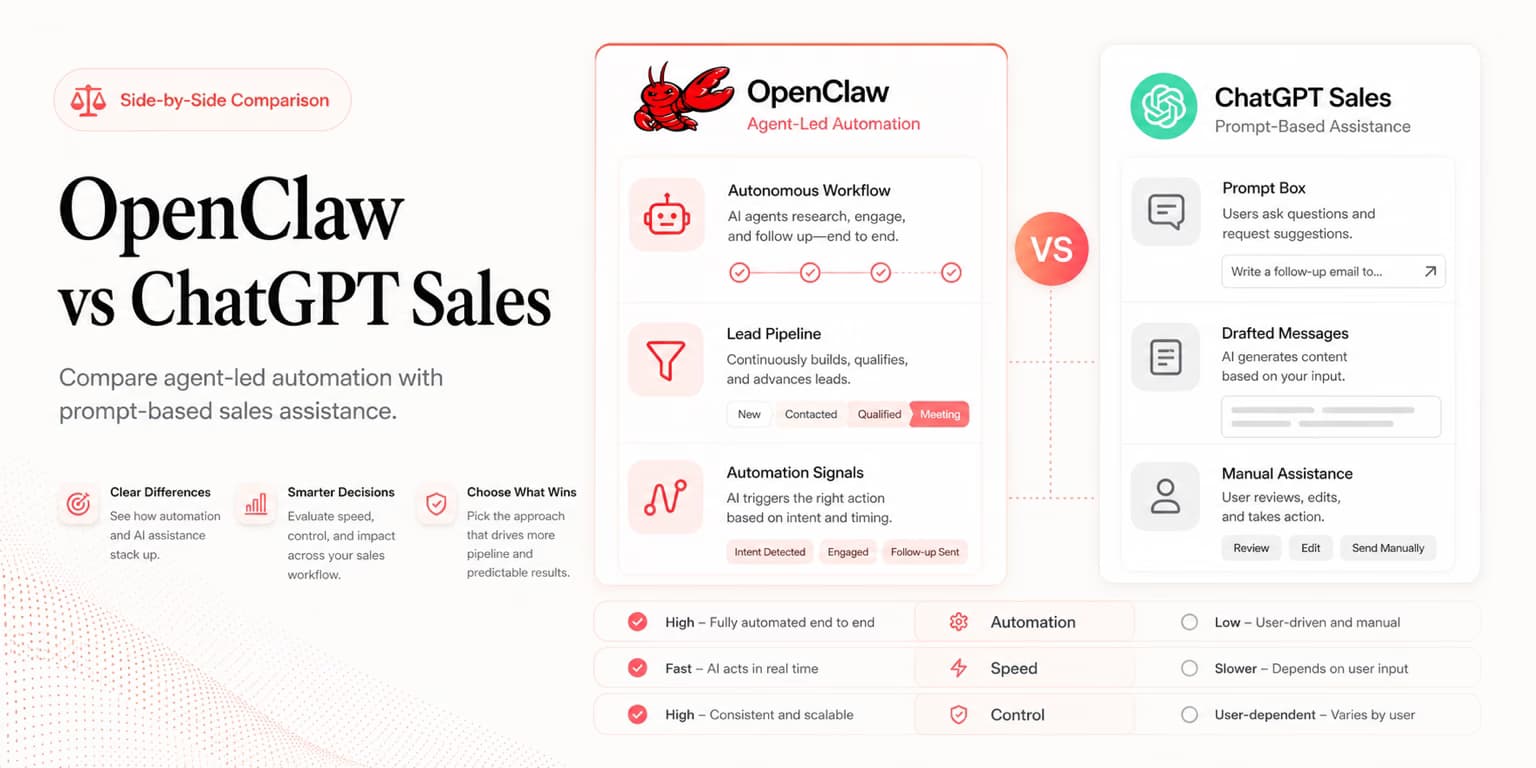
The useful answer to "OpenClaw vs ChatGPT for sales" is not which one is smarter. It is which job you are hiring each tool to do.
ChatGPT is strongest as a reasoning and drafting workspace. It helps you define an ICP, inspect messy lead notes, rewrite a weak message, role-play objections, and make decisions before a campaign goes live.
OpenClaw is more naturally an operator layer for agent workflows. Its official positioning is about making AI agents do work across connected surfaces, and its docs include an MCP workflow path for connecting tools. In sales terms, that makes it relevant when the process has moved beyond a single prompt into repeatable operations.
Quick answer
Use ChatGPT when the work is still judgment-heavy. Use OpenClaw when the work is already defined and needs to be operated through connected tools. Use neither as an excuse to blast generic messages from a real LinkedIn account.
For a founder, the normal progression is simple. First, use ChatGPT to clarify who you sell to, why they buy, what evidence matters, and what messages should sound like. Then, once the workflow is stable, use an agent layer such as OpenClaw to coordinate repeated actions with a dedicated sales system like Omentir.
The mistake is skipping the middle. If you hand an agent a vague instruction like "find leads and sell to them," you do not have an AI sales workflow. You have an unsupervised automation risk.
Where ChatGPT fits
ChatGPT is useful before the workflow becomes operational. It is where you shape the thinking: target market, lead scorecard, messaging angles, objection handling, follow-up logic, and review criteria.
Think of it as a sales strategist sitting beside you, not as the sending engine. The best sales tasks for ChatGPT are bounded and evidence-based.
- ICP refinement: turn a broad buyer idea into specific fit and disqualification rules.
- Lead review: inspect profile snippets or company notes and explain whether a prospect deserves outreach.
- Message drafting: rewrite a message so it references one real trigger and avoids exaggerated claims.
- Reply prep: draft calm answers for pricing, timing, and "send more info" objections.
- Post-call learning: summarize patterns from demos and turn them into positioning changes.
This is why the ChatGPT LinkedIn leads workflow treats ChatGPT as a reasoning layer. It should classify and explain lead fit from evidence you provide. It should not invent live prospects, bypass platform limits, or send from your account.
ChatGPT also shines when your process is still changing. Early sales is full of ambiguous judgment calls. A founder might realize after five demos that the best ICP is narrower, the opening problem is different, or the proof buyers need is not the proof the team expected. A conversational workspace is excellent for that kind of iteration.
Where OpenClaw fits
OpenClaw becomes interesting once you know the workflow well enough to operate it. Instead of asking one-off questions, you want an agent to move through connected steps: read the campaign brief, inspect lead groups, call tools, prepare drafts, summarize replies, and ask for approval when the action has risk.
That is a different job from brainstorming. Agent operations need tool boundaries, permissions, structured outputs, and review states. OpenClaw is relevant because it is designed around agents doing work through connected channels and tools, rather than a single chat window holding every instruction.
For sales, the key is still the underlying tool. OpenClaw can be the operator, but it needs a sales system that knows how to discover leads, respect quotas, draft safely, and route replies. Without that, the agent has a steering wheel but no safe road.
This is where Omentir fits. Omentir is built for LinkedIn outbound: it finds buyers matching an ICP, scores leads, drafts personalized outreach, follows up at human-paced limits, and collects replies in an intent-sorted inbox. An agent layer can operate that workflow through defined tools, but the sales guardrails should live in the workflow itself.
Sales workflow comparison
The cleanest way to compare the two is by sales stage. Some stages need flexible thinking. Others need repeatable execution.
| Sales task | ChatGPT fit | OpenClaw fit |
|---|---|---|
| Define ICP | Strong for brainstorming, critique, and turning customer notes into rules. | Useful after the ICP is written and needs to be applied through tools. |
| Qualify leads | Good for manual review of snippets and scorecard iteration. | Good for repeated tool-based qualification when evidence fields are structured. |
| Draft outreach | Strong for rewrites, tone checks, and angle exploration. | Useful for producing drafts inside a larger campaign workflow. |
| Send outreach | Poor fit by itself. Chat is not an account-safe sending layer. | Only appropriate through bounded tools with quotas, approval, and audit trails. |
| Handle replies | Strong for drafting responses when pasted context is clear. | Strong when connected to inbox summaries and intent routing. |
ChatGPT helps you think and write. OpenClaw helps an agent operate. Omentir provides the sales-specific motion those tools need if the target channel is LinkedIn.
Failure modes
ChatGPT fails in sales when teams treat a blank prompt as a data source. If you ask it for "50 ideal prospects" without live evidence, it may produce plausible guesses. Those guesses are not leads. They are unverified names wrapped in confidence.
It also fails when teams ask one prompt to do everything: qualify, personalize, pitch, follow up, and handle replies. That creates shallow output because the model has no clear job. Split the workflow into stages and make every decision inspectable.
OpenClaw-style agent workflows fail differently. The risk is not shallow brainstorming. The risk is poorly bounded action. If an agent can perform live sales actions without clear limits, review states, or structured evidence, small mistakes can reach real buyers.
Safety test
If the agent cannot explain why a lead was selected, what message will send, which quota applies, and what approval is still needed, the workflow is not ready for live outreach.
Sales automation should fail closed. Drafts are fine. Dry runs are fine. Shortlists are fine. Sending from a real profile should require a workflow that knows what it is protecting.
How to combine them
The best setup is not usually either-or. Use ChatGPT to design and improve the workflow. Use OpenClaw to operate the stable parts of that workflow through connected tools. Use Omentir for the sales-specific execution layer.
A clean combined workflow looks like this:
- Step 1: Use ChatGPT to write the ICP, disqualification rules, message principles, and reply handling guidelines.
- Step 2: Put those rules into Omentir so lead discovery and scoring match the actual sales motion.
- Step 3: Let an agent operating through OpenClaw inspect lead groups, rank exact leads, and summarize discovery activity.
- Step 4: Keep campaign activation human-approved and human-paced.
- Step 5: Feed replies and demo notes back into ChatGPT for positioning improvements.
This keeps each tool in its lane. ChatGPT improves judgment. OpenClaw coordinates agent work. Omentir keeps outreach grounded in lead fit, safe sending, and reply intent.
A practical one-week setup might look like this. On Monday, use ChatGPT to rewrite your ICP into three campaign lanes and list the disqualifiers for each lane. On Tuesday, review ten real prospects from each lane and ask ChatGPT to explain why each one should be pursued, nurtured, or skipped. On Wednesday, turn the best lane into an Omentir campaign draft with lead scoring and human review before activation.
On Thursday, use OpenClaw as the operator layer to inspect campaign readiness, check whether the draft has missing context, and summarize what still needs human approval. On Friday, review replies and demo notes, then bring those learnings back to ChatGPT to improve the ICP, the message angle, and the qualification rules.
That rhythm matters because it avoids two extremes. You are not trapped in endless prompting with no operational follow-through. You are also not giving an agent broad permission to act on a half-formed sales idea.
"Inspect the campaign draft for the HR SaaS founder lane. Summarize the lead count, the strongest three fit reasons, any missing evidence, and whether the draft should stay paused for human edits."
That is the kind of instruction an operator agent can handle well because it is bounded. It asks for inspection and summary, not blind sending. Once the human approves the campaign, the sales system should still enforce quotas, pacing, and reply routing.
If you want the protocol version of this setup, the MCP LinkedIn outreach guide covers the tool contract and approval gates in more detail.
Decision guide
Choose ChatGPT first if your sales process still changes every week. You need fast thinking, feedback, and copy iteration more than agent orchestration.
Choose OpenClaw-style operations when the process is repeatable enough to describe as steps. You should know what the agent is allowed to read, what it can draft, what it cannot send, and what a successful run produces.
Choose Omentir when the problem is qualified LinkedIn conversations from the right buyers, not a generic AI tool. That requires prospect discovery, scoring, messaging, follow-up, and inbox handling in one workflow.
The practical decision is less glamorous than the tool debate: do you need better thinking, better operations, or better sales execution? Once you answer that, the roles become obvious.
FAQs
Not universally. OpenClaw is better when you need an agent operation layer. ChatGPT is better when you need fast reasoning, drafting, and review in a conversational workspace.
A chat or agent interface is not enough. You still need lead qualification, daily limits, approval gates, reply handling, and account-safe execution.
Most founders should start with ChatGPT to clarify ICP, scripts, and review criteria. Move to OpenClaw-style agent operations when the workflow is stable enough to run repeatedly.
Omentir provides the sales workflow: LinkedIn lead discovery, ICP scoring, personalized drafts, human-paced follow-up, and an intent-sorted inbox that agents can operate through.