
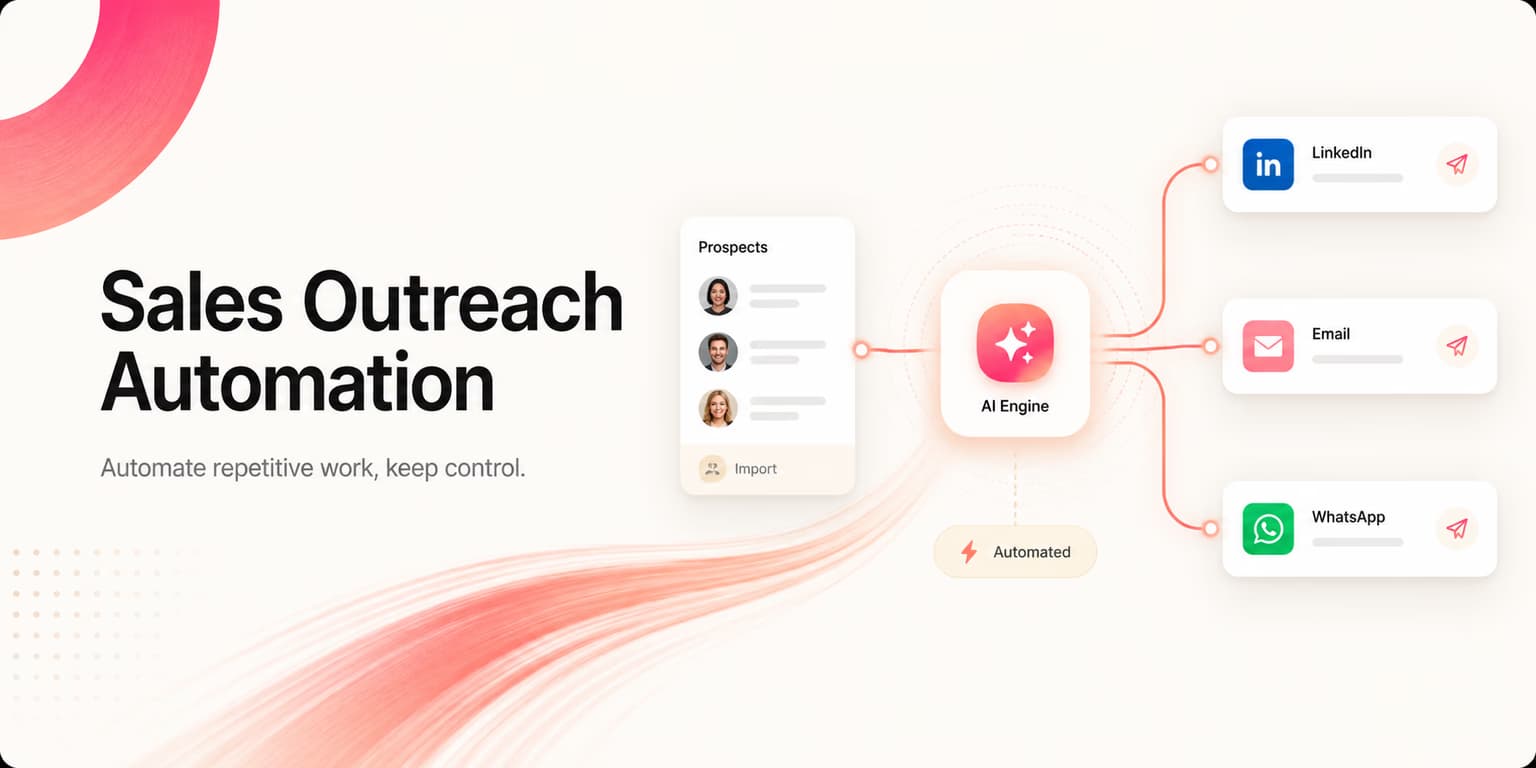
Outbound sales used to mean hours of manual work. Sales representatives sourced contacts, checked profiles, cleaned lists, and copy-pasted pitches across email and LinkedIn. That routine is slow, and it leaves little time for talking to qualified buyers.
A competitive pipeline now depends on sales outreach automation. Growth teams that keep up design systems that collect data, enrich lists, qualify leads, and schedule campaigns in the background. The goal is a GTM machine that surfaces warm opportunities without putting account security at risk.
Omentir is the orchestration platform for this work. It is an AI sales agent that connects to your LinkedIn account so you can source leads, qualify them against your ICP, draft personalized copy, and manage reply conversations. Below is the architecture and the tools needed to keep that engine safe.
Separate logic from execution. Automation is useful when it scales your focus, not when it sends more spam. Automate data gathering and copy drafting so your calendar goes to closing deals.
The safest automation systems also make failure visible. If a lead is rejected, the reason should be logged. If a draft is edited, the change should teach the system what better copy looks like. If replies are weak, you should know whether the problem is targeting, offer, timing, or follow-up.
The architecture of sales outreach automation
A stable outreach engine consists of four distinct layers: data sourcing, lead scoring, execution safety, and human oversight. Each layer must connect cleanly to the next to prevent data loss or campaign overlap.
The data sourcing layer pulls company details and contact profiles based on intent triggers. Next, the lead scoring layer reads the raw data and grades each prospect against your ideal customer profile. The execution layer manages the actual outreach actions so they stay inside compliant pacing. Finally, the human oversight layer provides a staging workspace where you can verify copy and approve scheduled drafts.
By structuring your automation this way, you avoid the common pitfalls of single-channel sequencers. For a comparison of multi-channel agents versus legacy email sequencers, read our analysis of outreach tools and alternatives. Keeping these roles distinct makes the workflow easier to audit and scale.
Do not merge these layers just because a tool makes it possible. A sourcing system should not automatically send. A copywriter should not decide account safety. A delivery queue should not invent new targeting rules. Clear boundaries let you inspect and fix the specific part of the machine that is underperforming.
Sourcing and enriching lead data
Outbound data must be real-time and enriched. Static list providers fail because contact details and company signals change rapidly. To build a continuous flow of prospects, route your GTM list through programmatic data waterfalls.
You can build these cascades using data engines like Clay, querying platforms like Apollo.io and Lusha to append verified contact fields. For instance, you can source new funding signals, extract the VP of Engineering's LinkedIn URL, verify their profile is active, and check for hiring postings in one flow. This pipeline feeds qualified leads directly into your outreach queue.
Designing programmatic data cascades
An enrichment cascade works by passing the outputs of one API call as the inputs to another. For example, if your initial query returns a company name, the next step queries their domain. That domain is then used to query LinkedIn profile links for specific roles like "VP of Sales" or "Head of Growth."
Once you have the profile links, route them through a verification API to confirm that the contacts are active. This multi-step waterfall ensures that you spend your outreach credits only on prospects who are highly likely to be active and receptive, reducing bounce rates and protecting your account standing.
Add a confidence score to every enriched field. A verified profile URL should be treated differently from an inferred email or a stale job title. Your outreach copy should only use high-confidence facts. Lower-confidence data can help with internal prioritization, but it should not appear in the message.
Execute LinkedIn actions safely
The execution layer is where most automation engines fail. Many outreach tools use browser extensions or scraping scripts that trigger platform security algorithms, leading to restricted social profiles.
To run automated outreach safely on LinkedIn, you must execute all profile actions through secure, compliant APIs and respect strict pacing rules. Space out connection requests, set daily quotas, and ensure that your profile activity matches natural human behavior.
Omentir solves this by managing connection requests and message tasks through integrations provided by Unipile. Omentir enforces human-paced limits, conservative daily quotas, and gradual campaign cadences. This structure is described in our guide on cold LinkedIn outreach parameters.
By avoiding brittle browser DOM manipulation, Omentir reduces operational risk and gives you a clearer reviewable workflow. The goal is not to hide automation; it is to make outreach behave like careful human work.
Keep human control and review
Human oversight is required no matter how good the AI copy becomes. Sending outbound without an approval gate produces awkward phrasing, incorrect claims, and brand damage.
A healthy sales automation stack places a review desk between drafting and sending. The AI SDR drafts personalized connection notes and follow-ups based on the target ICP and prospect details, staging them as drafts. The human sales rep checks the drafts queue, edits copy if needed, and approves the sequence. This manual check takes only a few minutes each day but protects your reputation. Read our resource on AI lead qualification and grading for detailed review structures.
The Approval Boundary Principle
Ensure your outreach platform separates the "drafting" state from the "sending" state. The AI should only place messages in a draft folder. A live connection note should only fire after a human has clicked approve.
MCP tool configuration and APIs
To build a unified GTM workflow, you need to connect your prospecting tools to your execution layers. In modern development stacks, this integration is achieved using the Model Context Protocol, which provides a standard for connecting AI agents to hosted APIs and tools.
By connecting Omentir's hosted MCP server to your AI agent (like Claude or ChatGPT), your agent can query context, update buyer profiles, pull lead sheets, and schedule connection request drafts. This removes the overhead of manual data entry, allowing your agent to run target prospecting loops in the background and surface only the prospects who reply with interest.
For instance, you can instruct your agent to query omentir_get_context, analyze the active campaigns, review the available lead groups, and propose a draft sequence for approval. This developer-ready architecture is detailed in our MCP outreach integration guide.
Outbound optimization and audits
Outbound automation is not a set-and-forget project. To maintain a healthy conversion rate, you must monitor your outreach funnel regularly and audit performance:
- Connection Acceptance: If acceptance drops, narrow your ICP filters or test sending simpler, lower-pressure connection invites.
- Reply Quality: If replies are low-quality, shorten your messaging drafts and focus on a soft value asset instead of a booking link.
- Handoff Conversion: If warm replies are not turning into meetings, review response time, objection handling, and whether the reply was actually high intent.
Establishing a weekly review cadence helps you spot leakage quickly. Instead of making broad adjustments, optimize one variable at a time (like your profile banner, connection note, or first follow-up) to isolate what drives conversion improvements.
Treat metrics as diagnostic signals, not vanity numbers. A high acceptance rate with no qualified replies may mean your invite is too vague. A high reply rate with no meetings may mean the offer creates curiosity but not urgency. A low reply rate from a high-fit segment may mean the pain is real but the copy is wrong.
Build continuous outbound feedback loops
A great sales automation setup uses campaign response metrics to refine its targeting rules. If a specific campaign segment is generating a high volume of positive replies, feed that customer segment profile back into your discovery filters.
Conversely, if a segment has a low reply rate, tighten the qualifying criteria so those companies drop out. The feedback loop should make targeting more precise over time, so your calendar fills with qualified conversations instead of noise.
The feedback loop should include human notes. When a founder or sales rep edits a draft, rejects a lead, or marks a reply as not qualified, that judgment should inform the next version of the campaign. Automation gets better when human taste is captured, not bypassed.
What a controlled outbound machine looks like
Sales outreach automation can scale B2B growth when it replaces manual spreadsheets with data pipelines, grades matches programmatically, and enforces safety limits.
Omentir provides the compliance, qualification, and execution framework to run this automated engine. Let it handle the lead scoring, secure LinkedIn actions, and draft queue while you focus your energy on speaking to qualified prospects.
The modern outbound machine is not fully hands-off. It is a controlled system where software handles the repetitive work and humans keep responsibility for judgment, quality, and relationships.
Frequently Asked Questions
The biggest risk is account restriction. Sending messages too quickly, using browser extensions, or blasting low-quality templates triggers platform security systems. Keeping sending pacing human-like is essential.
You can integrate systems programmatically using REST APIs or the Model Context Protocol. This allows your enrichment stack to push validated contact profiles directly into your outreach queue.
You should automate data discovery, qualification scoring, and message drafting. Keep final approvals manual, and handle response scheduling conversationally to protect the prospect experience.
Use conservative daily quotas and adjust based on account age, acceptance quality, failed sends, replies, and warnings. Avoid treating any public number as a universal safe limit.