
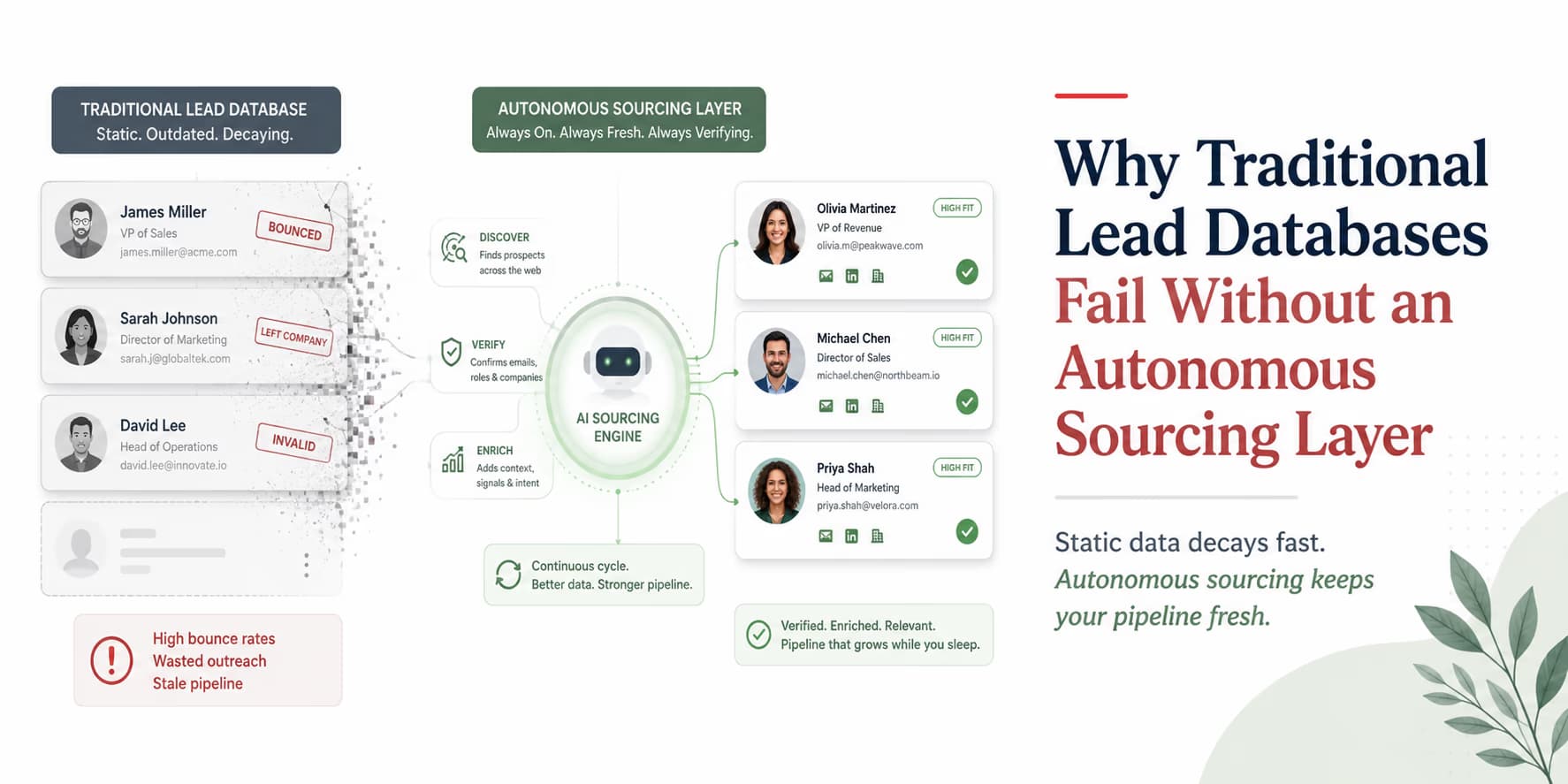
Traditional lead databases are not useless. They are useful for discovering the shape of a market: which companies exist, which titles might matter, and where a first list can begin. The problem starts when teams treat a database export as a campaign-ready truth source.
A flat list ages the moment it is exported. People change jobs, companies rename products, domains migrate, teams adopt new tools, hiring priorities shift, and buyers who looked relevant last quarter may no longer own the problem. The list still has rows, but the context behind those rows is decaying.
That is why static databases fail without an autonomous sourcing layer. The database can be an input, but something has to re-check the account, verify fit, look for current signals, and decide whether the lead deserves outreach now. Without that layer, outbound becomes a race to send more messages before the list gets worse.
Omentir is built around live discovery and ICP-based qualification rather than selling a static contact dump. It helps teams find relevant buyers, draft context-aware LinkedIn outreach, pace campaigns, and organize replies. The rest of this post covers why flat lists underperform and what a sourcing layer should do instead.
Why buying flat contact lists underperforms
Buying a flat contact list underperforms because it separates contact data from buying context. The list might tell you a person's title, company, and email. It usually does not tell you whether they still own the problem, whether the company fits your current ICP, or whether there is any timely reason to reach out.
When you send campaigns directly to outdated or unreviewed databases, you run into predictable issues:
- High bounce rates: Messages sent to inactive accounts bounce, alerting spam filters that you are using low-quality lists.
- Low relevance: If a prospect has recently changed roles, your pitch will be irrelevant to their new responsibilities.
- Wasted quotas: Your sending profiles will waste connection limits messaging profiles that are no longer active.
- False fit: A title may match your search while the company, team size, or business model does not.
- Missing timing: The account may be a good theoretical fit with no current trigger for conversation.
The deeper issue is that static lists encourage volume as the default solution. If one thousand contacts produce weak results, the team buys ten thousand. That hides the real question: which accounts should we contact, why now, and what evidence supports the message?
For details on how database scraping compares to active verification, read our analysis of active lead qualification methods.
The architecture of an autonomous sourcing layer
An autonomous sourcing layer is the system between raw data and outreach. It does not replace every database. It prevents databases from being treated as final authority. Instead of downloading historical data and sending immediately, the system checks current context before a lead enters a campaign.
A modern sourcing layer has five components:
- Source inputs: Databases, LinkedIn searches, website forms, referrals, and existing CRM records.
- Live context checks: Web and profile review that confirms the company, role, and public signals are still relevant.
- ICP scoring: A fit model that compares account, buyer, signal, and exclusions against your current target market.
- Verification waterfalls: Checks that reduce bad contact data before any email or LinkedIn workflow begins.
- Campaign routing: Rules that decide whether a lead is rejected, monitored, drafted for review, or launched into a paced campaign.
The most important part is routing. A lead should not automatically move from "found" to "messaged." It should pass through a decision layer. Some leads are rejected. Some need more evidence. Some are good-fit but low-timing and should be monitored. Only the best leads should reach the outbox.
This also clarifies where traditional databases still belong. They are useful at the top of the sourcing process, especially when you are mapping a new market or estimating the number of possible accounts. They are weak at the moment of outreach. Use them to create candidates, then let live checks decide whether those candidates are current, relevant, and worth a message.
A healthy workflow might start with a database export, but it should never end there. The export becomes a queue for validation, enrichment, signal review, and routing. That extra layer is what turns purchased data into a sales motion your team can trust.
Infrastructure rule: verify before sending
Never route a raw list directly to a sequencer. Validate contact data, current role, account fit, exclusion rules, and message evidence before anything reaches a live campaign.
Monitoring corporate sites and live career portals
Corporate websites and career portals often reveal what a database cannot: what the company is actively trying to build. Careers pages show roles, responsibilities, tools, reporting lines, and priorities. Product pages show positioning. Integration pages show workflows. Security pages can hint at the type of buyers the company serves.
An autonomous sourcing layer watches these sources for signals that matter to your ICP. If a company is hiring for outbound operations, that may matter to a sales automation product. If a company is adding data engineering roles, that may matter to an analytics vendor. If a company just launched a new partner page, that may matter to an integration platform.
The signal should be stored with source evidence. "Careers page mentions LinkedIn prospecting and weekly reporting" is useful. "Company needs outbound automation" is an interpretation. Keep both separate so your outreach does not overstate what the public data proves.
This is where live sourcing changes the message. A static database gives you a title. A sourcing layer gives you a reason to ask a better question. The first produces, "I help sales leaders book meetings." The second produces, "Saw the new role includes LinkedIn prospecting and weekly reporting. Are you trying to make that workflow repeatable before the hire ramps?"
Validating emails and phone records automatically
Contact validation is still useful, especially for email-led motion. A single provider may be wrong, stale, or incomplete, so teams often use a waterfall: check one source, then another, then another, until the data is good enough or the lead is rejected.
The same waterfall idea applies beyond email. You can verify a current role against LinkedIn, company domain against the website, buyer fit against your ICP, and signal freshness against the source page. The goal is not perfect certainty. The goal is to avoid sending based on obviously weak or conflicting data.
Good systems also record uncertainty. If an email cannot be verified, do not pretend it is verified. If a role changed recently, mark it. If a buying signal is old, lower the confidence score. Clean data is not only accurate data; it is data that tells you how much trust it deserves.
Protecting domain health from high bounce rates
Sending to stale data can hurt more than campaign performance. It can damage the channels you depend on. Email providers watch bounces, complaints, engagement, and sender behavior. LinkedIn also responds poorly to activity that looks automated, irrelevant, or excessive.
An autonomous sourcing layer protects reputation by reducing low-quality sends before they happen. It filters outdated addresses, stale roles, poor-fit accounts, inactive profiles, and weak signals. That improves the odds that outbound activity reaches people who might actually care.
You should also coordinate list quality with paced LinkedIn outreach. Omentir uses daily quotas and human-paced campaign execution rather than blasting every discovered lead at once. For details on account health, see our guide to pacing LinkedIn outreach campaigns.
The healthiest outbound teams source more than they send. That gives them room to choose. A raw database pushes teams to use every record because they paid for it. A sourcing layer lets teams spend sender reputation only on the accounts with enough fit and evidence.
SOP: the real-time lead discovery checklist
Implement this workflow to turn static data into qualified outreach:
- Step 1: Use databases or LinkedIn searches to create a candidate pool, not a final send list.
- Step 2: Verify current role, company domain, and account fit against live sources.
- Step 3: Match domains against exclusion lists for customers, competitors, partners, vendors, and poor-fit segments.
- Step 4: Check for current buying signals such as hiring, product changes, role changes, or relevant public activity.
- Step 5: Validate contact details where email is part of the motion.
- Step 6: Route only high-fit, source-backed leads into reviewed drafts or paced campaigns.
- Step 7: Feed reply quality and rejection reasons back into your sourcing rules.
Omentir helps with discovery, fit scoring, campaign creation, paced execution, and reply organization. The discipline is deciding what deserves to move forward. If a lead cannot explain why it belongs in the campaign, it should stay out.
Shifting sourcing from static to active
B2B data changes too quickly for static databases to be the final source of campaign truth. They can help you start, but they cannot tell you whether a buyer is current, qualified, and worth contacting today.
The better pattern is database plus sourcing layer. Use the database to discover possible accounts. Use live checks to verify fit and timing. Use scoring to reject weak leads. Use paced outreach to protect the channel.
That shift turns sourcing from a static export into an active operating system. It gives your sales team fewer bad leads, better reasons to reach out, and a healthier path to qualified conversations.
Frequently Asked Questions
They decay continuously because people change jobs, companies rebrand, domains change, and responsibilities move. The exact rate varies by market, but old exports should be treated as suspect until revalidated.
It is a system that uses real-time web scrapers and API queries to search prospect details immediately before launching a campaign, ensuring contact data is accurate when you reach out.
Omentir does not sell static databases. Instead, it runs discovery agents that check live corporate websites and verify prospect profiles in real-time before scheduling outreach campaigns.
Yes. You can use platforms like Apollo or Sales Navigator to build initial lists, then route them through enrichment waterfalls and Omentir's discovery agents to verify details.