
Every B2B founder and sales leader knows that personalized outreach outperforms generic spam. If you send a message referencing a prospect's recent hire, a specific challenge they posted about, or a tool they use, your reply rates jump.
The problem is that personalization does not scale. Spending fifteen minutes reading a prospect's LinkedIn feed, company blog, and job openings to write one email is highly inefficient. A sales rep executing this playbook can only contact 10 to 15 people a day, which is not enough volume to sustain a growing pipeline.
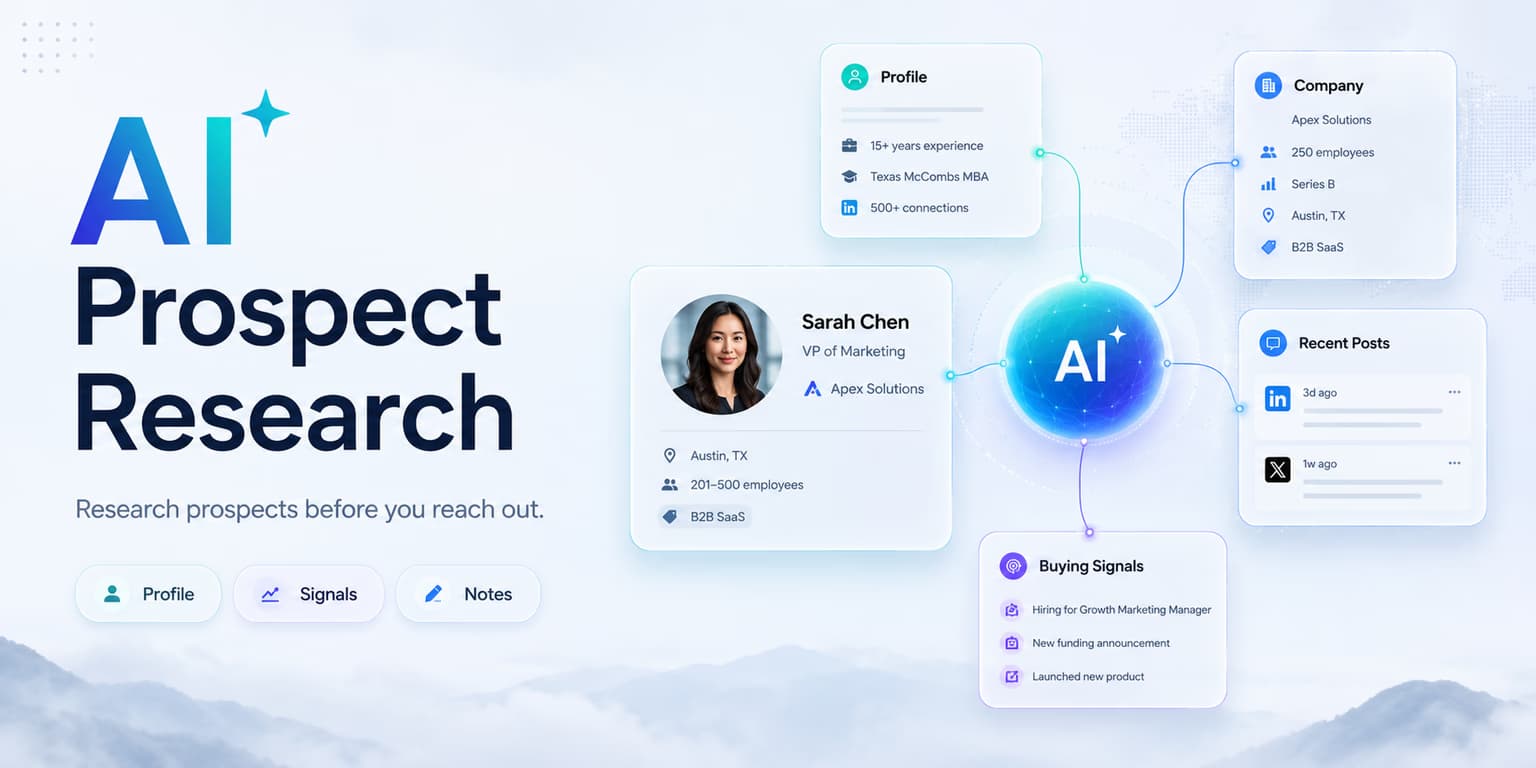
To scale outbound without going back to generic spam, use AI for prospect research. Instead of reading every profile by hand, connect an agent to your workflow. It can read unstructured company profiles, pull out the main challenges, and build a research sheet in seconds.
Omentir puts this research layer in your lead queue. It checks profiles, summarizes background, and drafts outreach, while you keep final approval. Here is how to build that research pipeline.
The best prospect research does not try to prove that every lead is ready to buy. It tries to answer a narrower question: is there enough observable evidence to justify a thoughtful first message? If the answer is no, the lead should stay out of the campaign, even if the title and company size look perfect.
Unstructured data sources on LinkedIn
Database providers supply structured variables: employee count, city, industry category, and job title. Those fields are useful, but they do not show buyer intent. To find active need, your agent has to read unstructured sources on LinkedIn:
- Profile about section: The summary where executives describe current initiatives, department goals, and technical focus.
- Recent feed posts: Updates they share about industry trends, team work, or operational challenges.
- LinkedIn job openings: Listings that show which technologies their teams need and what work they are expanding to handle.
- Company updates: Press releases, product launch posts, and funding announcements on the company page.
Feed those documents to an LLM and you can extract specific business challenges that static data points miss.
Treat each source differently. A job post is a stronger operational signal than a vague company tagline. A founder's post about a current bottleneck is stronger than a reposted industry article. A recent product launch is stronger than a two-year-old press release. The AI should rank evidence by freshness, specificity, and relevance to your offer.
You also need source boundaries. Do not ask the model to infer private facts or speculate about sensitive topics. Keep the research tied to public professional context: role, company direction, hiring, tooling, market, and stated initiatives. That keeps the output useful without making the message feel invasive.
Research note: watch the job descriptions
Check the 'Requirements' section of active job posts. If a company is hiring engineers who know Python and AWS, it confirms their tech stack is built on those tools, giving you a warm technographic opening.
Turn public context into likely pain points
Once the agent can read unstructured data, tell it to extract relevant pain points. Do not only ask it to summarize the profile, or you will get generic lines like: "This company builds software and is growing."
Ask the AI specific business questions instead:
- What is this department's main operational bottleneck based on active job requirements?
- Has the company recently launched a product that requires new marketing sequences?
- Does the VP's personal feed indicate they are concerned about deliverability, security, or remote team management?
That focus turns raw text into something a copywriter can use. You can learn more about extracting this data in our guide on how AI qualifiers evaluate leads.
Ask the model to separate facts from interpretations. A fact is "the company is hiring three account executives." An interpretation is "the company is likely expanding sales capacity." A messaging angle is "they may need cleaner prospecting and follow-up systems as the team grows." If those three layers are mixed together, reviewers cannot tell whether the hook is grounded or guessed.
A useful synthesis output should include the evidence, the likely pain, a confidence level, and a reason to skip the lead if the evidence is weak. The skip reason matters because it teaches your team what not to pursue. Over time, your best prospect research system becomes as good at exclusion as it is at finding hooks.
Build a structured research profile
Your system should compile findings into a standard research profile. That profile is the source of truth for the messaging sequence:
- Prospect: Jane Doe, VP of Sales at AcmeV2
- Target Pain Point: Low SDR productivity due to stale lead data
- Sourced Evidence: Job post for 'Sales Operations Lead' focusing on list cleaning
- Fit Score: 95/100 (matches company size, industry, and role)
- Recommended Hook: Focus on automated list enrichment
A structured profile makes it easy to audit the agent's work and confirm that its claims match verified data. For list qualification templates, check our guide to AI prospecting architectures.
Add two fields to every profile: "do not mention" and "needs human review." The first prevents the agent from using sensitive or awkward observations in outreach. The second catches cases where the evidence is promising but ambiguous. For example, a competitor mention might be useful research, but it may not belong in the first message.
The profile should also include the exact sentence the rep can safely use. "Hiring sales ops" is not enough. "Saw you are hiring for sales operations and mention list hygiene in the role" is specific, grounded, and easy to verify before sending.
Ground the first message in the research
Use the research profile to draft the outreach note. The agent should combine your product facts with the prospect's pain points to write a relevant value statement.
Omentir handles that grounding automatically. It combines the prospect's profile data with your settings, drafting a pacing-compliant note that avoids fake product claims. The same approach is detailed in our guide on ChatGPT founder outbound playbooks.
A good grounded message has three parts: the observed signal, the possible business implication, and a low-pressure question. It should not dump the whole research profile into the prospect's inbox. The point of research is to make the note feel relevant, not to prove how much you know about them.
For example: "Saw you are hiring a sales operations lead and mention list quality in the role. Usually that shows up when outbound volume is rising but reps are spending too much time cleaning data. Are you already trying to tighten that workflow?" That message uses one source, one implication, and one question.
Spot objections before you send
Reading unstructured data often lets you anticipate objections before they speak. If job listings show they use a competitor, or their profile says they are focusing on team alignment, adapt the first message to that setup.
If you know they use a competitor, frame your offer as an integration or a supplementary tool, rather than pitching a replacement. This shows respect for their current workflow and reduces immediate friction.
You can also spot objections from company stage. A tiny team may object to implementation effort. A larger team may object to security, approvals, or migration risk. A founder may care about speed and customer conversations. A VP may care about reporting and rep adoption. The same product needs different proof depending on who is reading.
The AI should not "handle" objections by arguing. It should help you choose a softer entry point. If the research suggests budget pressure, lead with a small workflow improvement. If the research suggests tool fatigue, lead with how little behavior change is required. If the research suggests a competitor is entrenched, lead with a complementary use case.
Keep research-heavy outreach paced
Research-heavy outreach tempts people to "use the notes." You spend an hour on a prospect, then send a long first message the same afternoon. The research was good. The send pattern still looks like a burst.
Separate research from delivery. Batch the reading. Send connection notes across the week, in the prospect's local business hours, and keep the first note short enough that the research shows up as one specific fact, not a dossier. Long personalization is still a message in the daily count.
Better research should reduce volume pressure. If your agent finds stronger evidence, you can send fewer messages and still create better conversations. That is the opposite of spam automation, where poor targeting is hidden behind higher send counts.
AI prospect research audit checklist
Follow this daily routine to audit research campaigns:
- Confirm hook source: Is the hook based on a real company event (job change, posting, or hiring) rather than location data?
- Audit pain statement: Does the pain point match their role? (e.g., target VP of Sales for pipeline, VP of Eng for dev tools).
- Verify copy length: Is the message under 100 words? Can a prospect read it on a mobile screen in 10 seconds?
- Check pacing: Is the campaign configured to stay within daily safety limits?
- Test links: Do all calendar and resource links resolve correctly?
Add a weekly quality review. Pull ten approved leads and ask whether each one had a clear signal, a truthful hook, and a message you would be comfortable sending manually. If several fail that test, tighten the research prompt before increasing volume.
Also track which research fields actually predict replies. Maybe job posts work well, but company announcements do not. Maybe founder posts create better conversations than technographic clues. The system should learn from outcomes rather than treating every data source as equally valuable.
Keep research consistent without turning it into spam
AI prospect research is a reliable way to scale B2B outbound without generic spam. By reading unstructured LinkedIn updates and summarizing buyer intent, you can send relevant notes that lead to demos.
Let Omentir handle the logistics. Configure discovery agents to track active buyers, summarize their background, and draft paced sequences that turn warm LinkedIn leads into conversations.
The real advantage is consistency. Human reps are good at judgment, but they get tired, rush research, and skip notes when the queue is full. AI can keep the research format consistent, while humans keep the judgment honest. That combination is what makes personalized outbound scale without turning into generic automation.
Frequently asked questions
Unstructured prospect data includes company updates, personal feed posts, about sections, and job descriptions. Reading it can surface specific company challenges that structured fields like city or employee count cannot.
Use approved data sources and integration paths rather than browser hacks. The research layer should summarize available context, keep source evidence visible, and avoid risky scraping behavior.
Yes. If a prospect recently bought a competitor product or has a flat headcount, you can frame the first note around integration effort or cost, instead of pitching a full replacement.
It depends on the number of sources and checks you require. The useful goal is not raw speed; it is a profile that shows the source evidence, likely pain, confidence level, and a draft worth reviewing.